Question
Write the important structural between DNA and RNA.

Answer

The structural differences between DNA and RNA are as follows :
(i) DNA is found in the chromsomes (located in the nucleus of the cell), whereas RNA is mainly found in the cytoplasm.
(ii) DNA contains $\beta$-D-deoxyribose sugar whereas RNA contains $\beta$-D-ribose sugar.
(iii) Pyrimidine base, thymine is present only in DNA whereas uracil is present only in RNA.
(iv) DNA has a double strand helix structure whereas RNA has a single helical structure.
Functional difference between DNA and RNA : DNA has the property of self-replication and it is the chemical basis of heredity, while RNA controls protein synthesis.

Need a full question paper?

Generate a complete, print-ready paper with questions like this in minutes — across 16+ boards, with answer keys.
Start Generating Free

Similar questions

(a) Write the IUPAC name of $\left[ K _4 Fe ( CN )_6\right]$
(b) Differentiate between the homoleptic and heteroleptic complexes.
(c) Draw the geometrical diagram of complex ion $\left( Co \left( NH _3\right)_6\right)^{3+}$
Give the structural formula and IUPAC name of the following compounds:
  1. BHC
  2. DDT
After watching a programee on TV about the adverse effects of junk food and soft drink on the health of school children, Sonali, a student of class XII, discussed the issue with the school principal. Principal immediately instructed the canteen contractor to replace the fast food with the fibre and vitamins rich food like sprouts, salad, fruits etc. This decision was welcomed by the parents and the students.
 After reading the above passage, answer the following questions:
  1. What values are expressed by Sonali and the principal of the school?
  2. Give two examples of water-soluble vitamins.
The electrical resistance of a column of $0.05 M KOH$ solution of diameter $1 \ cm$ and length $45_·5 \ cm$ is $4.55 \times 10^3 ohm$. Calculate its molar conductivity.
Write a note on molecularity of a reaction and its different types.
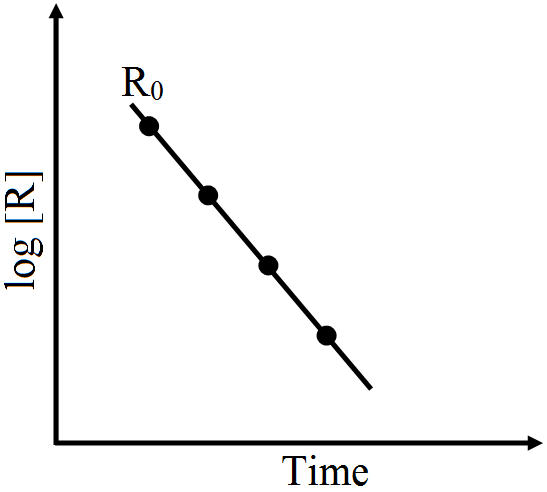
Observe the graph in diagram and answer the following questions.
  1. If slope is equal to $-2.0 \times 10^{-6} \sec^{-1} ,$ what will be the value of rate constant?
  2. How does the half$-$life of zero order reaction relate to its rate constant?
Consider a certain reaction $A \rightarrow$ Products with $k = 2.0 \times 10^{–2}s^{–1}$. Calculate the concentration of A remaining after $100 s$ if the initial concentration of A is $1.0 \ mol \ L^{–1}.$
The equilibrium constant of cell reaction :
$Sn^{4+}(.aq) + Al(s) Al^{3+ }\rightarrow + Sn^{2+} (aq)$  is  $4.617 \times 10^{184}, at 25 ^\circ C$
a. Calculate the standard emf of the cell. $($Given: $\log 4.617 \times 10^{184} = 184.6644)$
b. What will be the $E^\circ$ of the half cell $Al^{3+}/Al, if E^\circ$ of half cell $Sn^{4+}/Sn^{2+}$ is $4+ 0.15 V.$
Define the following terms:
  1. Glycosidic linkage.
  2. Invert sugar.
  3. Oligosaccharides.
A solution of glucose $($Molar mass $= 180 g\ mol^{–1})$ in water has a boiling point of $100.20^\circ C$. Calculate the freezing point of the same solution. Molal constants for water $K_f$ and $K_b$ are $1.86 K \ kg\ mol^{–1}$ and $0.512 K \ kg\ mol^{–1}$ respectively.