Questions

3 Marks Question

Take a timed test

4 questions · self-marked practice — reveal the answer and mark yourself.

Question 13 Marks
Write the important structural between DNA and RNA.
Answer
The structural differences between DNA and RNA are as follows :
(i) DNA is found in the chromsomes (located in the nucleus of the cell), whereas RNA is mainly found in the cytoplasm.
(ii) DNA contains $\beta$-D-deoxyribose sugar whereas RNA contains $\beta$-D-ribose sugar.
(iii) Pyrimidine base, thymine is present only in DNA whereas uracil is present only in RNA.
(iv) DNA has a double strand helix structure whereas RNA has a single helical structure.
Functional difference between DNA and RNA : DNA has the property of self-replication and it is the chemical basis of heredity, while RNA controls protein synthesis.
View full question & answer
Question 23 Marks
What are enzymes?
Answer
Life is possible only due to the coordination of various chemical reactions in living organisms such as digestion of food, absorption of suitable compounds and finally production of energy. All these processes occur in a sequence and take place under moderate conditions in the body. These occur with the help of some biocatalysts called enzymes. Therefore, the biocatalysts used in the biochemical reactions occuring in living organisms are called enzymes. All enzymes are globular proteins. Enzymes are very specific for a particular reaction and substrate.
Nomenclature : (i) Nomenclature of enzymes is based on the class of compounds upon which they work. 'ase' is written at the end of their name.
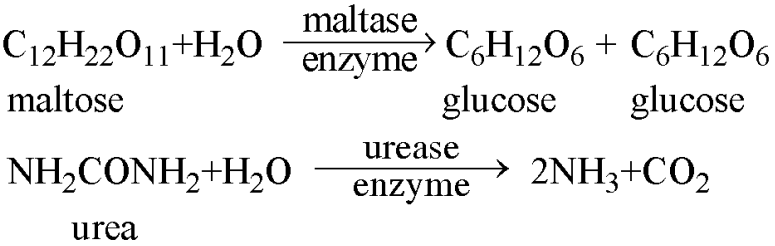
Example : Hydrolysis of maltose into glucose occurs in the presence of maltase enzyme.
Image
View full question & answer
Question 33 Marks
How do you explain the amphoteric behaviour of amino acids?
Answer
Due to the presence of both acidic $(- COOH )$ and basic $\left(- NH _2\right)$ groups in the same molecule in amino acids, they behave like salts.
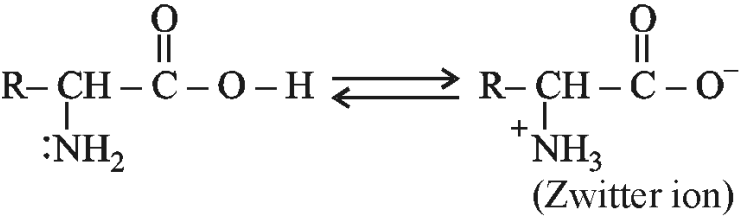
In aqueous solution of amino acids, the carboxyl group can donate (lose) a proton and amino group can accept a proton due to which a dipolar ion is formed known as Zwitter ion or inner salt. This is neutral but contains both positive and negative charge.
Image
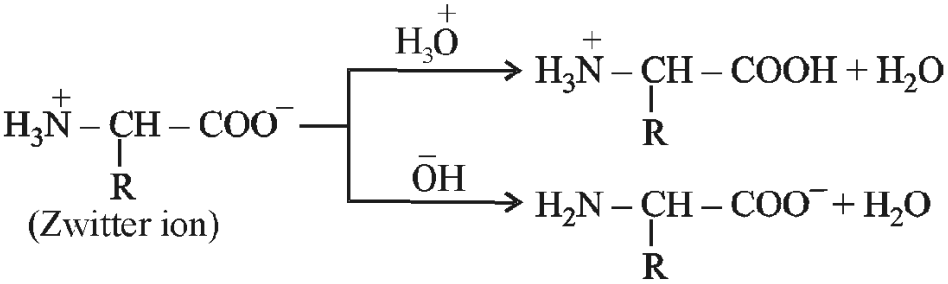
In zwitter ionic form, amino acids exhibit amphoteric behaviour because they react both with acids and bases.
Image
View full question & answer
Question 43 Marks
Define the following as related to protein :
Primary structure
Answer
(i) Primary structure of protein : In proteins one or more polypeptide chains are present. In each polypeptide of a protein, amino acids are linked in specific and definite sequence. The specific sequence of amino acids is called the primary structure of proteins. This sequence varies in different proteins. Frederick Sanger (1953) was the first to determine the primary structure of insulin secreted by the pancreas.
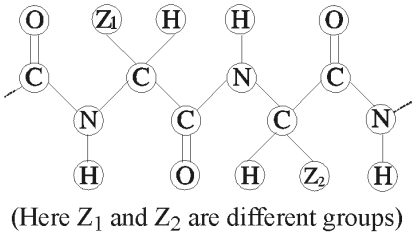
Among the various amino acids present in a particular protein, replacement of one $\alpha$-amino acid with another $\alpha$ amino acid changes or destroys biochemical reactivity of that protein. Example : Disease sickel cell anemia is caused when glutamic acid in hemoglobin is replaced by valine. The primary structure of proteins can be represented by following figure :
Image
View full question & answer