MCQ
Write the $IUPAC$ name of the following compound
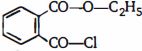
- ✓ethyl $-2-$ (chlorocarbonyl) benzoate
- Bethyl $-2-$ (chloro carbonyl) hexanoate
- C$2-$ (thoxycarbonyl) benzoyl chloride
- DNone of these
IUPAC name:- ethyl -$2$-( chlorocarbonyl) benzoate
Generate a complete, print-ready paper with questions like this in minutes — across 16+ boards, with answer keys.
$\begin{array}{*{20}{c}}
{C{H_3} - C = CH - C{H_2}C{H_3}} \\
{|\,\,\,\,\,\,\,\,\,\,\,\,\,\,\,\,\,\,\,\,\,\,\,\,\,\,\,\,\,\,\,\,} \\
{CH{{(C{H_3})}_2}\,\,\,\,\,\,\,\,\,\,}
\end{array}\xrightarrow[{(ii)\,{H_2}{O_2},O{H^ - }}]{{(i)\,{B_2}{H_6}}}[A]$$\xrightarrow[\Delta ]{{dil.\,{H_2}S{O_4}}}[B]$
The molar mass difference between compounds $Q$ and $R$ is $474 \mathrm{~mol}^{-1}$ and between compounds $P$ and $S$ is $172.5 \mathrm{~g} \mathrm{~mol}^{-1}$.
($1$)The number of heteroatoms present in one molecule of $R$ is. . . . . .
[Use: Molar mass (in g mol ${ }^{-1}$ ): $\mathrm{H}=1, \mathrm{C}=12, \mathrm{~N}=14, \mathrm{O}=16, \mathrm{Br}=80, \mathrm{Cl}=35.5$
Atoms other than $\mathrm{C}$ and $\mathrm{H}$ are considered as heteroatoms]
($2$)The total number of carbon atoms and heteroatoms present in one molecule of $S$. . . . . .
[Use: Molar mass in $\mathrm{g} \mathrm{mol}^{-1}$ ]: $\mathrm{H}=1, \mathrm{C}=12, \mathrm{~N}=14, \mathrm{O}=16, \mathrm{Br}=80, \mathrm{Cl}=35.5$
Atoms other than $\mathrm{C}$ and $\mathrm{H}$ are considered as heteroatoms
Give the answer quetion ($1$) and ($2$)