Question
Write the law of conservation of angular momentum. Also explain the example.

Answer

self

Need a full question paper?

Generate a complete, print-ready paper with questions like this in minutes — across 16+ boards, with answer keys.
Start Generating Free

Similar questions

An inductor-coil of resistance $10\Omega$ and induetanes 120mH is connected across a battery of emf 6V and Internal resistance $2\Omega.$ Find the charge which flows through the inductor in:
  1. 10ms
  2. 20ms
  3. 100 ms after the connections are made.
The speed of sound in hydrogen at $0^\circ C$ is $1280ms^{-1}$. The density of hydrogen at STP is $0.089kg/m^{-3}$. Calculate the molar heat capacities $C_p$ and $C_v$ of hydrogen.
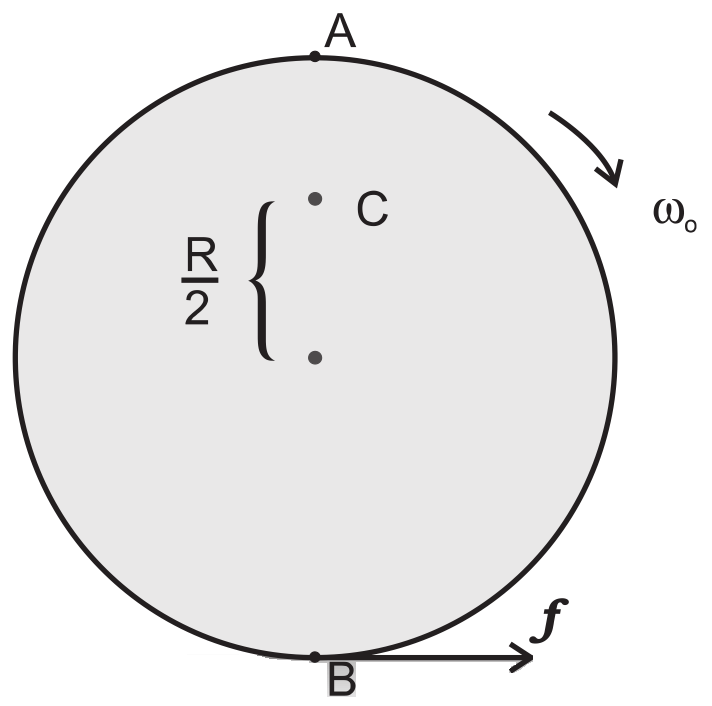
A disc rotating about its axis with angular speed $\omega_0$ is placed lightly (without any translational push) on a perfectly frictionless table. The radius of the disc is R. What are the linear velocities of the points A, B and C on the disc shown in will the disc roll in the direction indicated?
A cylindrical piece of cork of density of base area $A$ and height $h$ floats in a liquid of density $\rho_l$. The cork is depressed slightly and then released. Show that the cork oscillates up and down simple harmonically with a period $T=2 \pi \sqrt{\frac{h \rho}{\rho, g}}$ Where $\rho$ is the density of cork. (Ignore damping due to viscosity of the liquid).
Two trains A and B of length $400m$ each are moving on two parallel tracks with a uniform speed of $72km h^{–1}$ in the same direction, with A ahead of B. The driver of B decides to overtake A and accelerates by $1m s^{–2}$. If after $50s$, the guard of B just brushes past the driver of A, what was the original distance between them?
We have 0.5g of hydrogen gas in a cubic chamber of size 3cm kept at NTP. The gas in the chamber is compressed keeping the temperature constant till a final pressure of 100atm. Is one justified in assuming the ideal gas law, in the final state? (Hydrogen molecules can be consider as spheres of radius 1 A).
A bullet fired at an angle of $30°$ with the horizontal hits the ground $3.0km$ away. By adjusting its angle of projection, can one hope to hit a target $5.0km$ away? Assume the muzzle speed to be fixed, and neglect air resistance.
A particle executes simple harmonic motion of amplitude A.
i. At what distance from the mean position is its kinetic energy equal to its potential energy?
ii. At what points is its speed half the maximum speed?
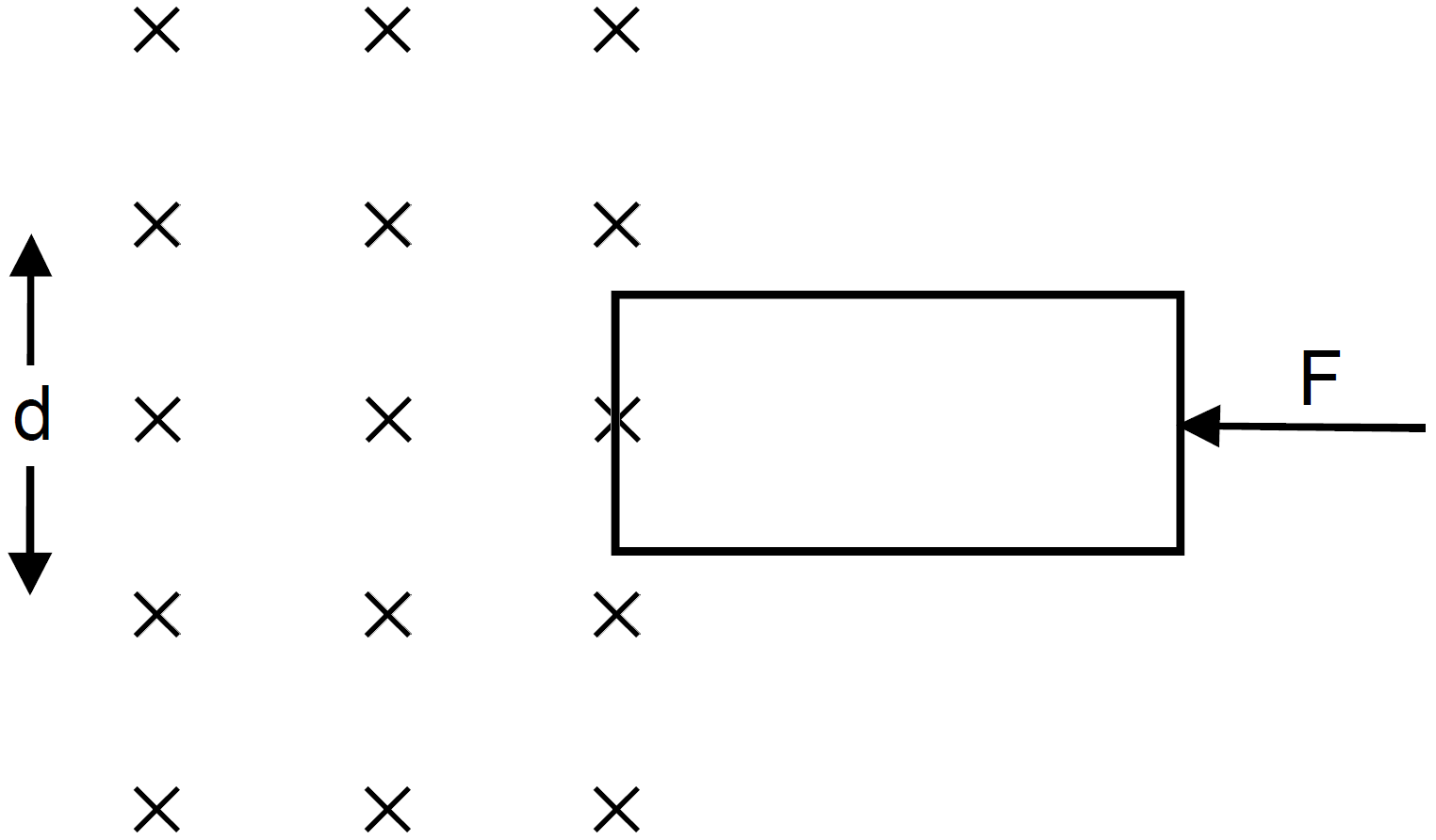
The rectangular wire-frame, shown in figure, has a width d, mass m, resistance R and a large length. A uniform magnetic field B exists to the left of the frame. A constant force F starts pushing the frame into the magnetic field at $t = 0$.
  1. Find the acceleration of the frame when its speed has increased to v.
  2. Show that after some time the frame will move with a constant velocity till the whole frame enters into the magnetic field. Find this velocity $v_0$.
  3. Show that the velocity at time t is given by $\text{v}=\text{v}_0\Big(1-\text{e}^{-\frac{\text{ft}}{\text{mv}_0}}\Big)$
What is the frequency of a second pendulum in an elevator moving up with an acceleration of $\frac{\text{g}}{2}$?