Question
Write the main characteristics of potential energy

Answer

 (i) Potential energy is a scalar function of position.
(ii) The negative value of the derivative of potential energy with respect to position determines the force $\overrightarrow{F}=-\frac{d}{d t} U_{(x)}$
(iii) The value of potential energy depends on the frame of reference.
(iv) The concept of potential energy is defined only for internal conservative forces and not for non-conservative forces.
(v) Change in potential energy continous during the motion of a rigid object because the distance between its particles doesn't change even when external force is applied to the motion of a rigid object.

Need a full question paper?

Generate a complete, print-ready paper with questions like this in minutes — across 16+ boards, with answer keys.
Start Generating Free

Similar questions

Find the average velocity of a projectile between the instants it crosses half the maximum height. It is projected with a speed u at an angle $\theta$ with the horizontal.
When 0.2kg of a body at 100°C is dropped into 0.5kg of water at 10°C, the resulting temperature is 16°C. Find the specific heat of the body. Specific heat of water is 4.2 × 10³J/ kg/ °C.
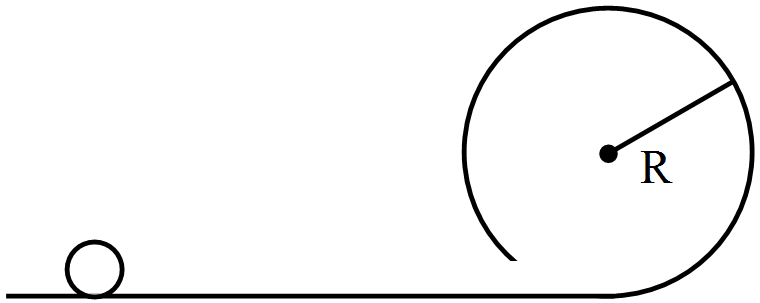
Figure shows a rough track, a portion of which is in the form of a cylinder of radius R. With what minimum linear speed should a sphere of radius r be set rolling on the horizontal part so that it completely goes round the circle on the cylindrical part.

Equal masses of air are sealed in two vessels, one of volume V0 and the other of volume 2V0. If the first vessel is maintained at a temperature 300K and the other at 600K, find the ratio of the pressures in the two vessels.
The ends of a metre stick a.re maintained at 100°C and 0°C. One end of a rod is maintained at 25°C. Where should its other end be touched on the metre stick so that there is no heat current in the rod in steady state?
Light in certain cases may be considered as a stream of particles called photons. Each photon has a linear momentum $\frac{\text{h}}{\lambda}$ where h is the Planck's constant and $\lambda$ is the wavelength of the light. A beam of light of wavelength $\lambda$ is incident on a plane mirror at an angle of incidence $\theta.$ Calculate the change in the linear momentum of a photon as the beam is reflected by the mirror.
An amount Q of heat is added to a monatomic ideal gas in a process in which the gas performs a work $\frac{\text{Q}}{2}$ on its surrounding. Find the molar heat capacity for the process.
The product of the hole concentration and the conduction electron concentration turns out to be independent of the amount of any impurity doped. The concentration of conduction electrons in germanium is 6 × 1019 per cubic metre. When some phosphorus impurity is doped into a germanium sample, the concentration of conduction electrons increases to 2 × 10²³ per cubic metre. Find the concentration of the holes in the doped germanium.
On what parameter does the $\lambda$ (mean free path) depends?
The earth-moon distance is about 60 earth radius. What will be the diameter of the earth (approximately in degrees) as seen from the moon?