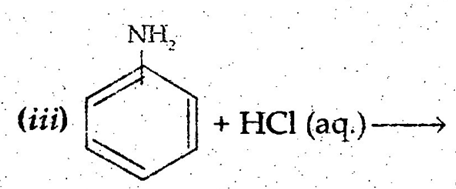
Question
Write the major products in the following:
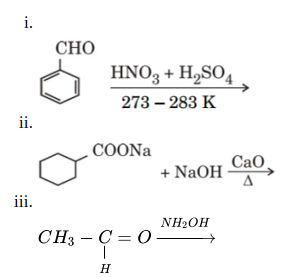
Image

Answer

Get the step-by-step solution for this question inside the Vidyadip app.

Get the answer in the app

Need a full question paper?

Generate a complete, print-ready paper with questions like this in minutes — across 16+ boards, with answer keys.

Start Generating Free

Similar questions

Predict the order of reactivity of the following compounds in $S_N1$ and $S_N2$ reactions: $\ce{C_6H_5CH_2Br, C_6H_5CH(C_6H_5)Br, C_6H_5CH(CH_3)Br, C_6H_5C(CH_3)(C_6H_5)Br}.$
Aqueous copper sulphate solution (blue in colour) gives :
(i) a green precipitate with aqueous potassium fluoride and
(ii) a bright green solution with aqueous potassium chloride. Explain these experimental results.
Explain the difference between instantaneous rate of a reaction and average rate of a reaction.
Answer the following the questions.
Name the three major classes of carbohydrates and give an example of each of these classes.
  1. Using valence bond theory, predict the shape and magnetic character of
  1. $\ce{[Ni(CO)_4]. [Ni = 28]}.$
  2. Give one example of application of coordination compounds$-$in medicine.
Vapour pressures of pure acetone and chloroform at $328\ K$ are $741.8\ mm\ Hg$ and $632.8\ mm\ Hg$ respectively. Assuming that they form ideal solution over the entire range of composition, plot $p_{total}, p_{chloroform},$ and $p_{acetone}$ as a function of $x_{acetone}.$ The experimental data observed for different compositions of mixture is:
$100 \times x_{acetone}$ $0$ $11.8$ $23.4$ $36.0$ $50.8$ $58.2$ $64.5$ $72.1$
$p_{acetone}/ mm\ Hg$ $0$ $54.9$ $110.1$ $202.4$ $322.7$ $405.9$ $454.1$ $521.1$
$p_{chloroform}/ mm\ Hg$ $632.8$ $548.1$ $469.4$ $359.7$ $257.7$ $193.6$ $161.2$ $120.7$
Plot this data also on the same graph paper. Indicate whether it has positive deviation or negative deviation from the ideal solution.
Complete the following reactions:
  1. $\text{CH}_{3}\text{CH}_{2}\text{NH}_{2}+\text{CHCl}_{3}+\text{alc. KOH}\rightarrow$
  2. $\text{C}_{6}\text{H}_{5}\text{N}_{2}^{+}\text{Cl}^{-}\xrightarrow[\text{(Room}\text{ temp.)}]{H_2O}$
Carbonyl group is present in carboxylic acids and their derivatives, yet they do not show the properties of carboxylic group, why?
Identify the product of the following reaction:$ \ \ \ \ \ \ \ \ \ \text{CH}_3\\ \ \ \ \ \ \ \ \ \ \ \ \ \ \text{|}\\\text{CH}_3-\text{C}-\text{CH}_2-\text{Br}\xrightarrow{\stackrel{{}}{\hbox{Na}}\stackrel{{}}{\hbox{OH}}}\\ \ \ \ \ \ \ \ \ \ \ \ \ \ \text{|} \ \ \ \ \ \ \ \ \ \ \ \ \ \ \ \ \ \ \ \ \ \ \ \ \ \ \ \ \ \Delta\\ \ \ \ \ \ \ \ \ \ \text{CH}_3$
How the following conversions can be carried out?
i. 2-Bromopropane to 1-bromopropane
ii. Chloroethane to butane
iii. Benzene to diphenyl