Question types

MODEL PAPER 9 question types

37 questions across 6 question groups — pick any mix to generate a Chemistry paper with step-by-step answer keys.

37
Questions
6
Question groups
5
Question types
Sample Questions

MODEL PAPER 9 questions

One sample from each question group in this chapter. Select any group above to see the full set with answer keys.

Match the types of solutions given Column I to the examples given in Column II.
Column IColumn II
(a) Solution of gas in gas(i) Brass
(b) Solution of solid in solid(ii) Air
(c) Solution of liquid in gas(iii) Zinc amalgam
(d) Solution of liquid in solid(iv) Chloroform in Nitrogen
View full solution
Interstitial compounds are formed when small atoms are trapped inside the crystal lattice of metals. Which of the following is not the characteristic property of interstitial compounds?
View full solution
Answer the following:
$(a)$ Give two examples of non-chemical process which obeys the first order kinetics.
$(b)$ The following results have been obtained during the kinetic studies for the reaction:
$P+2Q \rightarrow R + 2S$
Exp. Initial P(mol/L) Initial Q (mol/L) Init. Rate of Formation of R(M min-1)
$1$ $0.10$ $0.10$ $3.0 \times 10^{-4}$
$2$ $0.30$ $0.30$ $9.0 \times 10^{-4}$
$3$ $0.10$ $0.30$ $3.0 \times 10^{-4}$
$4$ $0.10$ $0.40$ $6.0 \times 10^{-4}$
Determine the rate law expression for the reaction.
View full solution
Transition metals can act as catalysts because these can change their oxidation state. How does Fe$(III)$ catalyze the reaction between iodide and persulphate ions?
View full solution
Q 153 Marks Question3 Marks
Calculate the emf of the following cell at $25^{\circ} C$.$Fe \left| Fe ^{2+}(0.001 M )\right|\left| H ^{+}(0.01 M )\right| H _2(g)(1 bar ) \mid Pt ( s )$
Given that, $E_{ Fe ^{2+} / Fe }^o=-0.44 V ; E_{H^{+} / H_2}^o=0.00 V$
View full solution
Indicate the types of isomerism exhibited by the following complexes and draw the structures for these isomers:
i. $\ce{k \left[ Cr \left( H _2 O \right)_2\left( C _2 O _4\right)_2\right]}$
ii. $\ce{\left[ Co ( en )_3\right] Cl _3}$
iii. $\ce{\left[ Co \left( NH _3\right)_5\left( NO _2\right)\left( NO _3\right)_2\right]}$
iv. $\ce{ \left [ Pt ( NH _3) ( H _2 O ) Cl _2\right].}$
View full solution
Attempt any five of the following:
(a) Why are polysaccharides considered non-sugars?
(b) What is meant by invert sugars?
(c) Write the name of the component of starch which is water-soluble.
(d) Write the products obtained after hydrolysis of DNA.
(e) Name the deficiency disease resulting from lack of vitamin A and E in the diet.
(f) Which vitamin is linked with anti-sterility?
(g) a. What is the difference between a nucleoside and nucleotide?
     b. What products would be formed when a nucleotide from DNA containing thymine is hydrolysed?
View full solution
i. Write the structure of main products when aniline reacts with the following reagents :
a. $Br _2$ water
b. HCl
c. $\left( CH _3 CO \right)_2 O /$ pyridine
ii. Arrange the following in the increasing order of their boiling point:$C _2 H _5 NH _2, C _2 H _5 OH ,\left( CH _3\right)_3 N$
iii. Give a simple chemical test to distinguish between the following pair of compounds : $\left( CH _3\right)_2 NH$ and $\left( CH _3\right)_3 N$.
View full solution
Write down the IUPAC name for each of the following complexes and indicate the oxidation state, electronic configuration, and coordination number. Also, give stereochemistry and magnetic moment of the complex:
a. $\left.K \left[ Cr \left( H _2 O \right)_2\right\}\left( C _2 O _4\right)_2\right] \cdot 3 H _2 O$
b. $\left[ Co \left( NH _3\right)_5 Cl \right] Cl _2$
c. $CrCl _3( py )_3$
d. $Cs \left[ FeCl _4\right]$
e. $K _4\left[ Mn ( CN )_6\right]$
View full solution
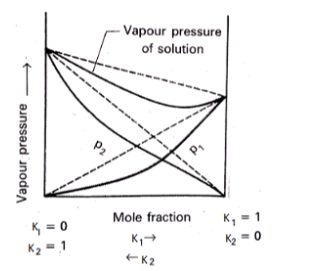
Read the following text carefully and answer the questions that follow: Raoult's law states that for a solution of volatile liquids, the partial vapour pressure of each component of the solution is directly proportional to its mole fraction present in solution.
Dalton's law of partial pressure states that the total pressure $(P_{total})$ over the solution phase in the container will be the sum of the partial pressures of the components of the solution and is given as: $P_{total} = P1 + P2$
Image
i. Is the above $-$ mentioned Raoult's law applicable for non $-$ volatile liquids?
ii. What type of deviation from Raoult's law does the above graph represent?
iii. Give an example of such system.
$OR$
iii. A solution of two liquids boils at a temperature more than the boiling point of either of them. What type of deviation will be shown by the solution formed in terms of Raoult's law?
View full solution
The d-block of the periodic table contains the elements of the groups 3 to 12 and are known as transition elements. In general, the electronic configuration of these elements is $(n-1) d^{1-10} n s^{1-2}$. The d-orbitals of the penultimate energy level in their atoms receive electrons giving rise to the three rows of the transition metals i.e. 3d, 4d and 5d series. However, $Zn , Cd$ and Hg are not regarded as transition elements. Transition elements exhibit certain characteristic properties like variable oxidation stables, complex formation, formation of coloured ions, alloys, catalytic activity etc. Transition metals are hard (except $Zn , Cd$ and Hg ) and have a high melting point.
i. Why are $Zn , Cd$ and Hg non-transition elements?
ii. Which transition metal of 3d series does not show variable oxidation state?
iii. Why do transition metals and their compounds show catalytic activity?
OR
iii. Why are melting points of transition metals high?
View full solution

Generate a MODEL PAPER 9 paper free

Pick question groups from the list above, set marks and difficulty, and export a branded PDF with step-by-step answer keys. First 3 chapters free — no signup.

Download App