Question
  1. Write the mathematical expression for Joule's law of heating.
  2. Compute the heat generated while transferring 96000 coulomb of charge in two hours through a potential difference of 40V.

Answer

  1. The mathematical expression of the Joules Law of heating is:

H = I2 Rt

Here, H is a heating effect, I is the current flowing through the device, and t is the time taken

  1. Given,

Amount of charge transferred = 96000C

Time taken = 2hrs = 2 × 60 × 60sec

= 7200sec

Potential difference = 40V

Heat generated = V × i × t

And we know that;

$\text{i}=\frac{\text{Q}}{\text{t}}$

So, H = VQ

= 40 × 96000

= 3.84 × 10⁶J.

Need a full question paper?

Generate a complete, print-ready paper with questions like this in minutes — across 16+ boards, with answer keys.
Start Generating Free

Similar questions

An object 2cm tall is placed on the axis of a convex lens of focal length 5cm at a distance of 10m from the optical centre of the lens. Find the nature, position and size of the image formed. Which case of image formation by convex lenses is illustrated by this example?
What is the difference between a direct current and an alternating current? How many times does AC used in India change direction in one second?
An object of height 5 cm is placed perpendicular to the principal axis of a concave lens of focal length 10 cm. If the distance of the object from the optical centre of the lens is 20 cm, determine the position, nature and size of the image formed using the lens formula.
The image of an object formed by a lens is of magnification - 1. If the distance between the object and its image is 60 cm, what is the focal length of the lens? If the object is moved 20 cm towards the lens, where would the image be formed? State reason and also draw a ray diagram in support of your answer.
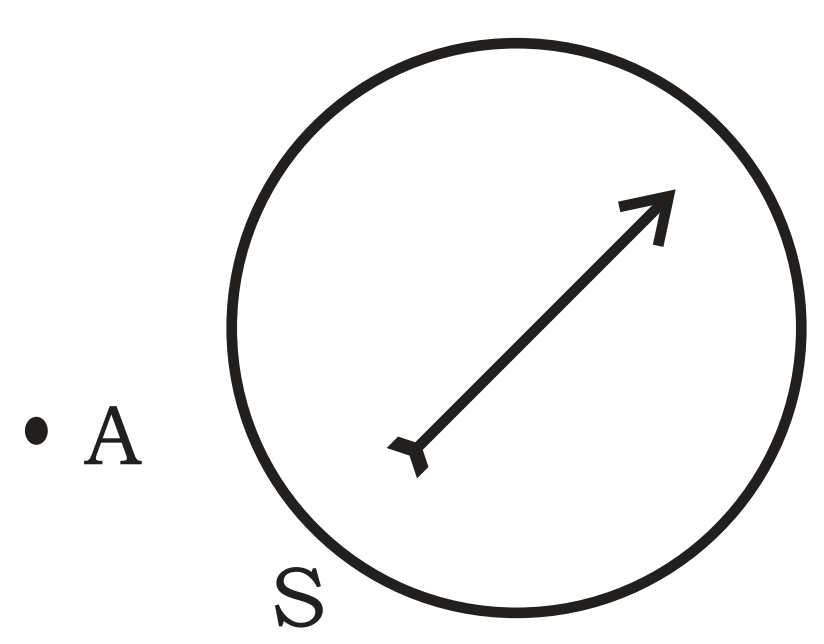
A magnetic compass needle is placed in the plane of paper near point A as shown in Figure. In which plane should a straight current carrying conductor be placed so that it passes through A and there is no change in the deflection of the compass? Under what condition is the deflection maximum and why?
The magnification of an image formed by a lens is -1. If the distance of the image from the optical centre of the lens is 25 cm, where is the object placed? Find the nature and focal length of the lens. If the object is displaced 15 cm towards the optical centre of the lens, where would the image be formed? Draw a ray diagram to justify your answer.
Mention the types of mirrors used as,

  1. Rear view mirrors.
  2. Shaving mirrors.

List two reasons to justify your answers in each case.

A convex lens of focal length 25cm and a concave lens of focal length 10cm are placed in close contact with one another.
  1. What is the power of this combination?
  2. What is the focal length of this combination?
  3. Is this combination converging or diverging?
Find the direction of magnetic field due to a current carrying circular coil held:
i. Vertically in North-South plane and an observer looking it from East sees the current to flow in anticlockwise direction.
ii. Vertically in East-West plane and an observer looking it from South sees the current to flow in anti-clockwise direction.
iii. Horizontally and an observer looking at it from below and see the current flowing in clockwise direction.
Give two circumstances in which a concave mirror can form a magnified image of an object placed in
front of it. Illustrate your answer by drawing labelled ray diagrams for both.