Question
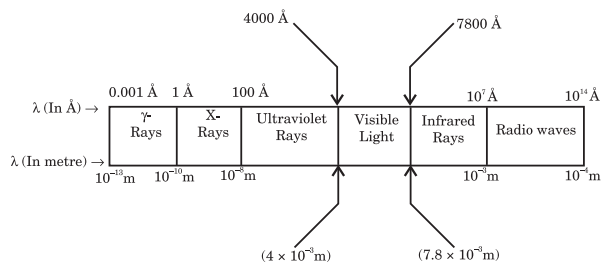
Write the name of different waves in electromagnetic spectrum and give brief introduction of their discovery, wavelength range, properties and applications.

Answer

1. $\gamma$ - Rays:
Wavelength range $10^{-13}$ to $10^{-10}$ metre.
Discovery - by Becquerel. (1896) and Curie (1898)
Production - By natural and artificial disintegration of radioactive substances.
Properties -They produce invisible, penetration and fluorescene, phosphorescence, ionisation and diffraction.
Applications-These are used to get the information about the structure of atomic nuclei.
2. X-Rays:
Wavelength range $10^{-10}$ to $10^{-8}$ metre.
Discovery-By Rontgen (1895)
Production - By bombardment of cathode rays on metal targets.
Properties-They are less penetrating than $\gamma$ - rays but more pennetrating than visible rays. They affect photographic plates. In human body tissues are transparent to them but bones are relatively opaque.
Applications - These are used to get the information about atomic structure and crystal structure and also used in medical diagnosis.
3. Ultraviolet Rays :
Wavelength range $10^{-8}$ to $4\times10^{-7}$ metre.
Discovery - Ritter (1802), Schuman (1890) and Lyman (1906).
Production - By electric discharge and vacuum spark.
Properties -They are very active. They show maxi-mum chemical effect and minimum heating effect.
Applications- These are useful in the detection of invisible writing, forged documents and finger prints.
4. Visible Rays (Light rays) :
Wavelength range $4\times10^{-7}$ to $7.8\times10^{-7}$ metre.
Discovery - Newton
Production - Reflection, refraction, interference diffration, polarisation, photo-electric effect, photographic action, sense of sight.
Applications -To see object by the eyes.
5. Infrared rays :
Wavelength range $7.8\times10^{-7}$ to $10^{-3}$ metre.
Discovery - By Herschell (1840)
Production - By heating the substance to a very high temperature.
Properties - Having more invisible penetrating effect on thermopile, bolometer.
Applications - These are used in revealing the secret writings on the ancient walls green houses to keep the plants warm and for looking through haze, fog or mist.
6. Radio Waves :
(a) Hertzian Waves or Short Radio Waves: i.e., Micro waves
Wavelength Range $10^{-3}$ to 1 metre.
Discovery - By Hertz (1888)
Image
Production - By spark gap.
Properties -They show reflection, refraction and interference.
Applications -These are used in radar and television.
(b) Long Radio waves or Wireless waves :
Wavelength range -104 metre.
Discovery - By Marconi (1896)
Production-When a ratio walve is used as an oscillator these waves are produced.
Properties-These waves are used in radio and wireless telegraphy. They show reflection, refraction and diffraction.
Applications-These are used in radio broadcasting.

Need a full question paper?

Generate a complete, print-ready paper with questions like this in minutes — across 16+ boards, with answer keys.
Start Generating Free

Similar questions

Three coplanar parallel wires, each carrying a current of 10A along the same direction, are placed with a separation 5.0cm between the consecutive ones. Find the matnitude ol the magnetic force per unit lenght acting on the wires.
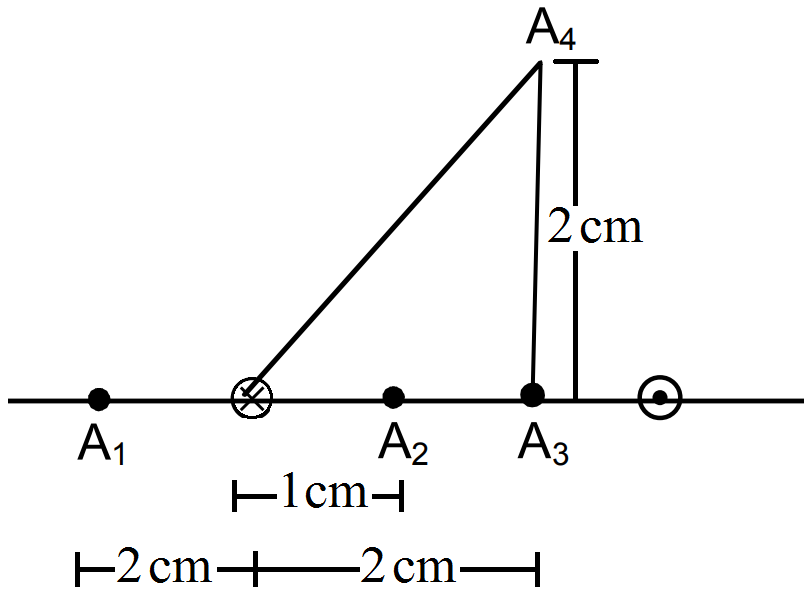
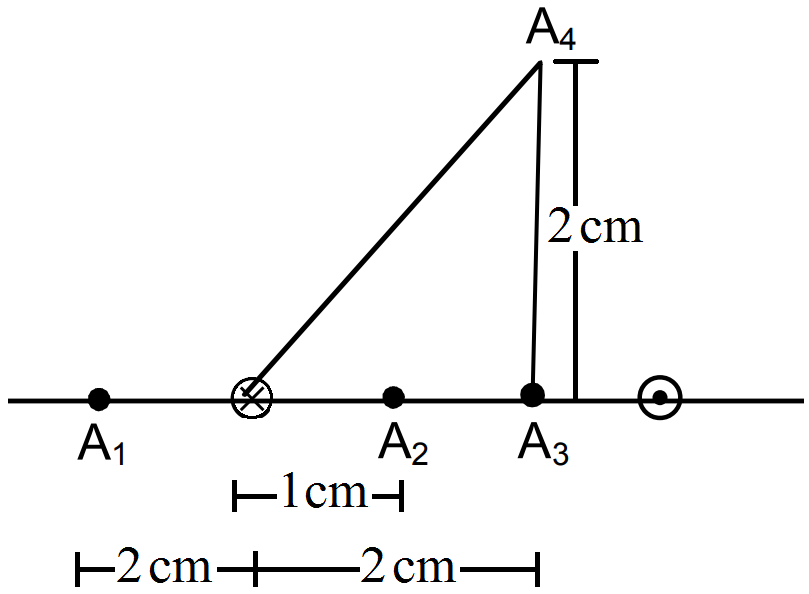
Figure shows two parallel wires separated by a distance of $4.0\ cm$ and carrying equal currents of $10A$ along opposite directions. Find the magnitude of the magnetic field $B$ at the points $A_1, A_2, A_3$ and $A_4.$​​​​​​​
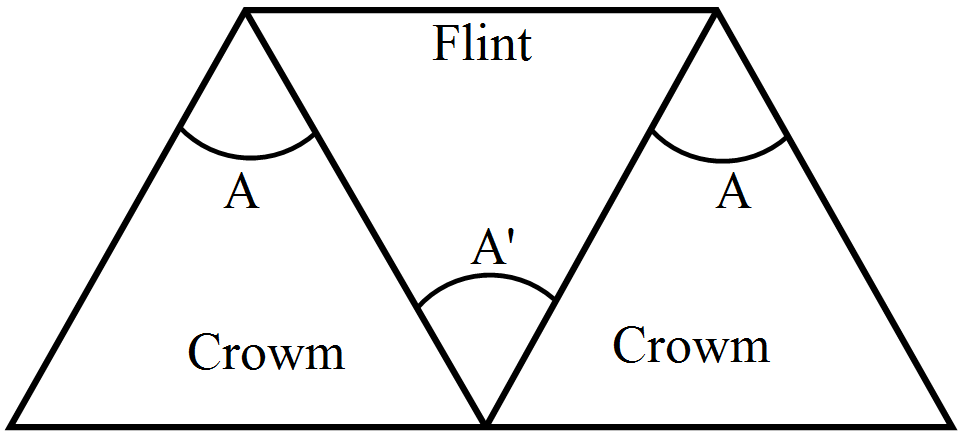
Three thin prisms are combined as shown in figure. The refractive indices of the crown glass for red, yellow and violet rays are $\mu_\text{r},\mu_\text{y}$ and $\mu_\text{v}$ respectively and those for the flint glass are $\mu'_\text{r},\mu'_\text{y}$ and $\mu'_\text{v}$ respectively. Find the ratio $\frac{\text{A}'}{\text{A}}$ for which.
  1. There is no net angular dispersion.
  2. There is no net deviation in the yellow ray.
How is $p-n$ junction diode is used as an half wave rectifier? Explain its action with proper circuit diagram. Show the input and output waveform also.
Deutrium was discovered in $1932$ by Harold Urey by measuring the small change in wavelength for a particular transition in $1H$ and $2H$. This is because, the wavelength of transition depend to a certain extent on the nuclear mass. If nuclear motion is taken into account then the electrons and nucleus revolve around their common centre of mass. Such a system is equivalent to a single particle with a reduced mass $\mu ,$ revolving around the nucleus at a distance equal to the electron $-$ nucleus separation. Here $\mu=\frac{\text{m}_\text{e}\text{M}}{\text{m}_\text{e}+\text{M}}$ where $M$ is the nuclear mass and me is the electronic mass. Estimate the percentage difference in wavelength for the $1^{st}$ line of the Lyman series in $1H$ and $2H. ($Mass of $1H$ nucleus is $1.6725 \times 10^{-27}kg,$ Mass of $2H$ nucleus is $3.3374 \times 10^{-27}kg$, Mass of electron $= 9.109 \times 10^{-31}kg).$
A simple pendulum of length $I$ is suspended through the ceiling of an elevator. Find the time period of small oscillations if the elevator,
  1. Is going up with an acceleration $a_0$
  2. Is going down with an acceleration $a_0$.
  3. Is moving with a uniform velocity.
What do you understand by sensitivity and efficiency of a galvanometer? On which factors does it depend?
The electric field associated with a light wave is given by $\text{E}=\text{E}_0\sin[(1.57\times10^7\text{m}^{-1})(\text{x}-{\text{ct}})].$ Find the stopping potential when this light is used in an experiment on photoelectric effect with the emitter having work function $1.9eV.$ 
A polariod (I) is placed in front of a monochromatic source. Another polatiod (II) is placed in front of this polaroid (I) and rotated till no light passes. A third polaroid (III) is now placed in between (I) and (II). In this case, will light emerge from (II). Explain.
Figure shows two parallel wires separated by a distance of $4.0\ cm$ and carrying equal currents of $10A$ along opposite directions. Find the magnitude of the magnetic field $B$ at the points $A_1, A_2, A_3$ and $A_4$.