Question
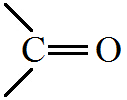
Write the names of the following functional groups:
  1. $-\text{CHO}$
  2. $-\text{OH}$
  3. $-\text{COOH}$
  4.  

  1. $-\text{X}$

Answer

  1. Aldehyde group.
  2. Alcohol group.
  3. Carboxylic acid group.
  4. Ketone group.
  5. Halo group.

Need a full question paper?

Generate a complete, print-ready paper with questions like this in minutes — across 16+ boards, with answer keys.

Start Generating Free

Similar questions

When zinc metal is treated with a dilute solution of a strong acid, a gas is evolved, which is utilised in the hydrogenation of oil. Name the gas evolved. Write the chemical equation of the reaction involved and also write a test to detect the gas formed.
A magnesium ribbon is burnt in oxygen to give a white compound X accompanied by emission of light. If the burning ribbon is now placed in an atmosphere of nitrogen, it continues to burn and forms a compound Y.
  1. Write the chemical formulae of X and Y.
  2. Write a balanced chemical equation, when X is dissolved in water.
The electronic configurations of three elements A, B and C are as follows:
A 2, 8, 1
B 2, 8, 7
C 2, 4
  1. Which of these elements is a metal?
  2. Which of these elements are non-metals?
  3. Which two elements will combine to form an ionic bond?
  4. Which two elements will combine to form a covalent bond?
  5. Which element will form an anion of valency 1?
Why should the metal sulphides and carbonates be converted to metal oxides in the process of extraction of metal from them?
What is a homologous series? Explain with an example.
  1. What are amphoteric oxides? Choose the amphoteric oxides from amongst the following oxides:

$\text{Na}_{2}\text{O, ZnO, Al}_{2}\text{O}_{3}, \text{CO}_{2}, \text{H}_{2}\text{O}$

  1. Why is it that non-metals do not displace hydrogen from dilute acids?
  1. Name a metal for each case:
  1. It does not react with cold as well as hot water but reacts with steam.
  2. It does not react with any physical state of water?
  1. When calcium metal is added to water, the gas evolved does not catch fire but the same gas evolved on adding sodium metal to water catches fire. Why is it so?
The non - metal A is an important constituent of our food and most of the fuels around us. A forms two oxides B and C. The oxide B is poisonous whereas oxide C causes global warming.
  1. Identify A, B and C.
  2. To which group of periodic table does A belong?
  3. Name another element which is placed in the same group as A.
How toothpaste prevents tooth decay?
Why does micelle formation take place when soap is added to water? Will a micelle be formed in other solvents such as ethanol also?