Question
Write the statements of Kirchhoff's laws.

Answer

The statements of Kirchhoff"s laws are as follows:
(1) Junction rule : "At any junction, the sum of the currents entering the junction is equal to the sum of currents leaving the junction."
(2) Loop rule : "The algebraic sum of changes in potential around any closed loop involving resistors and cells in the loop is zero."
Kirchhoff's junction rule works on the law of conservation of charge and loop rule works on the law of conservation of energy.

Need a full question paper?

Generate a complete, print-ready paper with questions like this in minutes — across 16+ boards, with answer keys.
Start Generating Free

Similar questions

Derive $D_m=A\left(n_{21}-1\right)$ for thin lens.
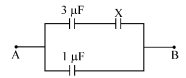
Three capacitors are arranged as shown in the circuit diagram. If the total capacitance between points A and B is $3 \mu F$, then the value of capacitance of X capacitor will be.
Image
$12J$ of work has to be done against an existing electric field to take a charge of $0.01C$ from $A$ to $B.$ How much is the potential difference $V_B - V_A?$
Two capacitors of capacitance $3 \mu F$ and 4 $\mu F$ are charged separately from a 6 V battery. When the battery is removed, they get connected to each other. In which the negative plate of one capacitor is connected to the positive plate of the other. Calculate the total final energy.
Explain the Bohr's Quantum condition of angular momentum. What will be the value of it, for the second orbit of electron?
If the solenoid in Exercise $5.5$ is free to turn about the vertical direction and a uniform horizontal magnetic field of $0.25 T$ is applied, what is the magnitude of torque on the solenoid when its axis makes an angle of $30^\circ$ with the direction of applied field?
In a cylindrical conductor, a direct current is flowing. Is there any electric field inside the conductor?
According to the classical electromagnetic theory, calculate the initial frequency of the light emitted by the electron revolving around a proton in hydrogen atom.
What is the specific heat capacity of:
  1. Melting ice
  2. Boiling water?
Identify the electromagnetic waves whose wavelengths lie in the range$:$
  1. $10^{–11} m < \lambda < 10^{–14} m$
  2. $10^{–4} m < \lambda < 10^{–6} m$
Write one use for each.