Question
  1. Write the structural difference between starch and cellulose.
  2. What type of linkage is present in Nucleic acids?
  3. Give one example each for fibrous protein and globular protein.

Answer

  1. Starch - Polymer of$\alpha - \text{D} - $ glucose units/Polymer of $\alpha -\text{ glucose}$ units.

Cellulose–polymer of $\beta - \text{D} - $glucose units/polymer of $\beta-\text{glucose}$ units.

  1. Phosphodiester linkage.
  2. Fibrous protein–Keratin/myosin/collagen. 

Globular protein-haemoglobin/insulin.

Need a full question paper?

Generate a complete, print-ready paper with questions like this in minutes — across 16+ boards, with answer keys.

Start Generating Free

Similar questions

While filling up of electrons in the atomic orbitals, the 4s orbital is filled before the 3d orbital but reverse happens during the ionisation of the atom. Explain why?
Among the isomeric alkanes of molecular formula C5H12, identify the one that on photochemical chlorination yields,
  1. A single monochloride.
  2. Three isomeric monochlorides.
  3. Four isomeric monochlorides.
Explain the following:
Haloalkanes react with KCN to form alkyl cyanides as main product while AgCN forms isocyanides as the major product.
Explain solubility of gas in a liquid solvent.
Give the formula of each of the following coordination entities:

  1. Co3+ ion is bound to one Cl, one NH3 molecule and two bidentate ethylenediamine (en) molecules.
  2. Ni2+ ion is bound to two water molecules and two oxalate ions.
Write the name and magnetic behaviour of each of the above coordination entities.

(At. nos. Co = 27, Ni = 28).

Explain the lanthanoid contraction.
The rate constants of a reaction at 500K and 700K are 0.02 S-1 and 0.07S-1 respectively. Calculate the values of E_{s} and A.
$\left[ R =8.314 JK ^{-1} mol^{-1}\right]$
Given that $\Lambda^{0}_{\text{m}}(\text{HCl})=426\text{ S cm}^2\text{mol}^{-1},\Lambda^{0}_{\text{m}}(\text{NaCl})\\=126\text{ S cm}^2\text{mol}^{-1}$
$\Lambda^{0}_{\text{m}}(\text{CH}_3\text{COONa})=91\text{ S cm}^2\text{mol}^{-1}$
Determine the osmatic pressure of a solution prepared by dissolving 2.5×10⁻²g of K2SO4 in 2L of water at 25oC, assuming that it is completely dissociated.

(R=0.0821 L atm K-1 mol-1, Molar mass of K2SO4=174 g moi-1).

Complete the following reactions:
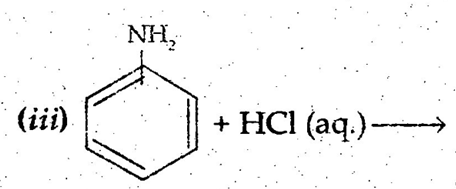
  1. $\text{CH}_{3}\text{CH}_{2}\text{NH}_{2}+\text{CHCl}_{3}+\text{alc. KOH}\rightarrow$
  2. $\text{C}_{6}\text{H}_{5}\text{N}_{2}^{+}\text{Cl}^{-}\xrightarrow[\text{(Room}\text{ temp.)}]{H_2O}$