Question
  1. Write the structural difference between starch and cellulose.
  2. What type of linkage is present in Nucleic acids?
  3. Give one example each for fibrous protein and globular protein.

Answer

  1. Starch - Polymer of$\alpha - \text{D} - $ glucose units/Polymer of $\alpha -\text{ glucose}$ units.

Cellulose–polymer of $\beta - \text{D} - $glucose units/polymer of $\beta-\text{glucose}$ units.

  1. Phosphodiester linkage.
  2. Fibrous protein–Keratin/myosin/collagen. 

Globular protein-haemoglobin/insulin.

Need a full question paper?

Generate a complete, print-ready paper with questions like this in minutes — across 16+ boards, with answer keys.

Start Generating Free

Similar questions

Explain by giving an equation how the presence of carbonyl group and five -OH groups in the structure of glucose is determined ### Write the equation reactions of glucose with NH, OH, HCN, and acetic anhydride and state what information is obtained about the structure of glucose through it.
The $K _{ sp }$ for AgCl at 298 K is $1.0 \times 10^{-10}$. Calculate the electrode potential for $Ag ^{+} / Ag$ electrode immersed in 1.0 M KCl solution. Given $E _{ A g ^{+} / A g }^\theta=0.80 V$
How will you convert?
(i) Propene → Propan-1-ol
(ii) Benzyl chloride → Benzyl alcohol
(iii) Ethyl Magnesium Bromide → 2-methyl Propan-2-ol
Explain molecular asymmetry, chirality and enantiomers.
Match the items of column I with items of column II.
 
Column I
 
Column II
(i)
Antifreeze used in car engine
(a)
Neutral ferric chloride
(ii)
Solvent used in perfumes
(b)
Glycerol
(iii)
Starting material for picric acid
(c)
Methanol
(iv)
Wood spirit
(d)
Phenol
(v)
Reagent used for detection of phenolic group
(e)
Ethleneglycol
(vi)
By product of soap industry used in cosmetics
(f)
Ethanol.
Give the plausible explanation for the following:
  1. Glucose doesn't give 2, 4-DNP test.
  2. The two strands in DNA are not identical but are complementary.
  3. Starch and cellulose both contain glucose unit as monomer, yet they are structurally different.
What are ambident nucleophiles? Explain with an example.
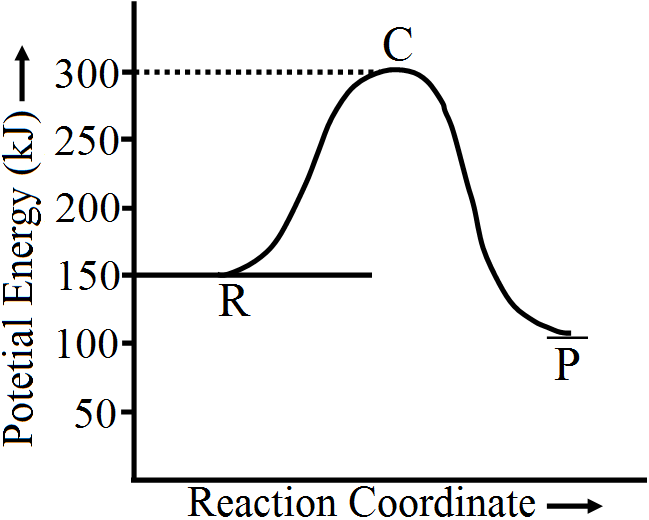
Answer the following questions on the basis of the given plot of potential energy vs reaction coordinate:

  1. What is the threshold energy for the reaction?
  2. What is the activation energy for forward reaction?
  3. What is the activation energy for backward reaction?
  4. What is enthalpy change for the forward reaction?

CCl4 and water are immiscible whereas ethanol and water are miscible in all proportions. Correlate this behaviour with molecular structure of these compounds.CCl4 is a non-polar covalent compound, whereas water is a polar compound. CCl4 can neither form hydrogen bonds with water molecules nor can it break hydrogen bonds between water molecule, therefore, it is insoluble in water. Ethanol is a polar compound and can form hydrogen bonds with water, which is a polar solvent, therefore it is miscible with water in all proportions.
The following results have been obtained during the kinetic studies of the reaction:

2A + B → C + D

Experiment [A]/mol L-1 [B]/mol L-1

Initial rate of formation of

D/mol L-1 min-1

I 0.1 0.1 6.0 × 10-3
II 0.3 0.2 7.2 × 10-2
III 0.3 0.4 2.88 × 10-1
IV 0.4 0.1 2.40 × 10-2
Determine the rate law and the rate constant for the reaction.