Question
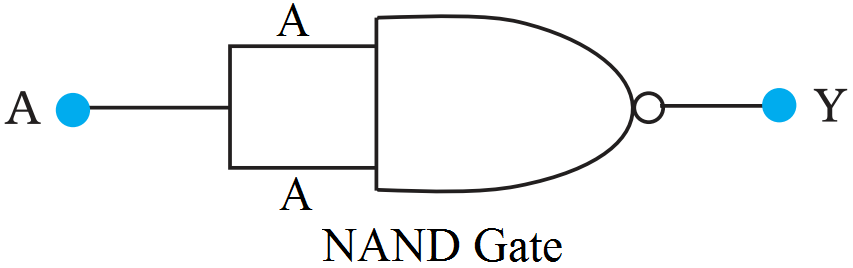
Write the truth table for a NAND gate connected as given in Fig. 14.45.
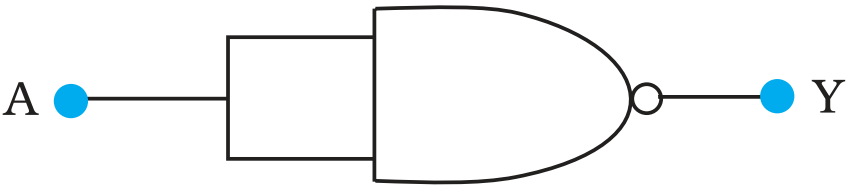
Hence identify the exact logic operation carried out by this circuit.
Answer

A acts as the two inputs of the NANO gate and Y is the output, as shown in the following figure.

Hence, the output can be written as:
$\text{Y}=\overline{\text{A}\cdot{\text{A}}}=\overline{\text{A}}+\overline{\text{A}}=\overline{\text{A}}\ \ \ ...\text{(i)}$
The truth table for equation (i) can be drawn as:
A $_{\text{Y}}\Big(=\overline{\text{A}}\Big)$
0 1
1 0
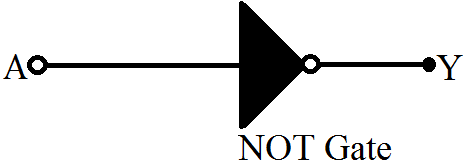
This circuit functions as a NOT gate. The symbol for this logic circuit is shown as:

Need a full question paper?

Generate a complete, print-ready paper with questions like this in minutes — across 16+ boards, with answer keys.
Start Generating Free

Similar questions

  1. Depict the equipotential surfaces for a system of two identical positive point charges placed a distance ‘d’ apart.
  2. Deduce the expression for the potential energy of a system of two point charges $q_1$ and $q_2$ brought from infinity to the points$\overrightarrow{\text{r}_{1}}$ and $\overrightarrow{\text{r}_{2}}$ respectively in the presence of external electric field $\overrightarrow{\text{E}}.$
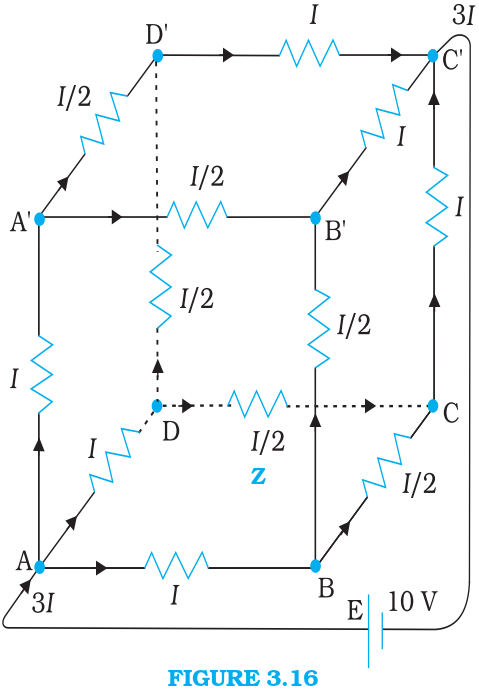
A battery of $10 V$ and negligible internal resistance is connected across the diagonally opposite corners of a cubical network consisting of 12 resistors each of resistance $1 \Omega$ (Fig. 3.16). Determine the equivalent resistance of the network and the current along each edge of the cube.
Image
(a) When a telescope is turned upside down and looked at the objective, it appears very small, why?
(b) Why does this not happen in a microscope?
Find the binding energy per nucleon of $\text{ }^{197}_{79}\text{Au}$ if its atomic mass is 196.96u.
A resistor of $12 \Omega$, a capacitor of $14 \Omega$ reactance and a pure inductor of inductance 0.1 H are joined in series and an alternating current of 200 V, 50 Hz is joined with them. Compute: (i) current in the circuit and (ii) phase angle between current and the voltage (Take $\pi=3$ ).
A converging lens and a diverging mirror are placed at a separation of 15cm. The focal length of the lens is 25cm and that of the mirror is 40cm. Where should a point source be placed between the lens and the mirror so that the light, after getting reflected by the mirror and then getting transmitted by the lens, comes out parallel to the principal axis?
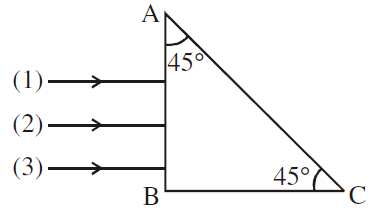
Three rays (1, 2, 3) of different colours fall normally on one of the sides of an isosceles right angled prism as shown. The refractive index of prism for these rays is 1.39, 1.47 and 1.52 respectively. Find which of these rays get internally reflected and which get only refracted from AC. Trace the paths of rays. Justify your answer with the help of necessary calculations.
The shows a circular wire loop of radius a and carrying a current i, which is placed in a perpendicular magnetic field B.
  1. Consider a small part dl of the wire. Find the force on this part of the wire exerted by the magnetic field.
  2. Find the force of compression in the wire.
The following graph shows the variation of stopping potential $V_0$ with the frequency v of the incident radiation for two photosensitive metals X and Y:
  1. Which of the metals has larger threshold wavelength? Give reason.
  2. Explain, giving reason, which metal gives out electrons, having larger kinetic energy, for the same wavelength of the incident radiation.
  3. If the distance between the light source and metal X is halved, how will the kinetic energy of electrons emitted from it change? Give reason.
Identify the following electromagnetic radiations as per the wavelengths given below.
  1. $10^{-3}nm$
  2. $10^{-3}m$
  3. 1nm
Write one application of each.