Question
(a) When a telescope is turned upside down and looked at the objective, it appears very small, why?
(b) Why does this not happen in a microscope?

Answer

(a) In a telescope, the focal length $\left(f_o\right)$ of the objective lens is much more than the focal length $\left(f_e\right)$ of the eyepiece and its magnification power is $f_o / f_e$. On looking back, the magnification power will become $f_e / f_o$, because $f_o \ll f_e$ hence now the object will appear very small.
(b) The formula for the magnifying power of a compound microscope is $\frac{v_o}{u_o} \times \frac{ D }{f_e}$, because the value of $v _0$ is only slightly more than the focal length $f_o$ of the objective of the microscope, hence the magnification can be considered as $\frac{v_o}{f_o} \times \frac{ D }{f_e}$; because $f_o$ and $f_e$ both have low values. Therefore, even after turning the microscope, the magnification power remains almost unchanged due to there being no significant difference in the value of $v_0$.

Need a full question paper?

Generate a complete, print-ready paper with questions like this in minutes — across 16+ boards, with answer keys.
Start Generating Free

Similar questions

Establish a relationship between electric current and drift velocity. Draw the direction of electron flowing in a circuit by drawing an electric circuit.
  1. Three photo diodes $D_1, D_2$ and $D_3$ are made of semiconductors having band gaps of 2.5eV, 2eV and 3eV respectively. Which of them will not be able to detect light of wavelength 600nm?
  2. Why photodiodes are required to operate in reverse bias? Explain.
A current loop of arbitrary shape lies in a uniform magnetic field B. Show that the net magnetic force acting on the loop is zero.
Consider Galileo's method of measuring the speed of light using two lanterns. To get an accuracy of about 10%, the time taken by the experimenter in closing or opening the shutter should be about one tenth of the time taken by the light in going from one experimenter to the other. Assume that it takes $\frac{1}{100}$ second for an experimenter to close or open the shutter. How far should the two experimenters be to get a 10% accuracy? What are the difficulties in having this separation?
The electric field in a region is given by $\overrightarrow{\text{E}}=\frac{3}{5}\text{E}_0\overrightarrow{\text{i}}+\frac{4}{5}\text{E}_0\overrightarrow{\text{j}}$ with $\text{E}_0=2.0\times10^3\text{NC}^{-1}.$ Find the flux of this field through a rectangular surface of area $0.2m^2$ parallel to the y-z plane.
Can an electromagnetic wave be polarised?
Light of wavelength 488 nm is produced by an argon laser which is used in the photoelectric effect. When light from this spectral line is incident on the emitter, the stopping (cut-off) potential of photoelectrons is 0.38 V. Find the work function of the material from which the emitter is made.
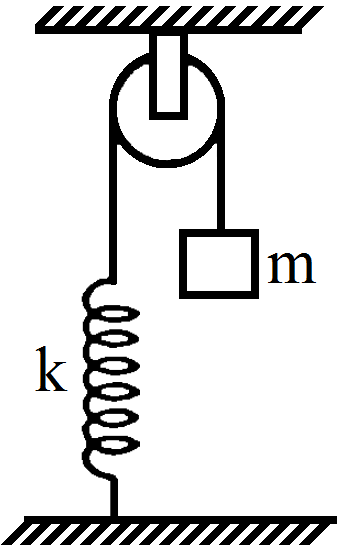
The string, the spring and the pulley shown in figure are light. Find the time period of the mass m.
A circular copper-ring of radius r translates in its plane with a constant velocity v. A uniform magnetic field B exists in the space in a direction perpendicular to the plane of the ring. Consider different pairs of diametrically opposite points on the ring.
  1. Between which pair of points is the emf maximum? What is the value of this maximum emf?
  2. Between which pair of points is the emf minimum? What is the value of this minimum emf?
A parallel-plate capacitor having plate area $25cm^2$ and separation 1.00mm is connected to a battery of 6.0V. Calculate the charge flown through the battery. How much work has been done by the battery during the process?