Question
Write the upper and lower limits of interference in terms of path difference.

Answer

We know that :
Phase difference $=\frac{2 \pi}{\lambda} \times$ path difference
or $\phi=\frac{2 \pi}{\lambda} y \quad \ldots(i)$
We also know that for constructive interference to $\quad \phi=2 n \pi \ldots(ii)$
From equation (i) and (ii)
$\frac{2 \pi}{\lambda} y=2 n \pi$
or $y=2 n \cdot \frac{\lambda}{2}$
For $n$th maxima, $y=y_n$
$\underline {y_n=2 n \cdot \frac{\lambda}{2}}$
Thus, to occur the constructive interference, path difference must be even multiple of $\frac{\lambda}{2}$
For minimum intensity $\quad \phi=(2 n+1) \pi$
or $\frac{2 \pi}{\lambda} y=(2 n+1) \pi$
$\therefore$ $y=(2 n+1) \frac{\lambda}{2}$
For $n$th minima : $y=y_n$
$\therefore$$y_n=(2 n+1) \frac{\lambda}{2}$
Thus, for destructive interference, path difference must be odd multiple of $\frac{\lambda}{2}$.

Need a full question paper?

Generate a complete, print-ready paper with questions like this in minutes — across 16+ boards, with answer keys.
Start Generating Free

Similar questions

A satellite is projected vertically upwards from an earth station. At what height above the earth's surface will the force on the satellite due to the earth be reduced to half its value at the earth station? (Radius of the earth is 6400km.)
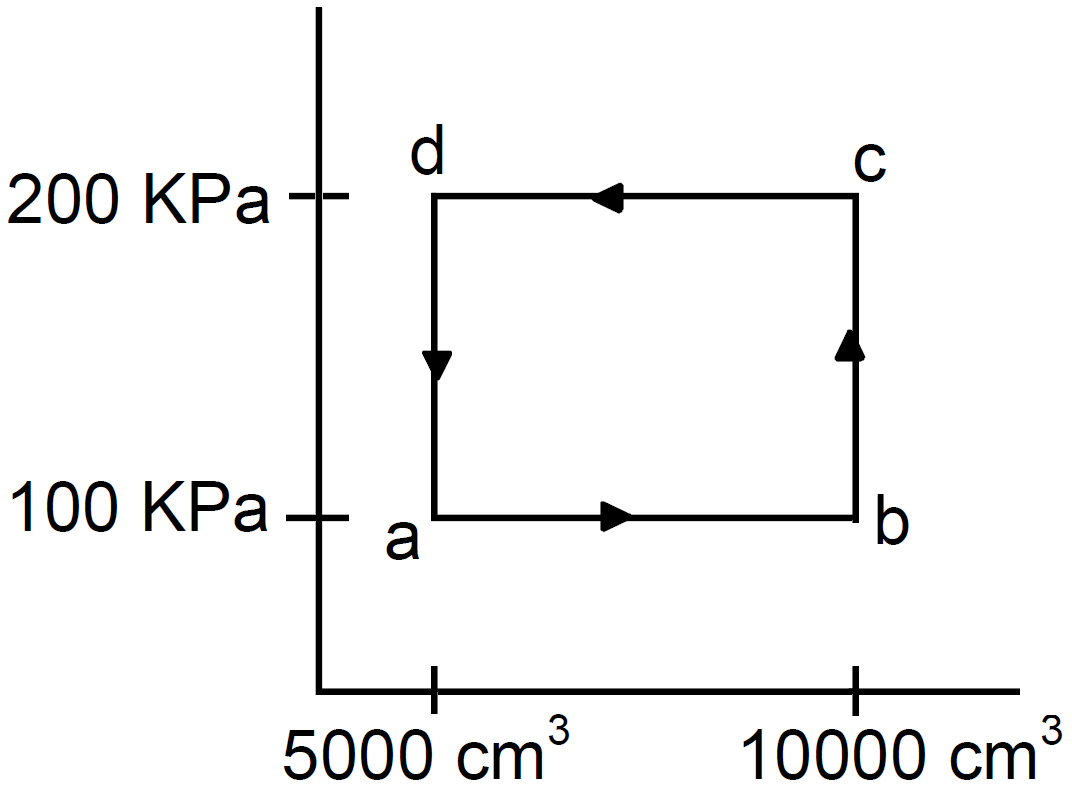
Half mole of an ideal gas $\Big(\gamma=\frac{5}{3}\Big)$ is taken through the cycle abcda, as shown in the figure. Take $\text{R}=\frac{25}{3}\text{JK}^{-1}\text{mol}^{-1}.$
  1. Find the temperature of the gas in the states a, b, c and d.
  2. Find the amount of heat supplied in the processes ab and bc.
  3. Find the amount of heat liberated in the processes cd and da.

Describe the main difference between Fraunhofer and Fresnel's diffraction. 
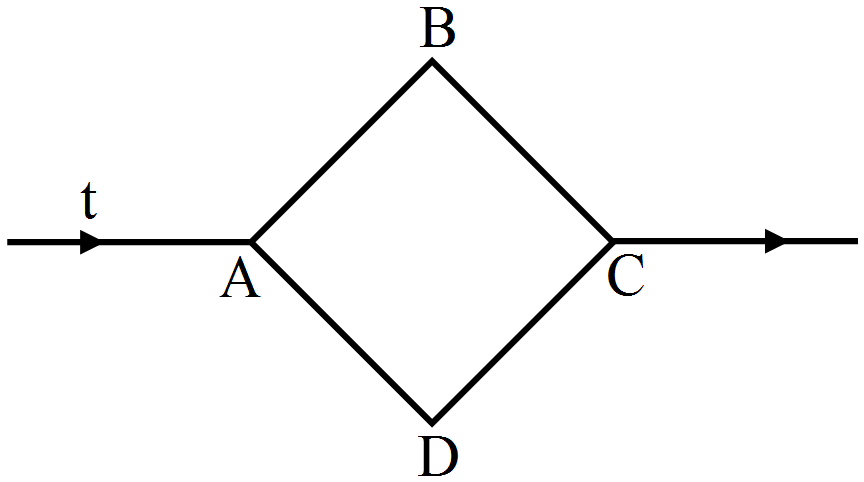
Figure shows a square loop ABCD with edgelength a. The resistance of the wire ABC is r and that of ADC is 2r. Find the magnetic field B at the centre of the loop assuming uniform wires.

An aluminium can of cylindrical shape contains 500cmof water. The area of the inner cross section of the can is 125cm2. All measurements refer to 10°C. Find the rise in the water level if the temperature increases to 80°C. The coefficient of linear expansion of aluminium = 23 × 10-6 °C-1 and the average coefficient of volume expansion of water = 3.2 × 10⁻⁴ °C-1 respectively.
A magnetic field set up using Helmholtz coils (described in Exercise 4.16) is uniform in a small region and has a magnitude of 0.75 T. In the same region, a uniform electrostatic field is maintained in a direction normal to the common axis of the coils. A narrow beam of (single species) charged particles all accelerated through 15 kV enters this region in a direction perpendicular to both the axis of the coils and the electrostatic field. If the beam remains undeflected when the electrostatic field is 9.0 × 10–5 V m–1, make a simple guess as to what the beam contains. Why is the answer not unique?
The two blocks in an Atwood machine have masses 2.0kg and 3.0kg. Find the work done by gravity during the fourth second after the system is released from rest.
What is nature of electromagnetic waves? Explain propagation of wave with the help of a diagram and explain their characteristics in detail.
A thermally insulated, closed copper vessel contains water at 15°C. When the vessel is shaken vigorously for 15 minutes, the temperature rises to l 7°C. The .mass of the vessel is 100g and that of the water is 200g. The specific heat capacities of copper and water are 420Jkg-1 K-1 and 4200Jkg-1 K-1 respectively. Neglect any thermal expansion.
  1. How much heat is transferred to the liquid-vessel system?
  2. How much work has been done on this system?
  3. How much is the increase in internal energy of the system?