Question
Write three characteristic features in photoelectric effect which cannot be explained on the basis of wave theory of light, but can be explained only using Einstein’s equation.

Answer

The three characteristic features which can’t be explained by wave theory are:
  1. Kinetic energy of emitted electrons are found to be independent of intensity of incident light.
  2. Below a certain frequency (threshold) there is no photo-emission.
  3. Spontaneous emission of photoelectrons.

Need a full question paper?

Generate a complete, print-ready paper with questions like this in minutes — across 16+ boards, with answer keys.
Start Generating Free

Similar questions

An electric bulb is designed to operate at 12 volts DC. If this bulb is connected to an AC source and gives normal brightness, what would be the peak voltage of the source?
Is $\text{p}=\frac{\text{E}}{\text{c}}$ valid for electrons?
A wheel rotating at a speed of $600\ rpm ($revolutions per minute$)$ about its axis is brought to rest by applying a constant torque for $10$ seconds. Find the angular deceleration and the angular velocity $5$ seconds after the application of the torque.
(a) A comb run through one's dry hair attracts small bits of paper. Why?
What happens if the hair is wet or if it is a rainy day? (Remember, a paper does not conduct electricity.)
(b) Ordinary rubber is an insulator. But special rubber tyres of aircraft are made slightly conducting. Why is this necessary?
(c) Vehicles carrying inflammable materials usually have metallic ropes touching the ground during motion. Why?
(d) A bird perches on a bare high power line, and nothing happens to the bird. A man standing on the ground touches the same line and gets a fatal shock. Why?
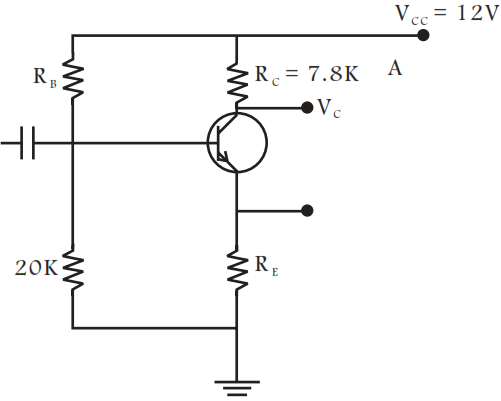
For the transistor circuit shown in Fig, evaluate $V_E, R_B, R_E$ given $I_C = 1 mA, V_{CE} = 3V, V_{BE} = 0.5 V$ and $V_{CC} = 12 V, \beta = 100.$​​​​​​​
Two narrow slits emitting iight in phase are separated by a distance of $1.0\ cm$. The wavelength of the light is $5.0 \times 10^{-7}m.$ The interference pattern is observed on a screen placed at a distance of $1.0m.$
  1. Find the separation between the consecutive maxima. Can you expect to distinguish between these maxima?
  2. Find the separation between the sources which will give a separation of $1.0\ mm$ between the consecutive maxima.
What is the kinetic energy of an electron in electronvolts with mass equal to double its rest mass?
Two neutral particles are kept 1m apart. Suppose by some mechanism some charge is transferred from one particle to the other and the electric potential energy lost is completely converted into a photon. Calculate the longest and the next smaller wavelength of the photon possible.
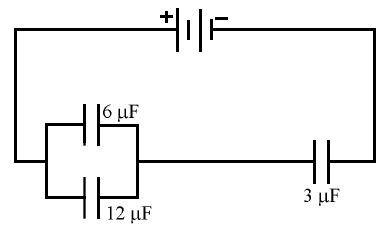
  1. In the following arrangement of capacitors, the energy stored in the $6 \mu F$ capacitor is $E$. Find the value of the following:
  2. Energy stored in $12 \mu F$ capacitor.
  3. Energy stored in $3 \mu F$ capacitor.
  4. Total energy drawn from the battery.
Calculate the amount of energy released during the $\alpha - $ decay of $^{238}_{92}\text{U}\to ^{234}_{92}\text{Th} + ^{4} _{2}\text{He}$Given:
  1. Atomic mass of $^{238}_{92}\text{U}= 238.05079u$
  2. Atomic mass of  $^{234}_{90}\text{Th}= 234.04363u$
  3. Atomic mass of $^{4}_{2}\text{He}= 4.00260\text{ u}$
$\text{1u} = 931.5 \text{MeV/c}^{2}$
Is this decay spontaneous? Give reason.