Question
Write three differences between Physisorption and Chemisorption.

Answer

  Physisorption Chemisorption
1. Because of van der Waals forces. Caused by chemical bond formation.
2. Reversible. Irreversible.
3. Enthalpy of adsorption is low(20-40 kJ/mol). Enthalpy of adsorption is high(80-240)kJ/mol.

Need a full question paper?

Generate a complete, print-ready paper with questions like this in minutes — across 16+ boards, with answer keys.
Start Generating Free

Similar questions

Explain the following items:
Biocatalysts.
An antifreeze solution is prepared from $222.6g$ of ethylene glycol $(C_2H_4(OH)_2)$ and $200$g of water. Calculate the molality of the solution. If the density of this solution be $1.072\ g\ mL^{-1},$ what will be the molarity of the solution?
Define the following terms:
  1. Lyophilic colloid.
  2. Zeta potential.
  3. Associated colloids.
Using Raoult’s law explain how the total vapour pressure over the solution is related to mole fraction of components in the following solutions.
$NaCl(s)$ and $H_2O(l)$
Answer the following questions:
Write the formulae for the following coordination compounds:
  1. Tetraammineaquachloridocobalt (III)chloride.
  2. Potassiumtetracyanonickelate (II).
  1. In which of the following does adsorption take place and why?
  1. Silica gel placed in the atmosphere saturated with water.
  2. Anhydrous $CaCl_2$ placed in the atmosphere saturated with water.
  1. How does $BF_3$ act as a catalyst in industrial process?
  2. Give an example of shape-selective catalysis.
While separating a mixture of ortho and para nitrophenols by steam distillation, name the isomer which will be steam volatile. Give reason.
Explain the following terms giving a suitable example in each case:
  1. Emulsification.
  2. Homogeneous catalysis.
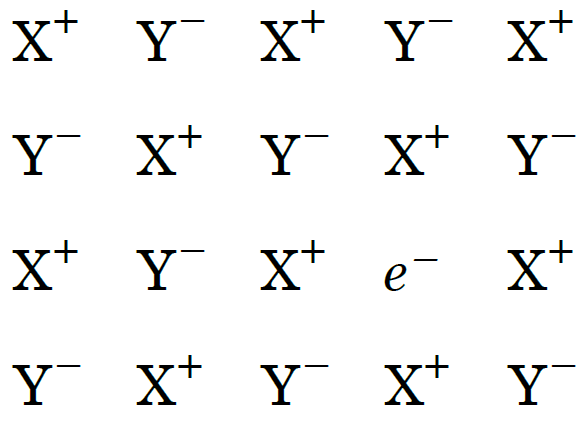
Examine the given defective crystal:
Answer the following questions:
  1. Is the above defect stoichiometric or non-stoichiometric?
  2. write the term used for the electron occupied site.
  3. Give an example of the compound which shows this type of defect.
The decomposition of $NH _3$ on platinum surface is zero order reaction. What are the rates of production of $N _2$ and $H_2$ if $k=2.5 \times 10^{-4} mol^{-1} Ls ^{-1}$ ?