Question
Write two important conclusions about nature of nuclear forces.

Answer

(i) These are attractive forces , (ii) These are short range non-electrical and non-gravitational forces.

Need a full question paper?

Generate a complete, print-ready paper with questions like this in minutes — across 16+ boards, with answer keys.

Start Generating Free

Similar questions

Among alpha, beta and gamma radiations, which get affected by electric field?
Is it always true that the molecules of a dense liquid are heavier than the molecules of a lighter liquid?
Define the term 'wattless current'.
How does the electric flux due to a point charge enclosed by a spherical Gaussian surface get affected when its radius is increased?
For transistor action, which of the following statements are correct:
  1. Base, emitter and collector regions should have similar size and doping concentrations.
  2. The base region must be very thin and lightly doped.
  3. The emitter junction is forward biased and collector junction is reverse biased.
  4. Both the emitter junction as well as the collector junction are forward biased.
Which electromagnetic waves are produced by the Hertz experiment and what is the range of their wavelength?
A long solenoid is fabricated by closely winding a wire of radius $0.5\ mm$ over a cylindrical nonmagnetic frame so that the successive turns nearly touch each other. What would be the magnetic field $B$ at the centre of the solenoid if it carries a current of $5A$?
Can alternating current cause electrolysis?
Answer the following questions, which help you understand the difference between Thomson’s model and Rutherford’s model better.
Is the probability of backward scattering (i.e., scattering of α-particles at angles greater than 90°) predicted by Thomson’s model much less, about the same, or much greater than that predicted by Rutherford’s model?
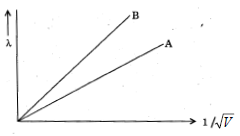
Two lines, A and B, in the plot given below show. the variation of de Broglie wavelength, $\lambda$ versus $1/\sqrt{\text{V}},$ where V is the accelerating potential difference, for two particles carrying the same charge. Which one of two represents a particle of smaller mass?