Question
Write two points of difference between n-type and p-type semiconductors.

Answer

S.no n- type semiconductor p- type semiconductor
1 Pentavalent impurity is added. Trivalent impurity is added.
2 Electrons are the majority charge carrier/(𝑛𝑒 >> 𝑛) Holes are the majority charge carriers/(𝑛 >> 𝑛𝑒).
3 New energy level formed near conduction band. New energy level formed near valence band.

Need a full question paper?

Generate a complete, print-ready paper with questions like this in minutes — across 16+ boards, with answer keys.
Start Generating Free

Similar questions

Illustrate by drawing the helical motion of a charged particle in a uniform magnetic field and derive the equations of pitch and radius of helix.
###
Discuss the path of motion of a charged particle entering with velocity at angle $\theta$ with uniform magnetic field. (where $\theta \neq 0, \frac{\pi}{2}, \pi$ )
Write two points of difference between intrinsic and extrinsic semiconductors.
Two thin lenses, whose power is +5 D and $-3 D$. are kept in mutual contact. Find the focal length of the combination.
Two tuning forks vibrate with the same amplitude but the frequency of the first is double the frequency of the second. Which fork produces more intense sound in air?
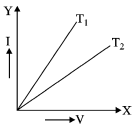
I-V graph at two different temperatures $T _1$ and $T _2$ for a metallic wire. Which temperature is greater and why? Image
What is called equipotential surface? Draw equipotential surfaces for point charges and write their properties.
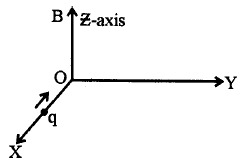
A charge ‘q’ moving along the X-axis with a velocity v is subjected to a uniform magnetic field B acting along the Z-axis as it crosses the origin O.

​​​​​​

  1. Trace its trajectory.
  2. Does the charge gain kinetic energy as it enters the magnetic field? Justify your answer.
Is neutral temperature always the arithmetic mean of inversion temperature and the temperature of the cold junction? Does the unit of temperature have an effect in deciding this question?
White light is used in a Young's double slit experiment. Find the minimum order of the violet fringe $(\lambda=400\text{nm}),$ which overlaps with a red fringe $(\lambda=700\text{nm}).$
When the last image of the telescope is formed at infinity, then what is the length of its tube? If the image is formed at the minimum distance of clear vision then will the length be less or more than before?