Question
X and Y are two parallel plate capacitors, whose plates have the same area and the same distance between them. There is air between the plates of $X$ and a dielectric material of dielectric constant $k=5$ between the plates of $Y$ (in the figure). (a) Calculate the potential diffe-rence between the plates X and Y . (b) What is the ratio of electrical potential energies stored in X and Y ?
Answer

(a) Capacitance of air capacitor
$ C_1=\frac{\epsilon_0 A}{d} $
and capacitance of Y $C _2=\frac{ KA \epsilon_0}{d}$ or $C _2= KC _1$
If $C_1=C$ then $C_2=K C$
$\Rightarrow \quad C_2=5 C$
$\because \quad K = C$
When two capacitors are connected in series, the charge stored on each is equal, therefore
$q= C _1 V_1= C _2 V_2$ or $q=C V_1=5 C V_2$
or $V_1=5 V_2$
But $V_1+V_2=12$
$\therefore \quad 5 V_2+V_2=12$
$6 V_2=12 \Rightarrow V_2=2$ volt
$\therefore \quad V _1=5 V_2=5 \times 2=10$ volt
(b) Since the energy of the charged capacitor
$U =\frac{1}{2} \frac{q^2}{ C }$
$U \propto \frac{1}{ C }$
$\therefore \quad \frac{ U _1}{ U _2}=\frac{ C _2}{ C _1}=\frac{5 C }{ C }=5$
or $U _1: U _2=5: 1$

Need a full question paper?

Generate a complete, print-ready paper with questions like this in minutes — across 16+ boards, with answer keys.

Start Generating Free

Similar questions

Explain the photoelectric effect when the radiation is incident on different metals?
Use the formula $\lambda_{ m } T =0.29 cm K$ to obtain the characteristic temperature ranges for different parts of the electromagnetic spectrum. What do the numbers that you obtain tell you?
Horizontal component of earth’s magnetic field at a place is $\sqrt{3}$ times its vertical component. What is the value of angle of dip at that place?
"The total energy of the electron in the hydrogen atom is negative." What does this fact indicate? If the total energy of the electron was positive than what result will have been achieved?
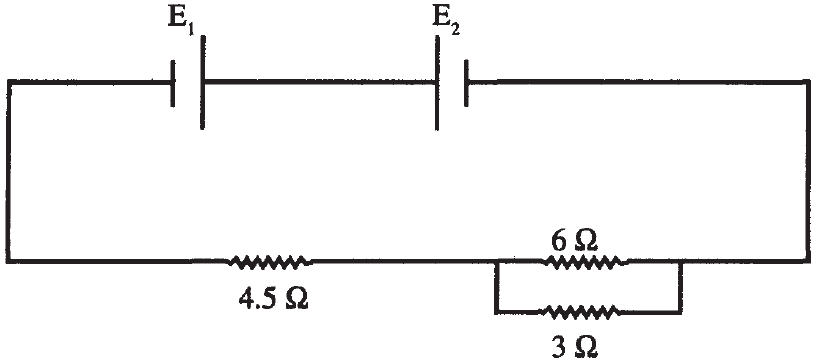
Two cells $E_1$ and $E_2$ in the given circuit diagram have an emf of $5 V$ and $9 V$ and internal resistance of $0.3 \Omega$ and $1.2 \Omega$ respectively.
Calculate the value of current flowing through the resistance of $3 \Omega$.
Draw the graph between the angle of incidence $(i)$ and the angle of deviation $(\delta)$ for a triangular prism.
A neutron having kinetic energy 12.5eV collides with a hydrogen atom at rest. Nelgect the difference in mass between the neutron and the hydrogen atom and assume that the neutron does not leave its line of motion. Find the possible kinetic energies of the neutron after the event.
A square coil of 200 turns of size $\frac{50}{\pi}$ is rotated in a magnetic field of 2.0 weber/ at the speed of 1200 rotations/minute. Calculate the magnitude of maximum induced electromotive force in the coil.
Find the maximum angular speed of the electron of a hydrogen atom in a stationary orbit.
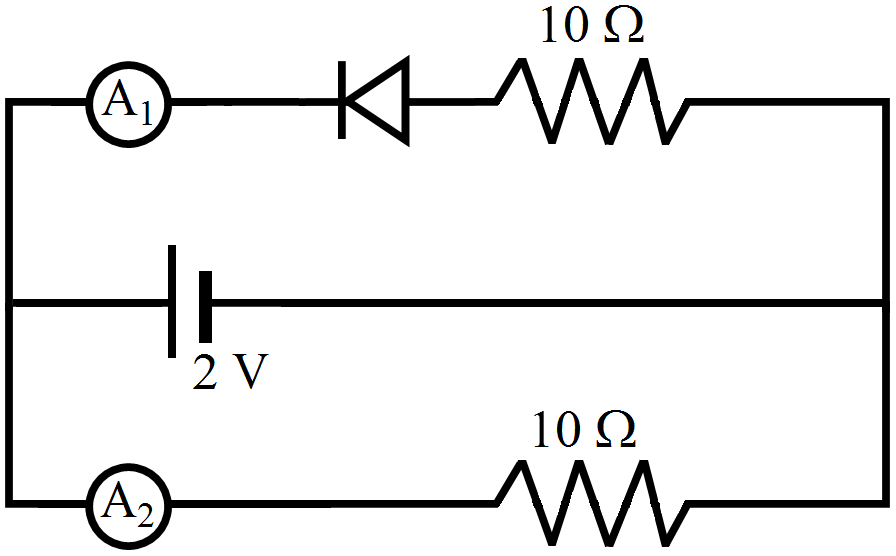
What are the readings of the ammeters $A_1$ and $A_2$ shown in figure. Neglect the resistance of the meters.​​​​​​​