MCQ
Two long straight wires $P$ and $Q$ carrying equal current $10\,A$ each were kept parallel to each other at $5\,cm$ distance. Magnitude of magnetic force experienced by $10\,cm$ length of wire $P$ is $F_1$. If distance between wires is halved and currents on them are doubled, force $F_2$ on $10\,cm$ length of wire $P$ will be :
  • $8 F_1$
  • B
    $10 F_1$
  • C
    $F_1 / 8$
  • D
    $F_1 / 10$

Answer

Correct option: A.
$8 F_1$
a
Force per unit length between two parallel straight

$\text { wires }=\frac{\mu_0 i_1 i_2}{2 \pi d }$

$\frac{ F _1}{ F _2}=\frac{\frac{\mu_0(10)^2}{2 \pi(5\,cm )}}{\frac{\mu_0(20)^2}{2 \pi\left(\frac{5 cm }{2}\right)}}=\frac{1}{8}$

$\Rightarrow F_2=8 F_1$

Need a full question paper?

Generate a complete, print-ready paper with questions like this in minutes — across 16+ boards, with answer keys.

Start Generating Free

Similar questions

The minimum wavelength of $X-$ ray emitted by $X-$ rays tube is $0.4125 Å$ . The accelerating voltage is......$ kV$
The gravitational force ${F_g}$ between two objects does not depend on
The angle between vectors $(\overrightarrow {\rm{A}} \times \overrightarrow {\rm{B}} )$ and $(\overrightarrow {\rm{B}} \times \overrightarrow {\rm{A}} )$ is
The result after adding $3.8 \times 10^{-6}$ with $4.2 \times 10^{-5}$ with due regard to significant figures is
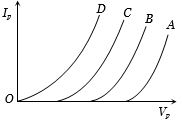
In the figure four plate characteristics of a triode at different grid voltage are shown. The difference between successive grid voltage is $1 V.$  Which curve will have maximum grid voltage and what is its value?
If the decay or disintegration constant of a radioactive substance is $\beta $, then its half life and mean life are respectively 

$(log_e \,2 =ln\, 2)$

$A$ block of mass $M$ is placed on $a$ horizontal surface and it is tied with an inextensible string to $a$ block of mass, as shown in figure. A block of mass $m_0$ is also placed on $M$ If $\mu < \mu_{min}$ (the minimum friction required to keep the block $m$ stationary), then the downward acceleration of $m$ is 
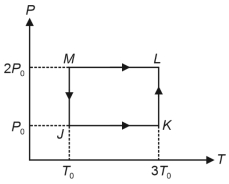
One mole of a monatomic ideal gas undergoes the cyclic process $J \rightarrow K \rightarrow L \rightarrow M \rightarrow J$, as shown in the $P - T$ diagram.

Match the quantities mentioned in $List-I$ with their values in $List-II$ and choose the correct option. [ $R$ is the gas constant]

$List-I$ $List-II$
($P$) Work done in the complete cyclic process ($1$) $R T_0-4 \ R T_0 \ln 2$
($Q$) Change in the internal energy of the gas in the process $JK$ ($2$) $0$
($R$) Heat given to the gas in the process $KL$ ($3$) $3 \ R T_0$
($S$) Change in the internal energy of the gas in the process $MJ$ ($4$) $-2 \ R T_0 \ln 2$
  ($5$) $-3 \ R T_0 \ln 2$

A conducting circular loop of radius $r$ carries a constant current $i$. It is placed in a uniform magnetic field $\overrightarrow B $, such that $\overrightarrow B $ is perpendicular to the plane of the loop. The magnetic force acting on the loop is
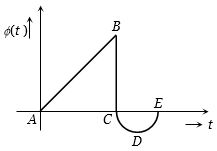
The graph Shows the variation in magnetic flux $\phi (t)$ with time through a coil. Which of the statements given below is not correct