MCQ
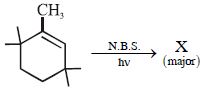
$X$ is
  • A


  • C

  • D

Answer

Correct option: B.

b

Need a full question paper?

Generate a complete, print-ready paper with questions like this in minutes — across 16+ boards, with answer keys.

Start Generating Free

Similar questions

Chemical bond implies
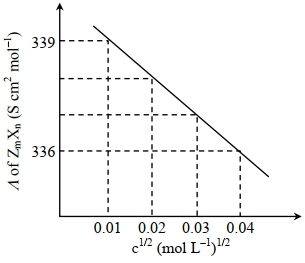
Consider the strong electrolytes $Z _{ m } X _{ n }, U _{ m } Y _{ p }$ and $V _{ m } X _{ n }$. Limiting molar conductivity $\left(\Lambda^0\right)$ of $U _{ m } Y _{ p }$ and $V _{ m } X _{ n }$ are $250$ and $440 S cm ^2 mol ^{-1}$, respectively. The value of $( m + n + p )$ is . . . . .Given:

$Ion$ $Z ^{ n +}$ $Z ^{ P +}$ $Z ^{ n +}$ $Z ^{ m +}$ $Z ^{ m +}$
$\lambda^0\left( S cm ^2 mol ^{-1}\right)$ $50.0$ $25.0$ $100.0$ $80.0$ $100.0$

$\lambda^0$ is the limiting molar conductivity of ions

The plot of molar conductivity $(4)$ of $Z _{ m } X _{ n } v s c ^{1 / 2}$ is given below.
Number of electrons in $ - CON{H_2}$ is
Which of the following relation is incorrect
An aromatic compound $‘A‘$ having molecular formula $C_7H_6O_2$ on treating with aqueous ammonia and heating forms compound $‘B’$. The compound $‘B’$ on reaction with molecular bromine and potassium hydroxide provides compound $‘C’$ having molecular formula $C_6H_7N$. The structure of $‘A’$ is
Standard reduction potentials of the half reactions are given below :

$F_{2(g)} + 2e^- \rightarrow 2F^-_{(aq)}\, ;$  $E^o = + 2.85\, V$

$Cl_{2(g)} + 2e^- \rightarrow 2Cl^-_{(aq)}\, ;$   $E^o = + 1.36\, V$

$Br_{2(l)} + 2e^- \rightarrow 2Br^-_{(aq)}\, ;$  $E^o = + 1.06\, V$

$I_{2(s)} + 2e^- \rightarrow 2I^-_{(aq)}\, ;$  $E^o = + 0.53\, V$

The strongest oxidising and reducing agents respectively are

Which pair of elements with the given atomic numbers is expected to have similar properties?
Which of the following paramagnetic ions would exhibit a magnetic moment (spin only) of the order of $5\,\,BM$ ?

(At. Nos. $Mn = 25, Cr = 24, V = 23, Ti = 22$ )

The oxidation state of $Cr$ in ${[Cr{(N{H_3})_4}C{l_2}]^ + }$ is
The reaction of formation of phosgene from $CO$ and $Cl_2$ is $CO + Cl_2 \to COCl_2.$ The proposed mechanism is

$(i)$  $C{l_2}\,\underset{{{k_2}}}{\overset{{{k_1}}}{\longleftrightarrow}}\,2Cl$

$(ii)$  $Cl + CO\,\underset{{{k_4}}}{\overset{{{k_3}}}{\longleftrightarrow}}\,COCl$

$(iii)$  $COCl\, + \,C{l_2}\,\,\xrightarrow{{{k_5}}}\,COC{l_2}\, + \,Cl$ (slow)

Find the correct expression of rate law