MCQ
$X-$ rays are produced in laboratory by
  • A
    Radiation
  • B
    Decomposition of the atom
  • Bombardment of high energy electron on heavy metal
  • D
    None of these

Answer

Correct option: C.
Bombardment of high energy electron on heavy metal
c
(c)

Need a full question paper?

Generate a complete, print-ready paper with questions like this in minutes — across 16+ boards, with answer keys.

Start Generating Free

Similar questions

Consider the following two statements
$1.$ Linear momentum of a system of particles is zero
$2.$ Kinetic energy of a system of particles is zeroThen
If $\overrightarrow{ P } \times \overrightarrow{ Q }=\overrightarrow{ Q } \times \overrightarrow{ P },$ the angle between $\overrightarrow{ P }$ and $\overrightarrow{ Q }$ is $\theta\left(0^{\circ} < \theta < 360^{\circ}\right) .$ The value of $\theta$ will be ........
The fundamental frequency of a sonometer with a weight of $4\,kg$ is $256\,Hz$ . The weight required to produce its octave is .... $kg-wt$
Resistance of tungsten wire at $150\,^oC$ is $133\,\Omega $. Its resistance temperature coefficient is $0.0045\,^oC$. The resistance of this wire at $500\,^oC$ will be .............. $\Omega$
A particle moving with a uniform acceleration travels $24\, m$ and $64\, m$ in the first  two consecutive intervals of $4\, sec$ each. Its initial velocity is......$m / \sec $
An electric dipole moment $\vec p = (2.0\hat i + 3.0\hat j)$ $\mu C. $ $m$ is placed in a uniform electric field $\vec E = (3.0\hat i + 2.0\hat k)$ $×$$10^5$ $N$ $C^{-1}$.
The period of a satellite in a circular orbit of radius $R$ is $T$, the period of another satellite in a circular orbit of radius $4R$ is
A wire of $1 \,\Omega$ has a length of $1\, m$. It is stetched till its length increases by $25\, \%$. The percentage change in resistance to the neartest integer is .....$\%$
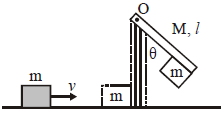
A block of mass $m =1\, kg$ slides with velocity $v=6\, m / s$ on a frictionless horizontal surface and collides with a uniform vertical rod and sticks to it as shown. The rod is pivoted about $O$ and swings as a result of the collision making angle $\theta$ before momentarily coming to rest. If the rod has mass $M =2 \,kg $ and length $l=1\, m$ the value of $\theta$ is approximately

(Take $\left.g=10 \,m / s ^{2}\right)$

The angle between $(\overrightarrow A - \overrightarrow B )$ and $(\overrightarrow A \times \overrightarrow B )$ is $(\overrightarrow{ A } \neq \overrightarrow{ B })$