An electric dipole moment $\vec p = (2.0\hat i + 3.0\hat j)$ $\mu C. $ $m$ is placed in a uniform electric field $\vec E = (3.0\hat i + 2.0\hat k)$ $×$$10^5$ $N$ $C^{-1}$.
Diffcult


Download our appand get started for free
Experience the future of education. Simply download our apps or reach out to us for more information. Let's shape the future of learning together!No signup needed.*
Similar Questions
- 1Three capacitors, each of $3\,\mu F$, are provided. These cannot be combined to provide the resultant capacitance of.........$\mu F$View Solution
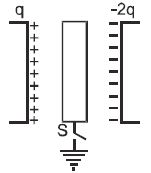
- 2The metal plate on the left in figure carries a charge $+q$. The metal plate on the right has a charge of $-2q$. What charge will flow through $S$ when it is closed, if central plate is initially neutralView Solution
- 3Capacitance of a capacitor made by a thin metal foil is $2\,\mu F$. If the foil is folded with paper of thickness $0.15\,mm$, dielectric constant of paper is $2.5$ and width of paper is $400\,mm$, then length of foil will be.....$m$View Solution
- 4If an electron moves from rest from a point at which potential is $50\, volt$ to another point at which potential is $70\, volt$, then its kinetic energy in the final state will beView Solution
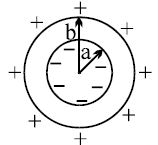
- 5An empty thick conducting shell of inner radius $a$ and outer radius $b$ is shown in figure.If it is observed that the inner face of the shell carries a uniform charge density $-\sigma$ and the surface carries a uniform charge density $ '\sigma '$View Solution
If the charge $q_A$ is slowly moved inside the shell, then choose the statement$(s)$
- 6A $10\, \mu F$ capacitor is fully charged to a potential difference of $50\, V$. After removing the source voltage it is connected to an uncharged capacitor in parallel. Now the potential difference across them becomes $20\, V$. The capacitance of the second capacitor is......$\mu F$View Solution
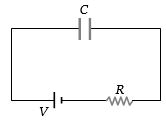
- 7As in figure shown, if a capacitor $C$ is charged by connecting it with resistance $R$, then energy is given by the battery will beView Solution
- 8A $10\ \mu F$ capacitor is charged to a potential difference of $1000\ V$. The terminals of the charged capacitor are disconnected from the power supply and connected to the terminals of an uncharged $6\ \mu F$ capacitor. What is the final potential difference across each capacitor.....$V$View Solution
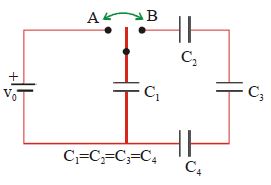
- 9The four identical capacitors in the circuit shown below are initially uncharged. The switch is then thrown first to position $A$, and then to position $B$. After this is done:View Solution
Note: $V_{1,2,3,4}$ are the potential differences across $C_{1,2,3,4}$ and $Q_{1,2,3,4}$ are the final charges stored in $C_{1,2,3,4}$ respectively.
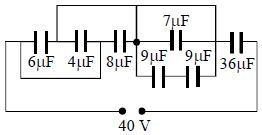
- 10In the following diagram, the charge and potential difference across $8\,\mu F$ capacitance will be nearlyView Solution