MCQ
X-rays of $\lambda=1 \mathrm{~A}^0$ have frequency
  • A
    $3 \times 10^{8} \mathrm{~Hz}$
  • $3 \times 10^{18} \mathrm{~Hz}$
  • C
    $3 \times 10^{10} \mathrm{~Hz}$
  • D
    $3 \times 10^{15} \mathrm{~Hz}$

Answer

Correct option: B.
$3 \times 10^{18} \mathrm{~Hz}$
(b) $3 \times 10^{18} \mathrm{~Hz}$

Need a full question paper?

Generate a complete, print-ready paper with questions like this in minutes — across 16+ boards, with answer keys.

Start Generating Free

Similar questions

Two identical cells send the same current in $2\,\Omega $ resistance, whether connected in series or in parallel. The internal resistance of the cell should be ............... $\Omega$
The potential (in volts ) of a charge distribution is given by

$V(z)\, = \,30 - 5{z^2}for\,\left| z \right| \le 1\,m$

$V(z)\, = \,35 - 10\,\left| z \right|for\,\left| z \right| \ge 1\,m$

$V(z)$  does not depend on $x$  and  $y.$  If this potential is generated by a constant charge per unit volume $\rho _0$ (in units of $\varepsilon _0$ ) which is spread over a certain region, then choose the correct statement
Full wave rectifier uses:
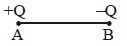
Two point charges of same magnitude and opposite sign are fixed at points $A$ and $B$. $A$ third small point charge is to be balanced at point $P$ by the electrostatic force due  to these two charges. The point $P$
Assertion : Balmer series lies inthe visible region of the electromagnetic spectrum.
Reason : $\frac{1}{\lambda } = R\,\left[ {\frac{1}{{{2^2}}} - \frac{1}{{{n^2}}}} \right]$ , where $n = 3, 4, 5$
The period of oscillations of a magnet is $ 2 \,sec$. When it is remagnetised so that the pole strength is $4$ $times$ its period will be......$sec$
$STATEMENT-1$ For practical purposes, the earth is used as a reference at zero potential in electrical circuits.and

$STATEMENT-2$ The electrical potential of a sphere of radius $R$ with charge $\mathrm{Q}$ uniformly distributed on the surface is given by $\frac{\mathrm{Q}}{4 \pi \varepsilon_0 R}$.

The current in a conductor varies with time t as $I = 2t + 3{t^2}$ where $I$ is in ampere and $t$ in seconds. Electric charge flowing through a section of the conductor during $t = 2\,\sec$ to $t = 3\,\sec$ is ............. $C$
The resistivity of a potentiometer wire is $40 \times {10^{ - 8}}\,ohm - m$ and its area of cross-section is $8 \times {10^{ - 6}}\,{m^2}$. If $0.2\, amp$ current is flowing through the wire, the potential gradient will be
The radius of the coil of a Tangent galvanometer. which has $ 10 $ $turns$ is $0.1\,m. $ The current required to produce a deflection of $60°$  $({B_H} = 4 \times {10^{ - 5}}\,T)$ is.....$A$