MCQ
X-rays of $\lambda=1 \mathring A$ have frequency
  • A
    $3 \times 10^8 \mathrm{~Hz}$
  • $3 \times 10^{18} \mathrm{~Hz}$
  • C
    $3 \times 10^{10} \mathrm{~Hz}$
  • D
    $3 \times 10^{15} \mathrm{~Hz}$

Answer

Correct option: B.
$3 \times 10^{18} \mathrm{~Hz}$
$v=\frac{c}{\lambda}=\frac{3 \times 10^8}{1 \times 10^{-10}}=3 \times 10^{18} \mathrm{~Hz}$

Need a full question paper?

Generate a complete, print-ready paper with questions like this in minutes — across 16+ boards, with answer keys.
Start Generating Free

Similar questions

The frequency of an alternating voltage is $50 cycles / sec$ and its amplitude is $120 V$. Then the r.m.s. value of voltage is
$A$ microammeter has a resistance of $100\,\Omega$ and $a$ full scale range of $50\,\mu$ $A$. It can be used as a voltmeter or a higher range ammeter provided a resistance is added to it. Pick the correct range and resistance combination $(s)$.
A body of mass $5 \mathrm{~kg}$ is placed at the origin, and can move only on the x-axis. A force of $10 \mathrm{~N}$ is acting on it in a direction making an angle of $60^{\circ}$ with the $x$-axis and displaces it along the $x$-axis by 4 metres. The work done by the force is
In which thermodynamic process, volume remains same
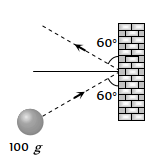
A mass of $100 \mathrm{~g}$ strikes the wall with speed $5 \mathrm{~m} / \mathrm{s}$ at an angle as shown in figure and it rebounds with the same speed. If the contact time is $2 \times 10^{-3} \mathrm{sec}$, what is the force applied on the mass by the wall
Image
We wish to see inside an atom. Assuming the atom to have a diameter of $100\  \mathrm{pm}$, this means that one must be able to resolved a width of say $10$ p.m. If an electron microscope is used, the minimum electron energy required is about
Lenz's law is expressed by the following formula (here $e=$ induced e.m.f., $\phi=$ magnetic flux in one turn and $N=$ number of turns)
The most commonly used material for making transistor is
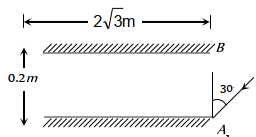
Two plane mirrors. $A$ and $B$ are aligned parallel to each other, as shown in the figure. A light ray is incident at an angle of $30^{\circ}$ at a point just inside one end of $A$. The plane of incidence coincides with the plane of the figure. The maximum number of times the ray undergoes reflections (including the first one) before it emerges out is
Image
A mass of $20 \mathrm{~kg}$ moving with a speed of $10 \mathrm{~m} / \mathrm{s}$ collides with another stationary mass of $5 \mathrm{~kg}$. As a result of the collision, the two masses stick together. The kinetic energy of the composite mass will be