MCQ
$Xe{F_6}$ on hydrolysis gives
  • $Xe{O_3}$
  • B
    $XeO$
  • C
    $Xe{O_2}$
  • D
    $Xe$

Answer

Correct option: A.
$Xe{O_3}$
a
(a)$Xe{F_6} + 3{H_2}O \to Xe{O_3} + 6HF$

Need a full question paper?

Generate a complete, print-ready paper with questions like this in minutes — across 16+ boards, with answer keys.

Start Generating Free

Similar questions

Dilute nitric acid on reaction with $Ag$ liberates
Which of the following orbitals has/have zero probability of finding the electron in $xy$ plane :
The number of different substitution products possible when bromine and ethane are allowed to react, is
Maximum number of different spectral lines which will be obtained when a sample of large number of $H$-atoms in $5^{th}$ excited state makes transition to ground state without emitting any line in Balmer series
In a $0.2\,\,molal$  aqueous solution of a weak acid $HX$  the degree of ionisation is $0.25.$  The freezing point of the solution will be nearest to ......... $^oC$. $(K_f = 1.86\,K \,\,kg\,mol^{-1})$
Consider the given data :
(a) $HCl ( g )+10 H _2 O ( l ) \rightarrow HCl .10 H _2 O$$\quad$$\Delta H =-69.01$ $kJ$ $mol ^{-1}$
(b) $HCl ( g )+40 H _2 O ( l ) \rightarrow HCl .40 H _2 O$$\quad$$\Delta H =-72.79$ $kJ$ $mol ^{-1}$
Choose the correct statement :
The equation

$k =\left(6.5 \times 10^{12} \,s ^{-1}\right) e ^{-26000 K / T }$

is followed for the decomposition of compound $A$. The activation energy for the reaction is $.....\,kJ$ $mol ^{-1}$. [nearest integer]

(Given: $R =8.314 \,J\, K ^{-1}\, mol ^{-1}$ )

Given below are two statements: one is labelled as Assertion $(A)$ and the other is labelled as Reason $(R)$

Assertion $(A)$ : Boron is unable to form $BF _{6}^{3-}$

Reason $(R)$ : Size of $B$ is very small.

In the light of the above statements, choose the correct answer from the options given below.
Zinc forms two important alloys, $(i)$  Brass and $ (ii) $ German silver. Metals present in them mainly are
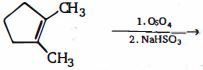
Product of the reaction is