MCQ
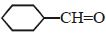
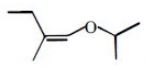
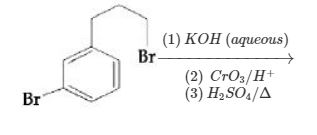
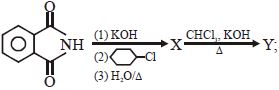
$Y$ is
  • A

  • B


  • D

Answer

Correct option: C.

c

Need a full question paper?

Generate a complete, print-ready paper with questions like this in minutes — across 16+ boards, with answer keys.

Start Generating Free

Similar questions

Nernst equation is, $E = {E^o} - \frac{{RT}}{{nF}}\,\ln Q$ . If $Q = {K_{eq}}$

then which one is not correct

The reaction of $50\%$ aq $KOH$ on an equimolar mixture of $4-$ methylbenzaldehyde and formaldehyde followed by acidification gives
In the given reaction

$\begin{array}{*{20}{c}}
  {C{H_3} - CH - C{H_2} - C{H_2} - CH - C{H_3}} \\ 
  {|\,\,\,\,\,\,\,\,\,\,\,\,\,\,\,\,\,\,\,\,\,\,\,\,\,\,\,\,\,\,\,\,\,\,\,\,\,\,\,\,\,\,\,\,\,\,\,\,\,\,\,\,\,|\,\,\,\,\,} \\ 
  {\,\,OTs\,\,\,\,\,\,\,\,\,\,\,\,\,\,\,\,\,\,\,\,\,\,\,\,\,\,\,\,\,\,\,\,\,\,\,\,\,\,\,\,\,\,\,\,OTs} 
\end{array}\xrightarrow[{(ii)\,KOH}]{{(i)\mathop {\,S}\limits^ \ominus  H\,(one\,\,equivalent)}}[X]$

$[X]$ will be :

Which of the following alcohol on treatment with $HCl$ give $3$ -chloro- $3$ - methyl cyclohexene as a product ?
1In electro-chemical corrosion of metals, the metal undergoing corrosion:
The total number of optically active compounds formed in the following reaction is

$[Figure]$ $\xrightarrow{{HBr}}$

In reaction of alcohols with alkali metal, acid etc. which of the following alcohol will react fastest
The major product of the following reaction is
The bad smelling substance formed by the action of alcoholic caustic potash on chloroform and aniline is
A solution containing $10 \mathrm{~g}$ of an electrolyte $\mathrm{AB}_2$ in $100 \mathrm{~g}$ of water boils at $100.52^{\circ} \mathrm{C}$. The degree of ionization of the electrolyte $(\alpha)$ is............ $\times 10^{-1}$.

(nearest integer)

[Given : Molar mass of $\mathrm{AB}_2=200 \mathrm{~g} \mathrm{~mol}^{-1} \cdot \mathrm{K}_{\mathrm{b}}$

(molal boiling point elevation const. of water)

$=0.52 \mathrm{~K} \mathrm{~kg} \mathrm{~mol}^{-1}$, boiling point of water $=100^{\circ} \mathrm{C}$;

$\mathrm{AB}_2$ ionises as $\left.\mathrm{AB}_2 \rightarrow \mathrm{A}^{2+}+2 \mathrm{~B}^{-}\right]$