MCQ
$y + {x^2} = \frac{{dy}}{{dx}}$ has the solution
  • $y + {x^2} + 2x + 2 = c{e^x}$
  • B
    $y + x + {x^2} + 2 = c{e^{2x}}$
  • C
    $y + x + 2{x^2} + 2 = c{e^x}$
  • D
    ${y^2} + x + {x^2} + 2 = c{e^x}$

Answer

Correct option: A.
$y + {x^2} + 2x + 2 = c{e^x}$
a
(a) $y + {x^2} = \frac{{dy}}{{dx}}$ ==> $\frac{{dy}}{{dx}} - y = {x^2}$

This is the linear differential equation in $y$, where $P = - 1,\,Q = {x^2}$

$I.F.$ $ = {e^{\int {P.dx} }}$$ = {e^{\int { - dx} }} = {e^{ - x}}$

Hence solution, $y.\,({\rm{I}}{\rm{.F}}). = \int {Q.({\rm{I}}{\rm{.F}})\,dx + c} $

==> $y{e^{ - x}} = - {x^2}{e^{ - x}} - 2x{e^{ - x}} - 2{e^{ - x}} + c$

==> $y + {x^2} + 2x + 2 = c{e^x}$.

Need a full question paper?

Generate a complete, print-ready paper with questions like this in minutes — across 16+ boards, with answer keys.

Start Generating Free

Similar questions

The equation of circle which passes through the point $(1,1)$ and intersect the given circles ${x^2} + {y^2} + 2x + 4y + 6 = 0$ and ${x^2} + {y^2} + 4x + 6y + 2 = 0$ orthogonally, is
Let $x$ and $y$ be two positive real numbers such that $x+y=1$. Then, the minimum value of $\frac{1}{x}+\frac{1}{y}$ is
If for real values of $x,\cos \theta = x + \frac{1}{x},$ then
Let $x=x(t)$ and $y=y(t)$ be solutions of the differential equations $\frac{ dx }{ dt }+ ax =0 \quad$ and $\frac{ dy }{ dt }+ by =0$ respectively, $a, b \in R$. Given that $x(0)=2 ; y(0)=1$ and $3 y(1)=2 x(1)$, the value of $t$, for which $x ( t )= y ( t )$, is :
If $a_1, a_2...,a_n$ an are positive real numbers whose product is a fixed number $c$ , then the minimum value of $a_1 + a_2 +.... + a_{n - 1} + 2a_n$ is
Let $[t]$ denote the greatest integer $\leq t$. The number of points where the function

$f(x)=[x]\left|x^{2}-1\right|+\sin \left(\frac{\pi}{[x]+3}\right)-[x+1], x \in(-2,2)$

is not continuous is ..... .
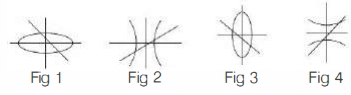
Suppose $a, b$ are real numbers such that $a b \neq 0$. Which of the following four figures represent the curve $(y-a x-b)\left(b x^2+a y^2-a b\right)=0$ ?
If $C$ is the centre of the ellipse $9x^2 + 16y^2$ = $144$ and $S$ is one focus. The ratio of $CS$ to major axis, is 
If $f(x) = \frac{{2x + 1}}{{3x - 2}}$, then $(fof)(2)$ is equal to
Given that $\int_0^\infty {\frac{{{x^2}\,dx}}{{({x^2} + {a^2})({x^2} + {b^2})({x^2} + {c^2})}} = \frac{\pi }{{2(a + b)(b + c)(c + a)}}} ,$ then the value of $\int_0^\infty {\frac{{{x^2}dx}}{{({x^2} + 4)({x^2} + 9)}}} $ is