MCQ
Young's experiment establishes that
  • Light consists of waves
  • B
    Light consists of particles
  • C
    Light consists of neither particles nor waves
  • D
    Light consists of both particles and waves

Answer

Correct option: A.
Light consists of waves
a
(a)

Need a full question paper?

Generate a complete, print-ready paper with questions like this in minutes — across 16+ boards, with answer keys.
Start Generating Free

Similar questions

A $40\, \mu F$ capacitor is connected to a $200\, V , 50 \,Hz$ ac supply. The rms value of the current in the circult is, nearly $.......A$
Let a total charge $2Q$ be distributed in a sphere of radius $R$, with the charge density given by $\rho(r) = kr$, where $r$ is the distance from the centre. Two charges $A$ and $B$, of $-Q$ each, are placed on diametrically opposite points, at equal distance, $a$, from the centre. If $A$ and $B$ do not experience any force, then
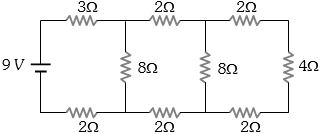
In the circuit shown in the figure, the current through
To get maximum current through a resistance of $2.5\,\Omega $, one can use $m$ rows of cells, each row having $n$ cells. The internal resistance of each cell is $0.5\,\Omega $. What are the values of $n$ and $m$ if the total number of cells is $45$ ?
If a drop of water is introduced between the glass plate and a convex lens in a Newton's ring system, the ring system:
A p-type semiconductor is:
The half-life of radium is about 1600 years. Of 100 g of radium existing now, 25 g will remain unchanged after
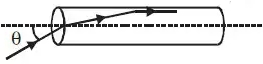
A transparent solid cylindrical rod has a refractive index of  $\frac{2}{{\sqrt 3 }}$ It is surrounded by air. A light ray is incident at the mid-point of one end of the rod as shown in the figure. The incident angle $\theta$ for which the light ray grazes along the wall of the rod is
Three capacitors each of $6\,\mu F$ are available. The minimum and maximum capacitances which may be obtained are
What is the de-Broglie wavelength of the $\alpha - $ particle accelerated through a potential difference $V$