MCQ
Young's modulus of a material has the same unit as:
  • A
    Stress.
  • B
    Energy.
  • C
    Compressibility.
  • D
    Pressure.

Answer

  1. Stress.
  1. Pressure.

Need a full question paper?

Generate a complete, print-ready paper with questions like this in minutes — across 16+ boards, with answer keys.

Start Generating Free

Similar questions

A person walks $25.0^{\circ}$ north of east for $3.18 \,km$. How far would she have to walk due north and then due east to arrive at the same location?
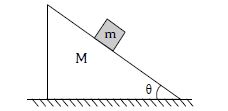
A block of mass $m$ slides down on a wedge of mass $M$ as shown in figure. Let $\vec a_1$ be the acceleration of the wedge and $\vec a_2$  the acceleration of block w.r.t. ground. $N_1$ is the normal reaction between block and wedge and $N_2$ the normal reaction between wedge and ground. Friction is absent everywhere. Select the incorrect alternative
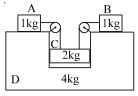
In the system shown in the figure there is no friction anywhere. The block $C$ goes down by $a$ distance $x_0 = 10\, cm$ with respect to wedge $D$ when system is released from rest. The velocity of $A$ with respect to $B$ will be $(g = 10\, m/s^2)$ ......... $m/s$
One mole of ideal monoatomic gas $(\gamma = 5/3)$ is mixed with one mole of diatomic gas $(\gamma = 7/5).$ What is $\gamma $ for the mixture$?$ $\gamma $ denotes the ratio of specific heat at constant pressure, to that at constant volume
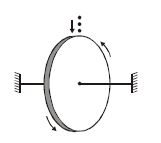
A uniform disc of mass $m_0$ rotates freely about a fixed horizontal axis passing through its centre. A thin cotton pad is fixed to its rim, which can absorb water. The mass of water dripping onto the pad per unit time is $\mu.$ After what time will the angular velocity of the disc get reduced to half its initial value ?
A tube of length $L$ is filled completely with an incompressible liquid of mass $M$ and closed at both the ends. The tube is then rotated in a horizontal plane about one of its ends with a uniform angular velocity $\omega $. The force exerted by the liquid at the other end is
The angular acceleration of a body, moving along the circumference of a circle, is :
A body falls freely from rest. It covers as much distance in the last second of its motion as covered in the first three seconds. The body has fallen for a time of........$s$
The period of oscillation of a simple pendulum is given by $T = 2\pi \sqrt {\frac{l}{g}} $ where $l$ is about $100 \,cm$ and is known to have $1\,mm$ accuracy. The period is about $2\,s$. The time of $100$ oscillations is measured by a stop watch of least count $0.1\, s$. The percentage error in $g$ is ......... $\%$
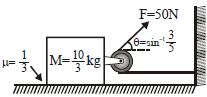
In the given figure the acceleration of $M$ is $(g = 10 \,ms^{-2})$