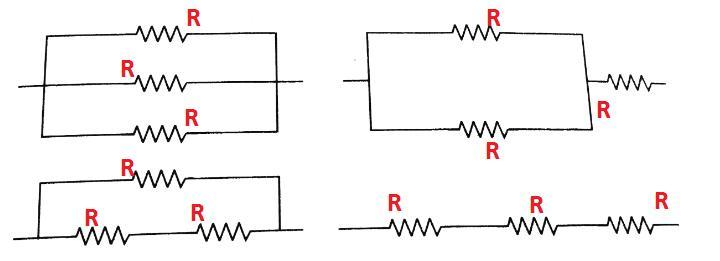
MCQ
Your are given three equal resistances. In how many combinations can they be arranged?
- AThree
- BFour
- CFive
- DTwo
Generate a complete, print-ready paper with questions like this in minutes — across 16+ boards, with answer keys.
A short bar magnet with its north pole facing north forms a neutral point at P in the horizontal plane. If the magnet is rotated by 90o in the horizontal plane, the net magnetic induction at P is (Horizontal component of earth’s magnetic field =  )
)
|
(a) 0 |
(b) 2 |
(c) |
(d) |
 and
and  are the electrical conductivities of Ge and Na respectively. If these substances are heated, then
|
(a) Both |
(b) |
|
(c) |
(d) Both |
A cell of internal resistance r is connected to an external resistance R. The current will be maximum in R, if
|
(a) R = r |
(b) R < r |
(c) R > r |
(d) R = r/2 |
A source emits light of wavelength 4700Å, 5400 Å and 6500 Å. The light passes through red glass before being tested by a spectrometer. Which wavelength is seen in the spectrum
|
(a) 6500 Å |
(b) 5400 Å |
(c) 4700 Å |
(d) All the above |
Value of potential at a point due to a point charge is
|
(a) Inversely proportional to square of the distance |
|
(b) Directly proportional to square of the distance |
|
(c) Inversely proportional to the distance |
|
(d) Directly proportional to the distance |
A milliammeter of range 10 mA has a coil of resistance 1 W. To use it as voltmeter of range 10 volt, the resistance that must be connected in series with it, will be
|
(a) 999 W |
(b) 99 W |
(c) 1000 W |
(d) None of these |
A square of side ‘a’ has charge Q at its centre and charge ‘q’ at one of the corners. The work required to be done in moving the charge ‘q’ from the corner to the diagonally opposite corner is
|
(a) Zero |
(b) |
(c) |
(d) |