MCQ
Your are given three equal resistances. In how many combinations can they be arranged?
- AThree
- BFour
- CFive
- DTwo
Generate a complete, print-ready paper with questions like this in minutes — across 16+ boards, with answer keys.
In Bohr model of hydrogen atom, the ratio of periods of revolution of an electron in n = 2 and n = 1 orbits is
|
(a) 2 : 1 |
(b) 4 : 1 |
(c) 8 : 1 |
(d) 16 : 1 |
In a transistor, a change of 8.0 mA in the emitter current produces a change of 7.8 mA in the collector current. What change in the base current is necessary to produce the same change in the collector current
| (a) 50 mA | (b) 100 mA | (c) 150 mA | (d) 200 mA |
A metal surface of work function 1.07 eV is irradiated with light of wavelength 332 nm. The retarding potential required to stop the escape of photo-electrons is
|
(a) 4.81 eV |
(b) 3.74 eV |
(c) 2.66 eV |
(d) 1.07 eV |
Two short magnets having magnetic moments in the ratio 27 : 8, when placed on opposite sides of a deflection magnetometer, produce no deflection. If the distance of the weaker magnet is 0.12 m from the centre of deflection magnetometer, the distance of the stronger magnet from the centre is
|
(a) 0.06 m |
(b) 0.08 m |
(c) 0.12 m |
(d) 0.18 m |
For a normal eye, the least distance of distinct vision is
|
(a) 0.25 m |
(b) 0.50 m |
(c) 25 m |
(d) Infinite |
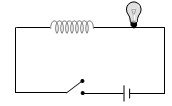
In the following circuit, the bulb will become suddenly bright if
|
(a) Contact is made or broken |
(b) Contact is made |
|
(c) Contact is broken |
(d) Won't become bright at all |
A photon of energy 3.4 eV is incident on a metal having work function 2 eV. The maximum K.E. of photo-electrons is equal to
|
(a) 1.4 eV |
(b) 1.7 eV |
(c) 5.4 eV |
(d) 6.8 eV |
The equivalent resistance of resistors connected in series is always
|
(a) Equal to the mean of component resistors |
|
(b) Less than the lowest of component resistors |
|
(c) In between the lowest and the highest of component resistors |
|
(d) Equal to sum of component resistors |