MCQ
Gauss's law is valid for:
- AAny closed surface.
- BOnly regular close surfaces.
- CAny open surface.
- DOnly irregular open surfaces.
Generate a complete, print-ready paper with questions like this in minutes — across 16+ boards, with answer keys.
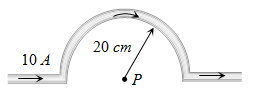
A current of 10A is passing through a long wire which has semicircular loop of the radius 20cm as shown in the figure. Magnetic field produced at the centre of the loop is
|
(a) 10 πμT |
(b) 5 πμT |
(c) 4 πμT |
(d) 2 πμT |
A circular coil of radius R carries an electric current. The magnetic field due to the coil at a point on the axis of the coil located at a distance r from the centre of the coil, such that r >> R, varies as
|
(a) |
(b) |
(c) |
(d) |
The dielectric strength of air at NTP is 3 then the maximum charge that can be given to a spherical conductor of radius 3 m is
|
(a) 3 |
(b) 3 |
(c) 3 |
(d) 3 |
The focal length of the objective lens of a compound microscope is
|
(a) Equal to the focal length of its eye piece |
|
(b) Less than the focal length of eye piece |
|
(c) Greater than the focal length of eye piece |
|
(d) Any of the above three |
The magnetic moment (μ) of a revolving electron around the nucleus varies with principal quantum number n as
|
(a) μ ∝ n |
(b) μ ∝ 1/n |
(c) μ ∝ |
(d) μ ∝ 1/ |
The current through choke coil increases form zero to 6A in 0.3 seconds and an induced e.m.f. of 30 V is produced. The inductance of the coil of choke is
|
(a) 5 H |
(b) 2.5 H |
(c) 1.5 H |
(d) 2 H |
200 MeV of energy may be obtained per fission of  . A reactor is generating 1000 kW of power. The rate of nuclear fission in the reactor is
|
(a) 1000 |
(b) 2 |
(c) 3.125 |
(d) 931 |
Which gates is represented by this figure

|
(a) NAND gate |
(b) AND gate |
(c) NOT gate |
(d) OR gate |
There are two charges +1 microcoulombs and +5 microcoulombs. The ratio of the forces acting on them will be
|
(a) 1 : 5 |
(b) 1 : 1 |
(c) 5 : 1 |
(d) 1 : 25 |


