Questions · Page 4 of 4

M.C.Q (1 Marks)

MCQ 1511 Mark
Which of the following trend is correct regarding reactivity of alkali metal oxides?
  • $ \mathrm{Li}_2 \mathrm{O}<\mathrm{Na}_2 \mathrm{O}<\mathrm{K}_2 \mathrm{O}<\mathrm{Rb}_2 \mathrm{O}<\mathrm{Cs}_2 \mathrm{O} $
  • B
    $ \mathrm{Li}_2 \mathrm{O}>\mathrm{Na}_2 \mathrm{O}>\mathrm{K}_2 \mathrm{O}>\mathrm{Rb}_2 \mathrm{O}>\mathrm{Cs}_2 \mathrm{O} $
  • C
    $ \mathrm{Li}_2 \mathrm{O}<\mathrm{Cs}_2 \mathrm{O}<\mathrm{K}_2 \mathrm{O}<\mathrm{Rb}_2 \mathrm{O}<\mathrm{Na}_2 \mathrm{O} $
  • D
    $ \mathrm{Na}_2 \mathrm{O}<\mathrm{K}_2 \mathrm{O}<\mathrm{Li}_2 \mathrm{O}<\mathrm{Rb}_2 \mathrm{O}<\mathrm{Cs}_2 \mathrm{O}$
Answer
Correct option: A.
$ \mathrm{Li}_2 \mathrm{O}<\mathrm{Na}_2 \mathrm{O}<\mathrm{K}_2 \mathrm{O}<\mathrm{Rb}_2 \mathrm{O}<\mathrm{Cs}_2 \mathrm{O} $
View full question & answer
MCQ 1521 Mark
What is minimum requirement $($in milligram$)$ of potassium per day for adult?
  • $4700$
  • B
    $14700$
  • C
    $20000$
  • D
    $30000$
Answer
Correct option: A.
$4700$
The minimum requirement of potassium per day for an adult is $4700\ mg.$
Potassium is very important in cellular biochemical reactions and energy metabolism.
Along with sodium, it regulates the water balance and the acid$-$base balance in the blood and tissues.
Thus, potassium is a very important mineral for our body.
View full question & answer
MCQ 1531 Mark
Which of the following represent the chemical name and formula of caustic soda?
  • A
    Sodium carbonate, $\mathrm{Na}_2 \mathrm{CO}_3 \cdot \mathrm{H}_2 \mathrm{O}$
  • B
    Sodium hydrogen carbonate, $\ce{NaHCO_3}$
  • C
    Sodium chloride, $\ce{NaCl}$
  • Sodium hydroxide, $\ce{NaOH}$
Answer
Correct option: D.
Sodium hydroxide, $\ce{NaOH}$
Sodium hydroxide $\ce{(NaOH)}$ is commonly known as caustic soda.
View full question & answer
MCQ 1541 Mark
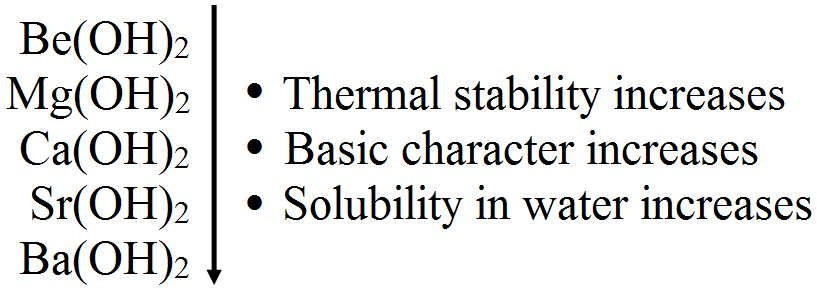
Which of the following properties of hydroxides of alkaline earth metals increases from top to bottom?
  • A
    Thermal stability.
  • B
    Basic character.
  • C
    Solubility in water.
  • All of these.
Answer
Correct option: D.
All of these.
On moving from top to bottom
View full question & answer
MCQ 1551 Mark
The order of decreasing ionisation enthalpy in alkali metals is:
  • A
    $\text{Na > Li > K > Rb}$
  • B
    $\text{Rb < Na < K < Li}$
  • $\text{Li > Na > K > Rb}$
  • D
    $\text{K < Li < Na < Rb}$
Answer
Correct option: C.
$\text{Li > Na > K > Rb}$
View full question & answer
MCQ 1561 Mark
Among the alkali metals $Cs$ is the most reactive because :
  • its incomplete shell is nearest to the nucleus
  • B
    it has a single electron in the valence shell
  • C
    it is the heaviest alkali metal
  • D
    its outermost electron is more loosely bound than the outermost electron ofthe other alkali metals
Answer
Correct option: A.
its incomplete shell is nearest to the nucleus
Among the alkali metals, $Cs$ is the most reactive because its outermost electron is more loosely bound than the outermost electron of the other alkali metals. This is due to the increase in distance between the outermost electron shell and the nucleus.
View full question & answer
MCQ 1571 Mark
Which of the following is/are characteristic$(s)$ of baking soda?
  • A
    It is used as an antiseptic for skin infections.
  • B
    It is used as fire extinguisher.
  • C
    It is used in preparation of cakes and bakery product.
  • All of the above are correct.
Answer
Correct option: D.
All of the above are correct.
View full question & answer
MCQ 1581 Mark
The formula of soda ash is :
  • $ \mathrm{NaHCO}_3 \cdot 10 \mathrm{H}_2 \mathrm{O} $
  • B
    $\mathrm{Na}_2 \mathrm{CO}_3 \cdot 2 \mathrm{H}_{2 \mathrm{O}} $
  • C
    $ \mathrm{Na}_2 \mathrm{CO}_3 \cdot \mathrm{H}_2 \mathrm{O} $
  • D
    $ \mathrm{Na}_2 \mathrm{CO}_3 $
Answer
Correct option: A.
$ \mathrm{NaHCO}_3 \cdot 10 \mathrm{H}_2 \mathrm{O} $
On heating washing soda, it loses its water of crystallization. Above $373 K$, it becomes completely anhydrous white powder called soda ash.
$\text{Na}_2\text{CO}_3.10\text{H}_2\text{O}\xrightarrow{>373\text{K}\ \ }\text{Na}_2\text{CO}_3\\\text{Washing soda}\ \ \ \ \ \ \ \ \ \ \ \ \ \ \ \ \ \ \text{Soda Ash}$
View full question & answer
MCQ 1591 Mark
Gastrointestinal symptoms are the most common side effects when we take excess of:
  • A
    potassium
  • sodium
  • C
    silicon
  • D
    aluminium
Answer
Correct option: B.
sodium
View full question & answer
MCQ 1601 Mark
What helps in digestion and nutrient transport in humans?
  • A
    Iron
  • Sodium
  • C
    Potassium
  • D
    None of the above
Answer
Correct option: B.
Sodium
Sodium allows your small intestine to absorb amino acids, glucose, and water from the foods you eat. It also affects kidney function, helping to retain nutrients in your body so they are not excreted in your urine.
View full question & answer
MCQ 1611 Mark
Which one of the following pairs of elements does not have diagonal relationship?
  • A
    $Li$ and $Mg$
  • B
    $Be$ and $Al$
  • C
    $B$ and $Si$
  • $Be$ and $Na$
Answer
Correct option: D.
$Be$ and $Na$
$Be$ and $Na$ does not have diagonal relationship.
A diagonal relationship is said to exist between certain pairs of diagonally adjacent elements in the second and third periods of the periodic table. These pairs $($lithium and magnesium, beryllium and aluminium, boron and silicon etc.$)$ exhibit similar properties.
View full question & answer
MCQ 1621 Mark
A substance which gives brick red flame and breaks down on heating to give oxygen and brown gas is :
  • A
    Magnesium nitrate.
  • B
    Calcium nitrate.
  • Barium nitrate.
  • D
    Strontium nitrate.
Answer
Correct option: C.
Barium nitrate.
$\text{Ca}(\text{NO}_3)_2\xrightarrow{\text{Heat}}\text{CaO}+\text{NO}_2+\text{O}_2.$
$Ca$ imparts brick red colour, $\text{NO}_2$ is a brown gas.
View full question & answer
MCQ 1631 Mark
The metallic lustre exhibited by sodium is explained by:
  • A
    Diffusion of sodium ions
  • Oscillation of loose electrons
  • C
    Excitation of free protons
  • D
    Existence of body centered cubic lattice
Answer
Correct option: B.
Oscillation of loose electrons
The metallic lustre exhibited by sodium is explained by oscillation of loose electron.
When light falls on the surface of sodium, the free electron starts oscillating at its mean position and get excited to higher levels. On returning back to lower levels, it emits light in all directions. Due to this sodium has a characteristic metallic lustre.
View full question & answer
MCQ 1641 Mark
Which of the following elements does not form hydride by direct heating with dihydrogen?
  • $Be$
  • B
    $Mg$
  • C
    $Sr$
  • D
    $Ba$
Answer
Correct option: A.
$Be$
Olny $\ce{BeH_2}$ cannot be prepared by direct combination with $\ce{H_2}$ in group $II$. It is prepared by reacting $\ce{BeCl_2}$ with $\ce{LiAlH_4}$.
$2\text{BeCl}_2+\text{LiAlH}_4\xrightarrow{\ \ \ \ \ \ \ }2\text{BeH}_2+\text{LiCl}+\text{AlCl}_3$
View full question & answer
MCQ 1651 Mark
Melting and boiling point of the alkaline earth metals are higher than the corresponding alkali metals due to:
  • Smaller size.
  • B
    Larger size.
  • C
    Same size.
  • D
    Moderate size.
Answer
Correct option: A.
Smaller size.
View full question & answer
MCQ 1661 Mark
Ripening of fruits can be carried out in the presence of :
  • A
    $\text{Na2SO4}$ ​
  • B
    $\text{NaCl}$
  • C
    $\text{CaCl2}$
  • $\text{CaC2}$​
Answer
Correct option: D.
$\text{CaC2}$​
Calcium carbide is also used for ripening fruit artificially in some countries. When calcium carbide comes in contact with moisture, it produces acetylene gas, which is quite similar in reaction to the natural ripening agent ethylene.
View full question & answer
MCQ 1671 Mark
Along the group and the period, atomic and ionic radii respectively:
  • Increases and decreases.
  • B
    Decreases and increases.
  • C
    Decreases and decreases.
  • D
    Both remain constant.
Answer
Correct option: A.
Increases and decreases.
View full question & answer
MCQ 1681 Mark
The violet flame shown by potassium in Bunsen flame is due to jumping of the electron from:
  • A
    $1s$ to $4p$
  • B
    $1s$ to $5p$
  • C
    $4p$ to $4s$
  • $5p$ to $4s$
Answer
Correct option: D.
$5p$ to $4s$
On heating an alkali earth metal or its salt, the electrons are excited easily to higher energy levels because of absorption of energy. When these electrons return to their ground states, they emit extra energy in form of radiations which fall in the visible region thereby imparting a characteristic colour to the flame.
The violet flame shown by potassiu in Bunsen flame is due to jumping of the electron from $5p$ to $4s$.
View full question & answer
MCQ 1691 Mark
Slaked lime on treatment with chlorine produces a compound $(X)$. What is the oxidation state of chlorine in the $'X' $?
  • A
    $+1$
  • B
    $-1$
  • Both $(a)$ and $(b)$
  • D
    $0$
Answer
Correct option: C.
Both $(a)$ and $(b)$
View full question & answer
MCQ 1701 Mark
Be shows diagonal relationship with :
  • A
    $B$
  • B
    $Mg$
  • $Al$
  • D
    $Ga$
Answer
Correct option: C.
$Al$
Be shows diagonal relationship with $Al$. They both have nearly equal electronegativity, small size and availability of only four orbitals in the valence shell. They both form amphoteric oxides and dimeric halides.
View full question & answer
MCQ 1711 Mark
Which of the following does not have rock salt type structure?
  • A
    $\text{Mgo}$
  • $\text{BeO}$
  • C
    $\text{BaO}$
  • D
    $\text{CaO}$
Answer
Correct option: B.
$\text{BeO}$
$\text{BeO}$ does not have rock salt type structure, while all the other oxides of the group have.
View full question & answer
MCQ 1731 Mark
The property of alkaline earth metals that increases with their atomic number is:
  • A
    Electronegativity.
  • Solubility of their hydroxides in water.
  • C
    Solubility of their sulfates in water.
  • D
    Ionesation erthalpy.
Answer
Correct option: B.
Solubility of their hydroxides in water.
It is because hydration energy dominates over lattice energy.
View full question & answer
MCQ 1741 Mark
Which of the following element$(s)$ form stable superoxide?
  • A
    $K$
  • B
    $Rb$
  • C
    $Cs$
  • All of these
Answer
Correct option: D.
All of these
The superoxide $\mathrm{O}_2^{-}$ion is stable only in the presence of large cation such as $\mathrm{K}^{+}, \mathrm{Rb}^{+}, \mathrm{CS}^{+}$.
View full question & answer
MCQ 1751 Mark
Which of the following is also a constitent of sodium pump?
  • $ \mathrm{K}^{+} $
  • B
    $ \mathrm{Fe}^{2+} $
  • C
    $ \mathrm{Ca}^{2+} $
  • D
    $ \mathrm{Mg}^{2+} $
Answer
Correct option: A.
$ \mathrm{K}^{+} $
View full question & answer
MCQ 1761 Mark
Gypsum on heating about $120^{\circ}C$ forms a compound. What is the mass of water of crystallisation in compound obtained?
  • A
    $18$
  • B
    $36$
  • C
    $42$
  • $9$
Answer
Correct option: D.
$9$
$\text{CaSO}_4+2\text{H}_2\text{O}\xrightarrow{120^\circ\text{C} \ \ \\ }\text{CaSO}_4\cdot\frac{1}{2}\text{H}_2\text{O}\\ \ \ \ \ \ \text{Gypsum}\ \ \ \ \ \ \ \ \ \ \ \ \ \ \ \ \ \ \ \ \ \ \text{Plaster of paris(POP)}$
Water of crystallisation in POP $=\frac{1}{2}\text{H}_2\text{O}$
Mass of $\frac{1}{2}\text{H}_2\text{O}$
$=\frac{18}{2}=9$
View full question & answer
MCQ 1771 Mark
Due to diagonal relationship between $Be$ and $Al$:
  • A
    Both are metals
  • B
    Both are metalloids
  • Both form polymeric covalent hydrides
  • D
    None of these
Answer
Correct option: C.
Both form polymeric covalent hydrides
Due to diagonal relationship between $Be$ and $Al,$ both form polymeric covalent hydrides.
View full question & answer
MCQ 1781 Mark
$\ce{K2​CS3}$​ can be called :
  • A
    Potassium Sulphocyanide
  • B
    Potassium Thiocarbide
  • Potassium Thiocarbonate
  • D
    Potassium Thiocyanate
Answer
Correct option: C.
Potassium Thiocarbonate
$\ce{K2​CS3}$​ can be called Potassium Thiocarbonate.
View full question & answer
MCQ 1791 Mark
Estimation of calcium and magnesium is done by:
  • $\text{EDTA.}$
  • B
    oxalate.
  • C
    phosphate.
  • D
    None of these.
Answer
Correct option: A.
$\text{EDTA.}$
Estimation of calcium and magnesium is done by $\text{EDTA}$ in complexometric titration.
Hexadentate ligand $\text{EDTA} ($ethylene diammine tetra acetate$)$ forms metal chelates with calcium and magnesium
View full question & answer
MCQ 1801 Mark
Which of the following order is correct regarding electropositive character of alkaline earth metals?
  • $\text{Be < Mg > Ca < Sr < Ra}$
  • B
    $\text{Be > Mg > Ca > Sr > Ba}$
  • C
    $\text{Be < Mg < Ca < Sr < Ba}$
  • D
    None of the above
Answer
Correct option: A.
$\text{Be < Mg > Ca < Sr < Ra}$
View full question & answer
MCQ 1811 Mark
Passivity is exhibited by : $\text{(A)Be, (B)Mg, (C)Al, (D)B}$:
  • A
    $A, B$
  • B
    $B, C$
  • $A, C$
  • D
    $B, D$
Answer
Correct option: C.
$A, C$
Action of oxidizing agents such as conc. nitric acid forms a layer of an oxide on the surface of $Be$ and $Al$. Hence these metals become passive and do not react.
View full question & answer
MCQ 1821 Mark
Dead burnt plaster is:
  • $\text{CaSO}_4$
  • B
    $\text{CaSO}_4\frac{1}{2}\text{H}_2\text{O}$
  • C
    $\text{CaSO}_4\cdot\text{H}_2\text{O}$
  • D
    $\text{CaSO}_4\cdot2\text{H}_2\text{O}$
Answer
Correct option: A.
$\text{CaSO}_4$
View full question & answer
MCQ 1831 Mark
Which one of the following alkaline earth metal sulphates has its hydration enthalpy greater than its lattice enthalpy?
  • A
    $\ce{CaSO4}$
  • $\ce{BeSO_4}$
  • C
    $\ce{BeSO_4}$
  • D
    $\ce{SrSO_4}$
Answer
Correct option: B.
$\ce{BeSO_4}$
As we move down the group, size of metal increases. Be has lower size while $\mathrm{SO}^{2-} 4$ has bigger size, that's why $\ce{BeSO_4}$ breaks easily and lattice energy becomes smaller but due to lower size of Be, water molecules are gathered around and hence, hydration energy increases.
View full question & answer
MCQ 1841 Mark
By adding gypsum to cement:
  • Setting time of cement becomes less.
  • B
    Setting time of cement increases.
  • C
    Colour of cement becomes light.
  • D
    Shining surface is obtained.
Answer
Correct option: A.
Setting time of cement becomes less.
Raw materials for cement are limestone, clay and gypsum. Cement is a dirty greyish heavy powder containing calcium aluminates and silicates. Gypsum $(\mathrm{CaSO}_4-2 \mathrm{H}_2 \mathrm{O})$ is added to the components to increase the setting time of cement so that it gets sufficiently hardened. Setting of cement is an exothermic process and involves hydration of calcium aluminates and , silicates.
View full question & answer
MCQ 1851 Mark
On heating which of the following reliare $\ce{CO_2}$ easily
  • $\mathrm{MgCO}_3$
  • B
    $\mathrm{CaCO}_3$
  • C
    $\mathrm{K}_2 \mathrm{CO}_3$
  • D
    $\mathrm{Na}_2 \mathrm{CO}_3$
Answer
Correct option: A.
$\mathrm{MgCO}_3$
Because it is more covalent and least ionic among these compounds.
View full question & answer
MCQ 1861 Mark
$Be$ and $Al$ have following resemblance due to the diagonal relationship:
  • A
    Have nearly equal electronegativity
  • B
    Form amphoteric oxides
  • C
    Both form dimeric halides
  • All of the above
Answer
Correct option: D.
All of the above
$Be$ and $Al$ have resemblance due to the diagonal relationship, they have nearly equal electronegativity, small size and availability of only four orbitals in the valence shell. They both form amphoteric oxides and dimeric halides.
View full question & answer
MCQ 1871 Mark
$Be$ and $Al$ show diagonal relationship hence, both have:
  • A
    Same degree of electronegativity.
  • B
    Amphoteric nature of oxides.
  • C
    Approximately same charge$/$ radius ratio.
  • All the properties above.
Answer
Correct option: D.
All the properties above.
Metal hydroxides with a highly $-$ charged central metal atom forms amphoteric. In addition to aluminum, metals such as zinc, tin, lead, and beryllium also forms amphoteric oxides.
The two elements have same electronegativity and their charge$/$ radius ratios.
View full question & answer
MCQ 1881 Mark
The most correct reason for the colour of the flame due to alkali metal ions is:
  • A
    Presence of single valence electron.
  • B
    Excitation of valence electron.
  • Emission of radiation in visible region when electron come back to the ground state energy level.
  • D
    None of the above.
Answer
Correct option: C.
Emission of radiation in visible region when electron come back to the ground state energy level.
View full question & answer
MCQ 1891 Mark
Shine at freshly cut sodium is because of :
  • due to oscillations of free electrons.
  • B
    due to weak metallic bonding.
  • C
    due to absorption of light in crystal lattice.
  • D
    due to the presence offree valency at the surface.
Answer
Correct option: A.
due to oscillations of free electrons.
Freshly cut sodium metal has a bright, shiny surface due to the oscillations of free electrons that quickly becomes a dull grey as it reacts with oxygen in the air around it. Over time, the metal becomes covered with a white crust of sodium oxide that prevents further reaction of the metal and oxygen.
View full question & answer
MCQ 1901 Mark
Amphoteric hydroxides react with both alkalies and acids. ‘Which of the following group $2$ metal hydroxides is soluble in sodium hydroxide?
  • $\ce{Be(OH)_2}$
  • B
    $\ce{Mg(OH)_2}$
  • C
    $\ce{Ca(OH)_2}$
  • D
    $\ce{Ba(OH)_2}$
Answer
Correct option: A.
$\ce{Be(OH)_2}$
$\ce{Be(OH)_2}$ reacts with $\ce{NaOH}$ to give beryllate ion, becoming soluble in it.
$\text{Be(OH)}_2+2\text{OH}^-\xrightarrow{}\text{[Be(OH)}_4]^2$
View full question & answer
MCQ 1911 Mark
When sodium is dissolved in liquid ammonia, a solution of deep blue colour is obtained. The colour of the solution is due to:
  • Ammoniated electron.
  • B
    Sodium ion.
  • C
    Sodium amide.
  • D
    Ammoniated sodium ion.
Answer
Correct option: A.
Ammoniated electron.
Alkali metals are dissolved in liquid ammonia and givre deep blue highly conducting liquid. The colour of the solution is due to ammoniated electrons which exite to high energy level by absorbing red wavelength and transmitted blue colour.
$\text{Na}+(\text{x + y})\text{NH}_3\xrightarrow{}[\text{Na}(\text{NH}_3)_\text{x}]^+\text{e}(\text{NH}_3)^-_\text{y}\ (\text{Ammoniated electrons})$
View full question & answer