Question 14 Marks
Read the following and answer any four questions from (i) to (v) given below:
The DNA, which is transferred from one organism into another by joining it with the vehicle DNA is called passenger or foreign DNA. Generally three types of passenger DNAs are used. These are complementary DNA (cDNA), synthetic DNA (sDNA) and random DNA. Complementary DNA (cDNA) is synthesized on RNA template (usually mRNA) with the help of reverse transcriptase. Synthetic DNA (sDNA) is synthesized on DNA template or without a template. Random DNA are small fragments fanned by breaking a chromosome of an organism in the presence of restriction endonucleases.
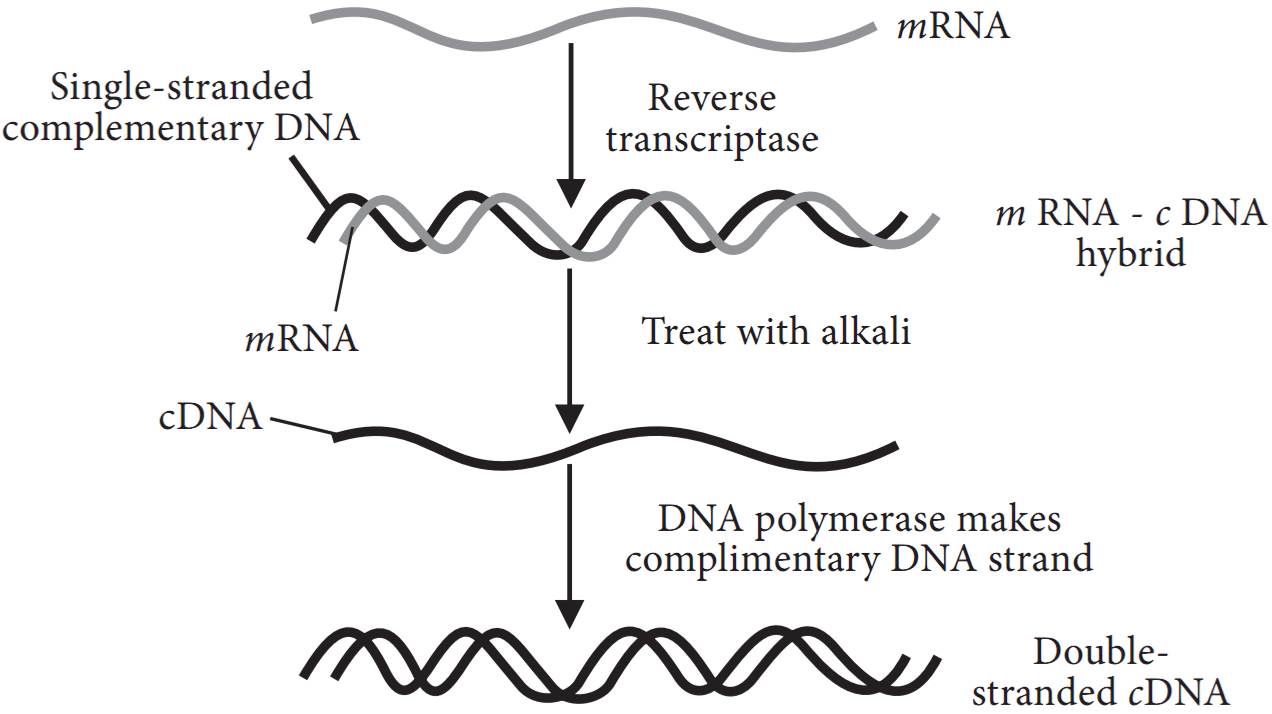
The DNA, which is transferred from one organism into another by joining it with the vehicle DNA is called passenger or foreign DNA. Generally three types of passenger DNAs are used. These are complementary DNA (cDNA), synthetic DNA (sDNA) and random DNA. Complementary DNA (cDNA) is synthesized on RNA template (usually mRNA) with the help of reverse transcriptase. Synthetic DNA (sDNA) is synthesized on DNA template or without a template. Random DNA are small fragments fanned by breaking a chromosome of an organism in the presence of restriction endonucleases.
- Reverse transcriptase enzyme was discovered by:
- Temin and Baltimore.
- Cohen and Boyer.
- Arber and Nathan.
- Paul Berg.
- During cDNA formation, what would happen if DNA formed by reverse transcriptase is not treated with the alkali?
- cDNA will not be digested.
- mRNA will not be digested.
- Hydrogen bonds will not form between base pairs.
- rnRNA will not be formed.
- Enzyme that helps in the formation of double stranded cDNA is:
- DNA synthetase
- Ligase
- DNA polymerase
- Helicase.
- DNA polymerase can be obtained form:
- Retrovirus.
- Agrobacteriurn.
- Tobacco mosaic virus.
- Thermus aquaticus.
- DNA synthesised without a template is referred to as:
- Complementary DNA.
- Random DNA.
- Synthetic DNA.
- Z-DNA..
Answer
View full question & answer→- (a) Temin and Baltimore.
- (b) mRNA will not be digested.
The cDNA formation involves the alkaline denaturation of the mRNA-cDNA hybrid. The double stranded DNA molecule formed after the activity of reversetranscriptase is treated with alkali to digest mRNA.
In a bioreactor, all operations must be carried under sterile conditions to avoid contamination.
- (c) DNA polymerase
Explanation:
A cDNA strand is formed on the separated single stranded DNA template with the help of DNA polymerase enzyme.
- (d) Thermus aquaticus.
- (c) Synthetic DNA.