Question types

Aldehydes, Ketones, and Carboxylic Acids question types

355 questions across 8 question groups — pick any mix to generate a Chemistry paper with step-by-step answer keys.

355
Questions
8
Question groups
5
Question types
Sample Questions

Aldehydes, Ketones, and Carboxylic Acids questions

One sample from each question group in this chapter. Select any group above to see the full set with answer keys.

Q 2M.C.Q [1M]1 Mark
What is the correct IUPAC name of the given compound?
$\ \ \ \ \ \ \ \ \ \ \ \text{CH}_3\\\ \ \ \ \ \ \ \ \ \ \ \ \ {\text{|}}\\\text{CH}_3-\text{C}-\text{CH}_2-\text{CH}_3\\\ \ \ \ \ \ \ \ \ \ \ \ \ {\text{|}}\\\ \ \ \ \ \ \ \text{COOH}$
  • A
    2, 2-Dimethylbutanoic acid.
  • B
    2-Carboxyl-2-methylbutane.
  • C
    2-Ethyl-2-methylpropanoic acid.
  • D
    3-Methylbutane carboxylic acid.
View full solution
Q 4M.C.Q [1M]1 Mark
Which of the following compound obtained by Clemmensen reaction of Ketones -
  • A
    Alcohol
  • Alkane
  • C
    Carboxylic acid
  • D
    Alkyne

Answer: B.

View full solution
In these questions, a statement of assertion followed by a statement of reason is given. Choose the correct answer out of the following choices.
  1. Assertion and reason both are correct statements and reason is correct explanation for assertion.
  2. Assertion and reason both are correct statements but reason is not correct explanation for assertion.
  3. Assertion is correct statement but reason is wrong statement.
  4. Assertion is wrong statement but reason is correct statement.
Assertion: Formic acid is a stronger acid than benzoic acid.
Reason: pKa of formic acid is lower than that ofbenzoic acid.
View full solution
In these questions, a statement of assertion followed by a statement of reason is given. Choose the correct answer out of the following choices.
  1. Assertion and reason both are correct statements and reason is correct explanation for assertion.
  2. Assertion and reason both are correct statements but reason is not correct explanation for assertion.
  3. Assertion is correct statement but reason is wrong statement.
  4. Assertion is wrong statement but reason is correct statement.
Assertion: Fluoroacetic acid is stronger than chloroacetic acid.
Reason: Carboxylic acids are weak acids and turn blue litmus red.
View full solution
View full solution
In these questions, a statement of assertion followed by a statement of reason is given. Choose the correct answer out of the following choices.
  1. Assertion and reason both are correct statements and reason is correct explanation for assertion.
  2. Assertion and reason both are correct statements but reason is not correct explanation for assertion.
  3. Assertion is correct statement but reason is wrong statement.
  4. Assertion is wrong statement but reason is correct statement.
Assertion: Benzaldehyde undergoes aldol condensation
Reason: Aldehydes having $\alpha$-hydrogen atom undergo aldol condensation.
View full solution
Note: In the following questions a statement of assertion followed by a statement of reason is given. Choose the correct answer out of the following choices.
  1. Assertion and reason both are correct and reason is correct explanation of assertion.
  2. Assertion and reason both are wrong statements.
  3. Assertion is correct statement but reason is wrong statement.
  4. Assertion is wrong statement but reason is correct statement.
  5. Assertion and reason both are correct statements but reasson is not correct explanation of assertion.
Assertion: Formaldehyde is a planar molecule.
Reason: It contains sp2 hybridised carbon atom.
View full solution
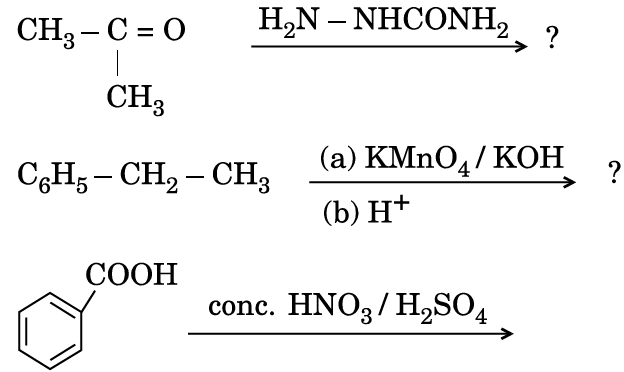
Predict the product of the following reaction:

$\ \ \ \ \ \ \ \ \ \ \ \ \ \ \ \ \ \ \ \ \ \ \ \ \ \ \ \ \ \ \ \ \ \ \ \ \ \ \ \ \ \ \ \ \ \ \ \ \ \ \ \ \ \ \ \ \ \ \text{O}\\\ \ \ \ \ \ \ \ \ \ \ \ \ \ \ \ \ \ \ \ \ \ \ \ \ \ \ \ \ \ \ \ \ \ \ \ \ \ \ \ \ \ \ \ \ \ \ \ \ \ \ \ \ \ \ \ \ \ \ ||\\\text{R}-\text{CH}=\text{CH}-\text{CHO }+\text{ NH}_2-\text{C}-\text{NH}-\text{NH}_2\xrightarrow{\ \ \text{H}^+\ }$

View full solution
An organic compound with the molecular formula C9H10O forms 2,4-DNP derivative, reduces Tollens’ reagent and undergoes Cannizzaro reaction. On vigorous oxidation, it gives 1, 2-benzenedicarboxylic acid. Identify the compound.
View full solution
An organic compound (A) (molecular formula C8H16O2) was hydrolysed with dilute sulphuric acid to give a carboxylic acid (B) and an alcohol (C). Oxidation of (C) with chromic acid produced (B). (C) on dehydration gives but-1-ene. Write equations for the reactions involved.
View full solution
An organic compound contains 69.77% carbon, 11.63% hydrogen and rest oxygen. The molecular mass of the compound is 86. It does not reduce Tollen's reagent but forms an addition compound with sodium hydrogensulphite and give positive iodoform test. On vigorous oxidation it gives ethanoic and propanoic acid. Write the possible structure of the compound.
View full solution
Q 223 Marks Question3 Marks
What happens when
  1. Ethyl chloride is treated with NaI in the presence of acetone,
  2. Chlorobenzene is treated with Na metal in the presence of dry ether,
  3. Methyl chloride is treated with KNO2?
Write chemical equations in support of your answer.
View full solution
Q 243 Marks Question3 Marks
Write the structures of compounds A, B and C in the following reactions:
  1. $\text{CH}_3-\text{COOH}\xrightarrow{\text{ }\text{ }\text{ }\text{NH}_3/\triangle\text{ }\text{ }\text{ }}\text{A}\xrightarrow{\text{ }\text{ }\text{ }\text{Br}_2/\text{KOH(aq)}\text{ }\text{ }\text{ }}\text{B}\xrightarrow{\text{ }\text{ }\text{ }\text{CHCL}_3+\text{alc.KOH}\text{ }\text{ }\text{ }}\text{C}$
  1. $\text{C}_6\text{H}_5\text{N}_2^+\text{BF}_4^-\xrightarrow[\triangle]{\text{NaNO}_2/\text{Cu}\text{ }\text{ }}\text{A}\xrightarrow{\text{ }\text{ }\text{ }\text{Fe}/\text{HCL}\text{ }\text{ }\text{ }}\text{B}\xrightarrow{\text{ }\text{ }\text{ }\text{CH}_3\text{COCL}/pyridine\text{ }\text{ }\text{ }}\text{C}$
View full solution
Q 253 Marks Question3 Marks
An organic compound A has the molecular formula C8H16O8. It gets hydrolysed with dilute sulphuric acid and gives a carboxylic acid B and an alcohol C. Oxidation of C with chromic acid also produced B. C on dehydration reaction gives but-1-ene. Write equations for the reactions involved.
View full solution
Which of the following compounds would undergo aldol condensation, which the Cannizzaro reaction and which neither? Write the structures of the expected products of aldol condensation and Cannizzaro reaction.
  1. Methanal
  2. 2-Methylpentanal
  3. Benzaldehyde
  4. Benzophenone
  5. Cyclohexanone
  6. 1-Phenylpropanone
  7. Phenylacetaldehyde
  8. Butan-1-ol
  9. 2,2-Dimethylbutanal.
View full solution
Read the passage given below and answer the following questions:

Fehling's reagent: Fehling's reagent is a mixture of two solutions. Fehllng's solution A is aqueous copper sulphate solution. Fehling's solution Bis alkaline sodium potassium tartarate (Rochelle salt).

$\ \ \ \ \ \ \ \ \ \ \ \ \ \ \ \ \ \ \ \ \text{CH(OH)COONa}\\\text{CuSo}_{4\text{(aq)}}+|\\\ \ \ \ \ \ \ \ \ \ \ \ \ \ \ \ \ \ \ \ \text{CH(OH)COOK}$

It is a mild oxidising agent. It is weaker than Tollens' reagent. It oxidises only aliphatic aldehydes to carboxylate ions and itself gets reduced to reddish brown precipitate of cuprous oxide. Aromatic aldehydes do not respond to Fehling's test. This reaction is used for the test of aliphatic aldehydes known as Fehling's reagent test.

In these questions (Q. No. l-iv), a statement of assertion followed by a statement ofreason is given. Choose the correct answer out of the following choices.

  1. Assertion and reason both are correct statements and reason is correct explanation for assertion.
  2. Assertion and reason both are correct statements but reason is not correct explanation for assertion.
  3. Assertion is correct statement but reason is wrong statement.
  4. Assertion is wrong statement but reason is correct statement.
  1. Assertion: Fehling's solution can be used to distinguish between acetaldehyde and acetone.

Reason: Fehling's reagent is a mixture of two solutions.

  1. Assertion: Aromatic aldehydes can be distinguished from aliphatic aldehydes by Fehling's solution.

Reason: Aromatic aldehydes reduce Fehling's solution, but aliphatic aldehydes do not.

  1. Assertion: Fehling's solution oxidises acetaldehyde to acetic acid but not benzaldehyde to benzoic acid.

Reason: The C-H bond of -CHO group in benzaldehyde is stronger than in acetaldehyde.

  1. Assertion: CH3CHO and C6H5CH2CHO cannot be distinguished chemically by Fehling's solution.

Reason: CH3CHO and C6H5CH2CHO cannot be distinguished chemically by Fehling's solution.

  1. Assertion: Formaldehyde, when heated with Fehling's reagent produces a reddish brown ppt, of Cu.

Reason: Fehling's reagent oxidises fonnaldehyde to formate ion.
View full solution
Read the passage given below and answer the following questions:

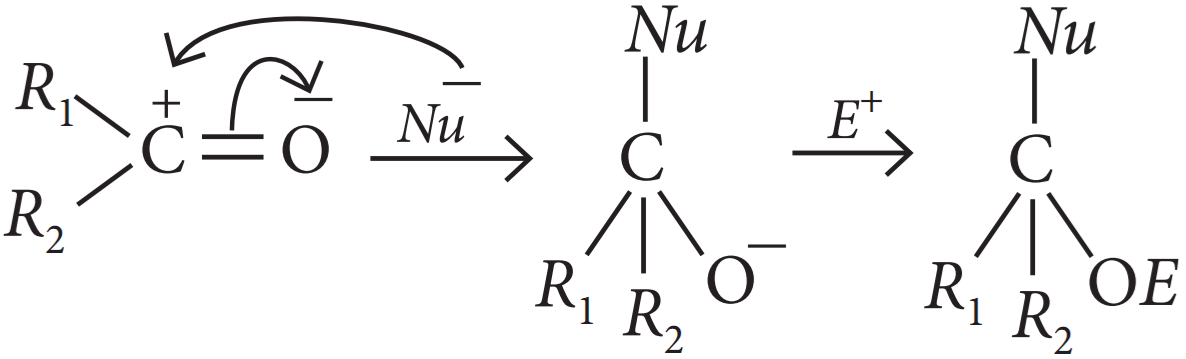
Aldehydes and ketones undergo nucleophilic addition reactions.

Carbonyl carbon is electron deficient hence acts as an electrophi le. Nucleophile attacks on the electrophili c carbon atom of the carbonyl group from a direction perpendicular to the plane of the molecule.
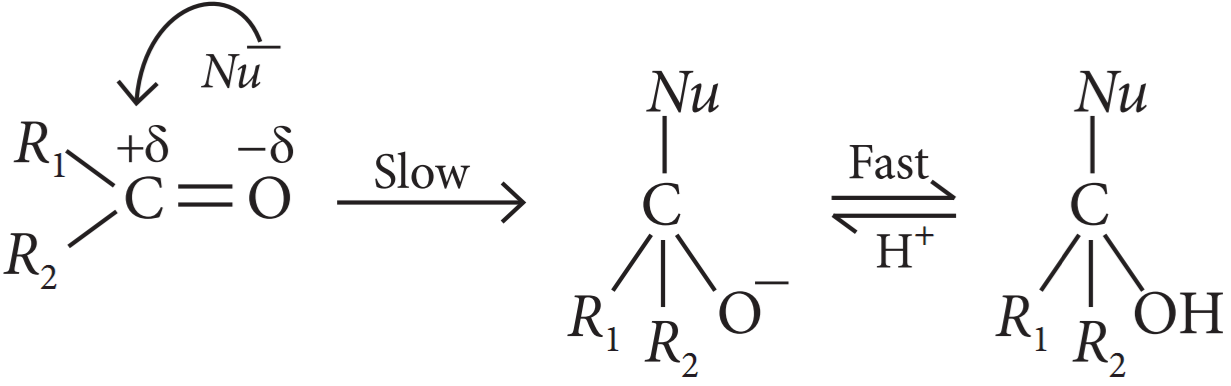
ln this process, hybridisation of carbon atom changes from sp2 to sp3 and a tetrahedral alkoxide ion is formed as intermediate. This intermediate captures proton from the reaction medium to give the neutral product. Aldehydes are generally more reactive than ketones in nucleophilic addition reactions.

In these questions (Q. No. l-iv), a statement of assertion followed by a statement ofreason is given. Choose the correct answer out of the following choices.

  1. Assertion and reason both are correct statements and reason is correct explanation for assertion.
  2. Assertion and reason both are correct statements but reason is not correct explanation for assertion.
  3. Assertion is correct statement but reason is wrong statement.
  4. Assertion is wrong statement but reason is correct statement.
  1. Assertion: Benzaldehyde is more reactive than ethanal towards nucleophitic attack.

Reason: The overall effect of -I and +R effect of phenyl group decreases the electron density on the carbon atom of >c=o group in benzaldehyde.

  1. Assertion: (CH3)3CCOC(CH3)3 and acetone can be distinguished by the reaction with NaHSO3.

Reason: HSO3 is the nucleophile in bisulphite addition.

  1. Assertion: Ease of nucleophilic addition of the compounds (I). CH3CHO(II) and CH3COCH3(III) is I > II > III.

Reason: Aldehydes and ketones undergo nucleophilic addition reactions.

  1. Assertion: The formation of cyanohydrin from an aldehyde or ketone occurs very slowly with pure HCN. The is reaction is catalysed by a base.

Reason: Base generates CN- ion which is a stronger nucleophile.
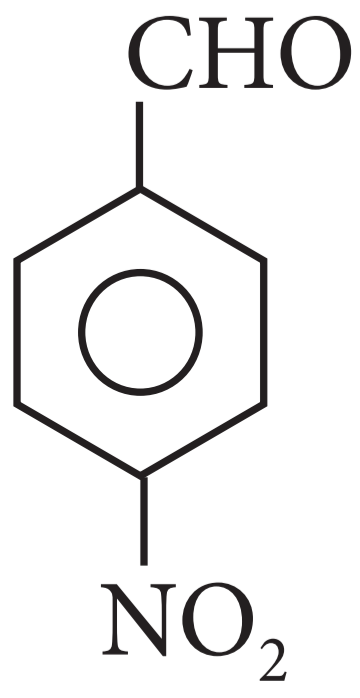
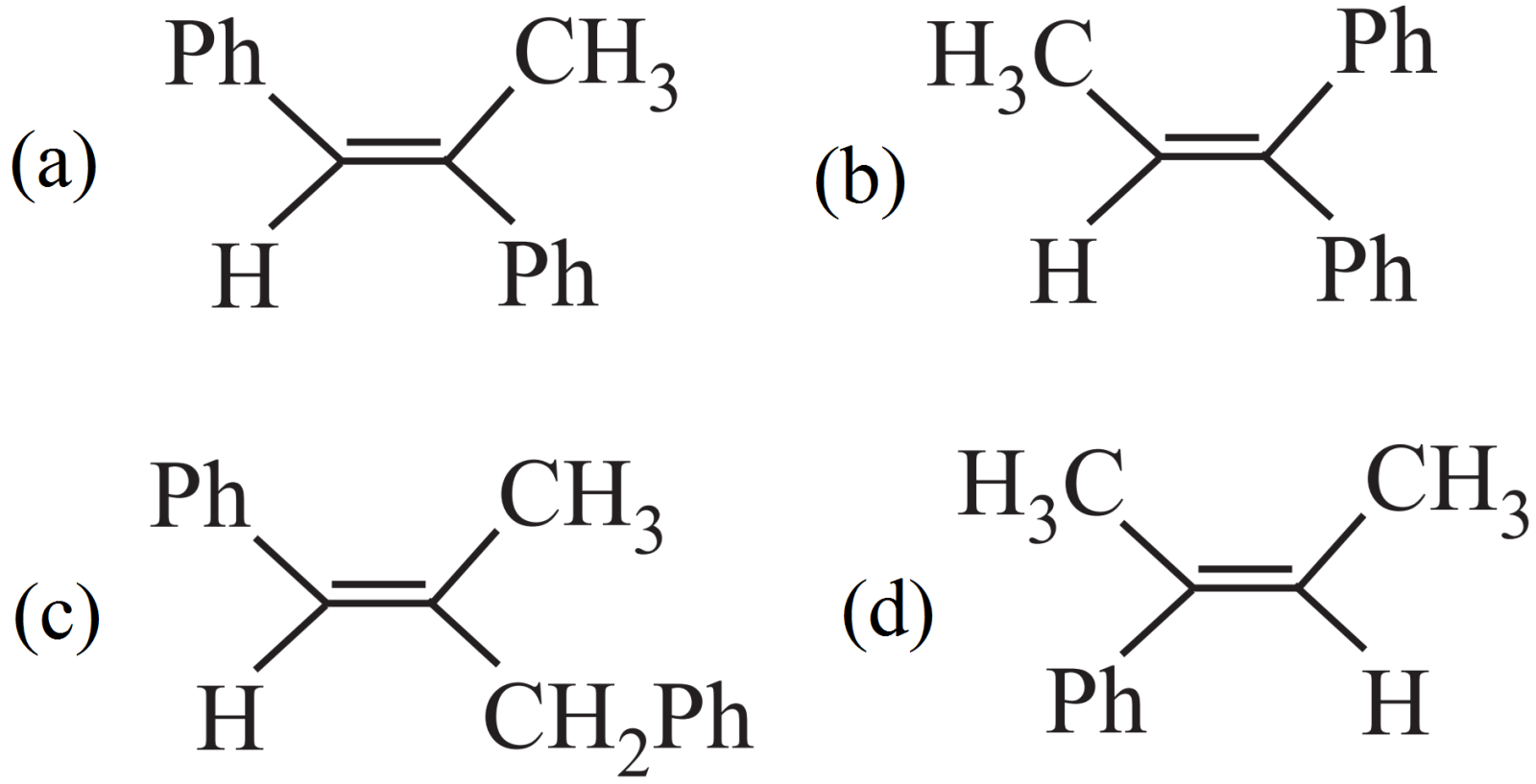
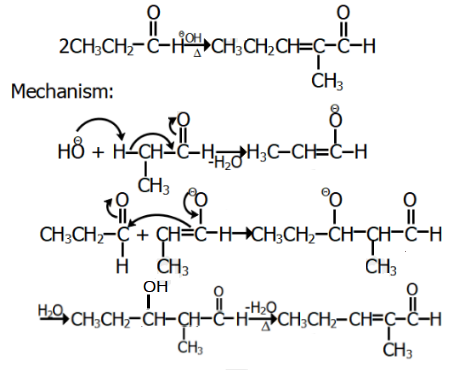
  1. Assertion:  is more reactive towards nucleophilic addition reaction than .
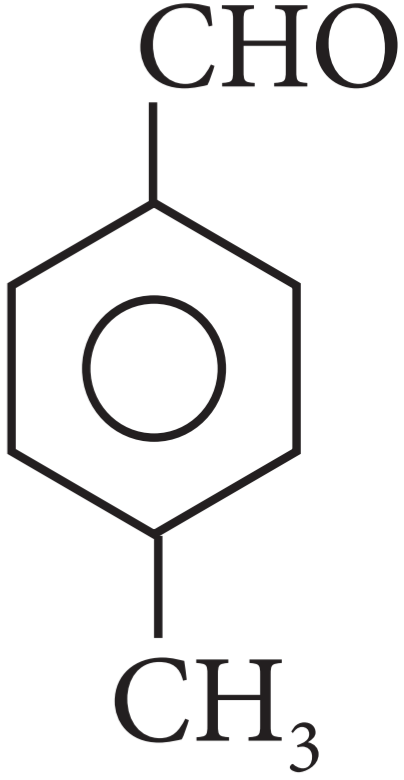
Reason: Reactivity of carbonyl group is due to electrophilic nature of carbonyl carbon.
View full solution

Read the passage given below and answer the following questions:

(A), (B) and (C) are three non-cyclic functional isomers of a carbonyl compound with molecular formula C4H8O. Isomers (A) and (C) give positive Tollen's test whereas isomer (B) does not give Tollen's test but gives positive iodoform test. Isomers (A) and (B) on reduction with $\frac{\text{Zn(Hg)}}{\text{conc.}}.$ HCl give the same product (D).

The following questions are multiple choice questions. Choose the most appropriate answer:

  1. Compound A is:
  1. $\text{CH}_3-\text{CH}-\text{CHO}\\\ \ \ \ \ \ \ \ \ \ \ \ \ |\\ \ \ \ \ \ \ \ \ \ \ \ \ \text{CH}_3$

  2. $\text{CH}_3\text{CH}_2\text{CH}_2\text{CHO}$

  3. $\ \ \ \ \ \ \ \ \ \ \ \ \text{O}\\\ \ \ \ \ \ \ \ \ \ \ \ \ ||\\\text{CH}_3-\text{C}-\text{CH}_2-\text{CH}_3$

  4. None of these.
  1. Compound (C) is:
  1. Iso-butyraldehyde
  2. Butyraldehyde
  3. Crotonaldehyde
  4. Acrolein
  1. Compound (B) can be obtained by:
  1. $\text{CH}_3-\text{C}\equiv\text{C}-\text{CH}_2-\text{CH}_3\xrightarrow[333\text{K}]{\text{dil.H}_2\text{SO}_4+\text{HgSO}_4}$

  2. $(\text{CH}_3\text{CH}_2\text{COO})_2\text{Ca}\xrightarrow{\text{Dry distill}}$

  3. $\text{CH}_3-\text{C}\equiv\text{C}-\text{CH}_3\xrightarrow[\frac{\text{H}_2\text{O}_2}{\text{NaOH}}]{\frac{\text{B}_2\text{H}_6}{\text{THF}}}$

  4. $\text{CH}_3-\text{CH}=\text{CH}-\text{CH}_3\xrightarrow[\frac{\text{ZN}}{\text{H}_2\text{O}}]{\text{O}_3}$

  1. Out of (A), (B) and ( C) isomers, which one is least reactive towards addition of HCN?
  1. A
  2. B
  3. C
  4. All are equally reactive.
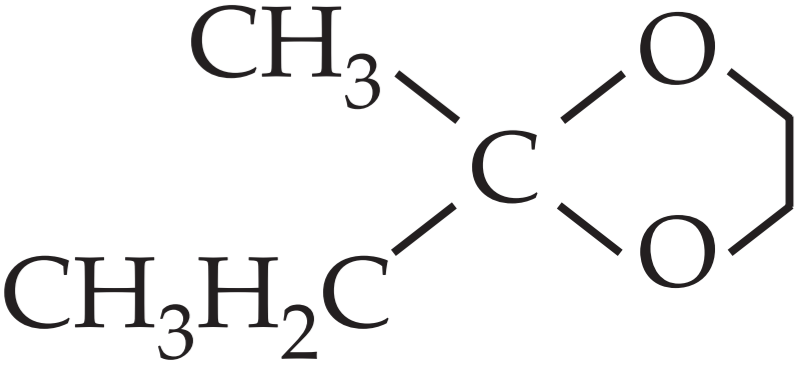
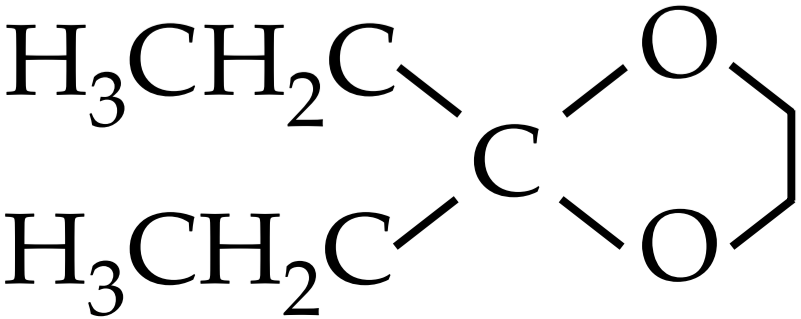
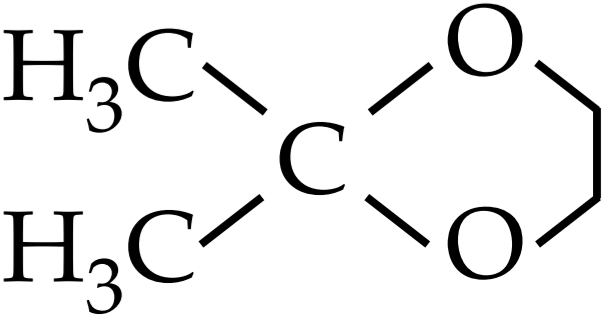
  1. What will be the product when (B) reacts with ethylene glycol in presence of HCl gas?
  1.  

  1.  

  1.  

  1. None of these.
View full solution
View full solution
Read the passage given below and answer the following questions:

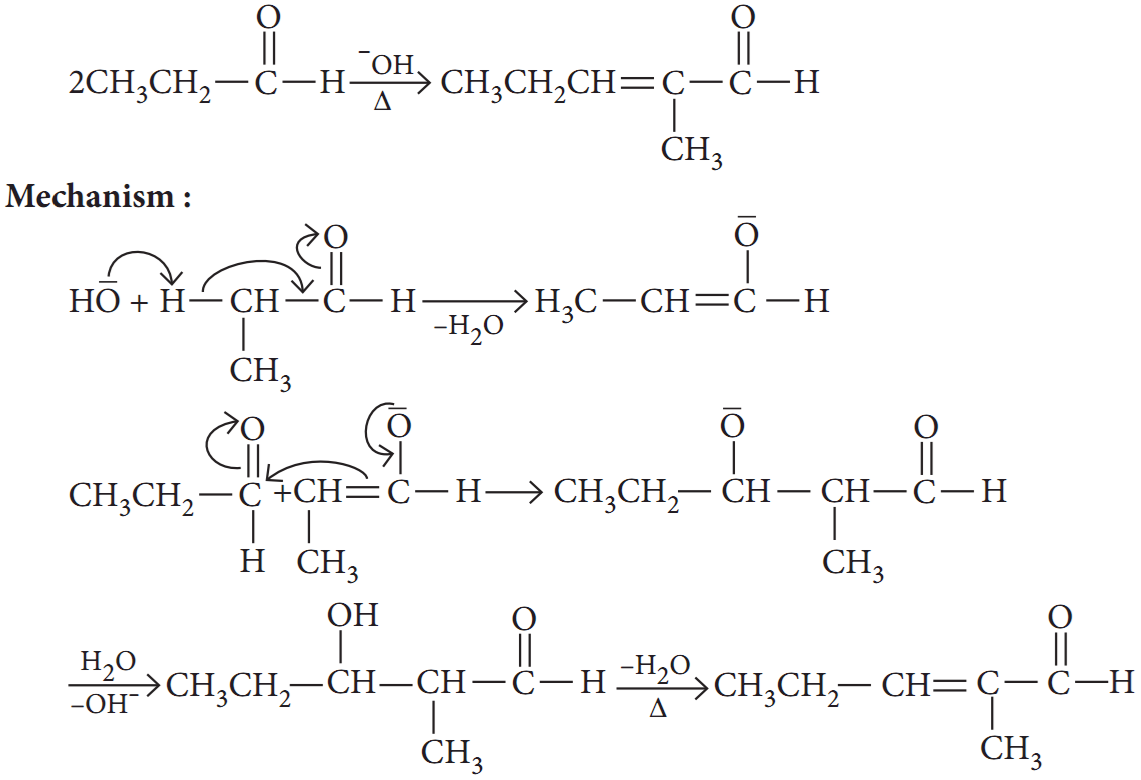
The addition reaction of enol or enolate to the carbonyl functional group of aldehyde or ketone is known as aldol addition. The β-hydroxyaldehyde or ββ-hydroxyketone so obtained undergo dehydration in second step to produce a conjugated enone. The first part of reaction is an addition reaction and the second part is an elimination reaction. Carbonyl compound having αα-hydrogen undergoes aldol condensation reaction.

  1. Condensation reaction is the reverse of which of the following reaction?
  1. Lock and key hypothesis
  2. Oxidation
  3. Hydrolysis
  4. Glycogen formation
  1. Which of the following compounds would be the main product of an aldol condensation of acetaldehyde and acetone?
  1. CH3CH=CHCHO
  2. CH3CH=CHCOCH3
  3. (CH3)2C=CHCHO
  4. (CH3)2C=CHCOCH3
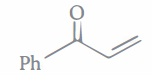
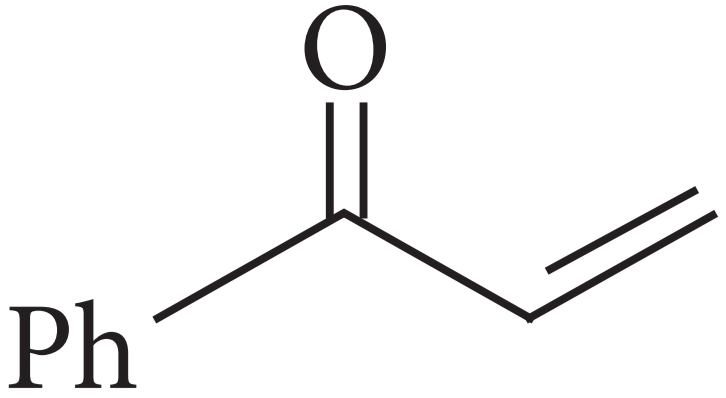
  1. Which combination of carbonyl compounds gives phenyl vinyl ketone by an aldol condensation?

  1.  Acetophenone and Formaldehyde
  2. Acetophenone and acetaldehyde
  3. Benzaldehyde and acetaldehyde
  4. Benzaldehyde and acetone
  5. Which of the following will undergo aldol condensation?
  1. HCHO
  2. CH3CH2OH
  3. C6H5CHO
  4. CH3CH2CHO
View full solution
(a) Give Reasons -
(i) Monochloro ethanoic acid has a higher P ka value than dichloro ethanoic acid.
(ii) Ketones are less reactive towards nucleophilic addition reaction than aldehydes.
(b) Write short note on aldol condensation
View full solution

Generate a Aldehydes, Ketones, and Carboxylic Acids paper free

Pick question groups from the list above, set marks and difficulty, and export a branded PDF with step-by-step answer keys. First 3 chapters free — no signup.

Download App