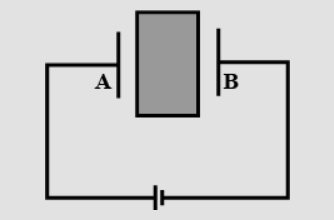
- AStore electrical energy.
- ✓Build up high voltage of few million volts.
- CDecelerate charged particle like electrons.
- DBoth $(a)$ and $(b).$
Angular momentum about the hinge point of the ball will be max at point. mV will be max at closer point because law of conservation says that the swinging energy will be gathered when it will be at lowest point. The potential energy is maximum.
Capacitance of a parallel plate capacitor.
$\text{C}=ε0\text{AdC}=ε0\text{Ad}$
A parallel plate capacitor is charged $($battery is disconnected$)$ then the plates are pulled apart, the capacitance decreases while the charge remains the same.
$\because$ Potentialdifference $=$ ChargeCapacitance\because Potentialdifference $=$ ChargeCapacitance.
$\therefore$ potential difference increases.


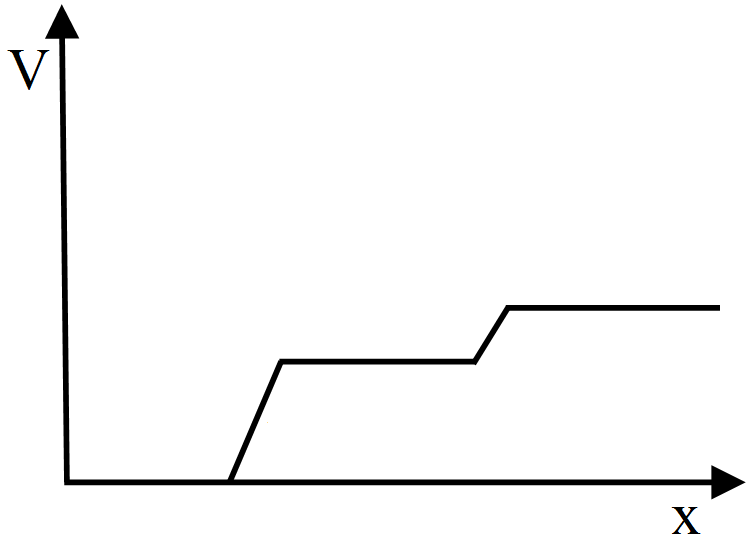
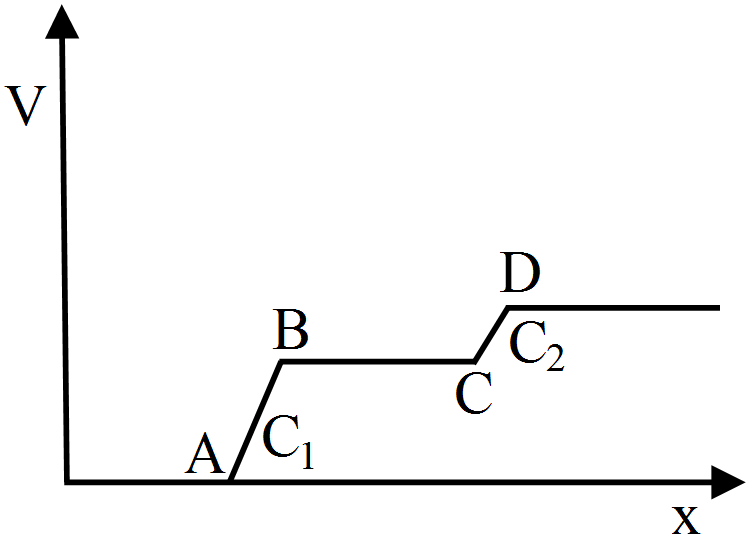
Region $A B$ shows the potential difference across capacitor $C_1$ and region $C D$ shows the potential difference across capacitor $C_2$. Now, we can see from the graph that region $A B$ is greater than region $C D$. Therefore, the potential difference across capacitor $C_1$ is greater than that across capacitor $C_2$.
$\because$ Capacitance, $C =\frac{ Q }{ V }$
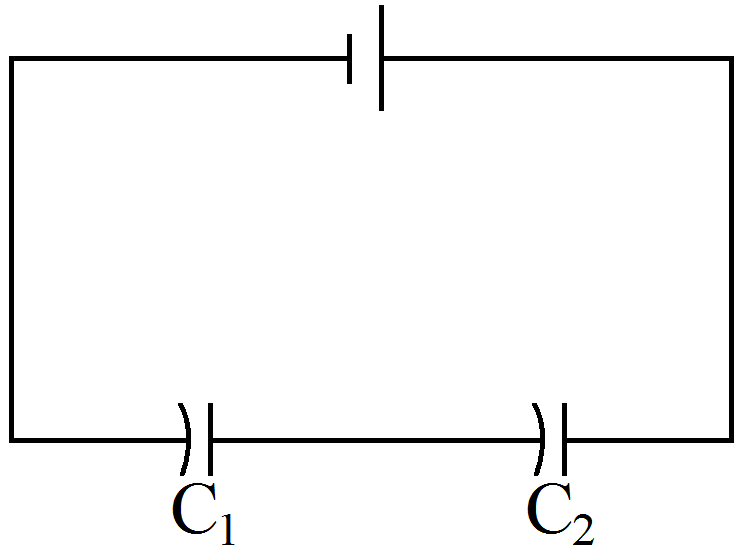
$\therefore C _1< C _2 (Q$ remains the same in series connection$).$
The volt is a measure of electric potential. One volt is defined as the difference in electric potential between two points of a conducting wire when an electric current of one ampere dissipates one watt of power between those points. It is also equal to the potential difference between two parallel, infinite planes spaced $1$ meter apart that create an electric field of $1$ newton per coulomb. Additionally, it is the potential difference between two points that will impart one joule of energy per coulomb of charge that passes through it. It can be expressed in terms of $SI$ base units $(m, kg$, s, and $A)$
$1\text{volte}=\frac{1\text{joule}}{\text{Coulomb}}$
When electron comes closer to the other stationary electron, its kinetic energy decreases because of repulsion between them. As per conservation of energy, the potential energy increases.


A parallel $-$ plate capacitor with a dielectric. The electric field is reduced between the plates because the dielectric material is polarized, producing an opposing field. When there is a dielectric, the potential is also reduced because potential is inversely proportional to dielectric
By Gauss’s theorem, the charge enclosed by the gaussian surface is zero. Consequently, the electric field must be zero at every point inside the cavity. Then, the entire excess charge lies on its surface.
The net displacement round one complete circle is $0.$
Electrical potential is a type of potential energy, and refers to the energy that could be released if electric current is allowed to flow.
The force between the plates is given by
$\text{F}=\frac{\text{q}^2}{2\in_0\text{A}}$
Since the capacitor is isolated, the charge on the plates remains constant.
We know that the charge is conserved in an isolated system.
Thus, the force acting between the plates remains unchanged.