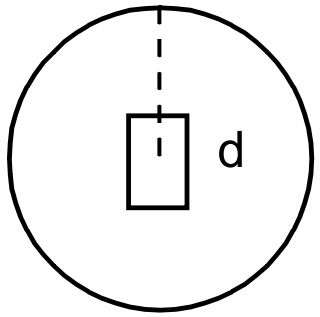
If the loop is free to rotate, what would be its orientation in stable equilibrium?
28 questions · timed · auto-graded
Explanation:
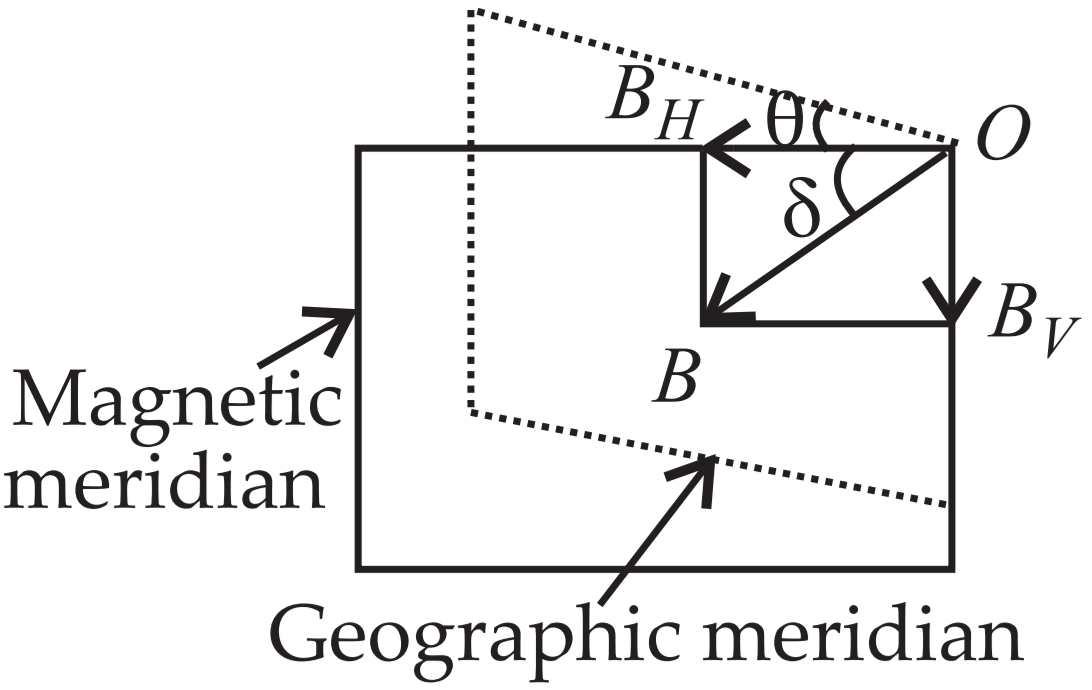
$\tan\theta=\frac{\text{B}_\text{V}}{\text{B}_\text{H}}$ and $\text{B}_\text{H}=\frac{\text{B}_\text{V}}{\sqrt{3}}$
$\therefore\tan\theta=\sqrt{3}\text{ i.e. }\theta=\frac{\pi}{3}$
Explanation:
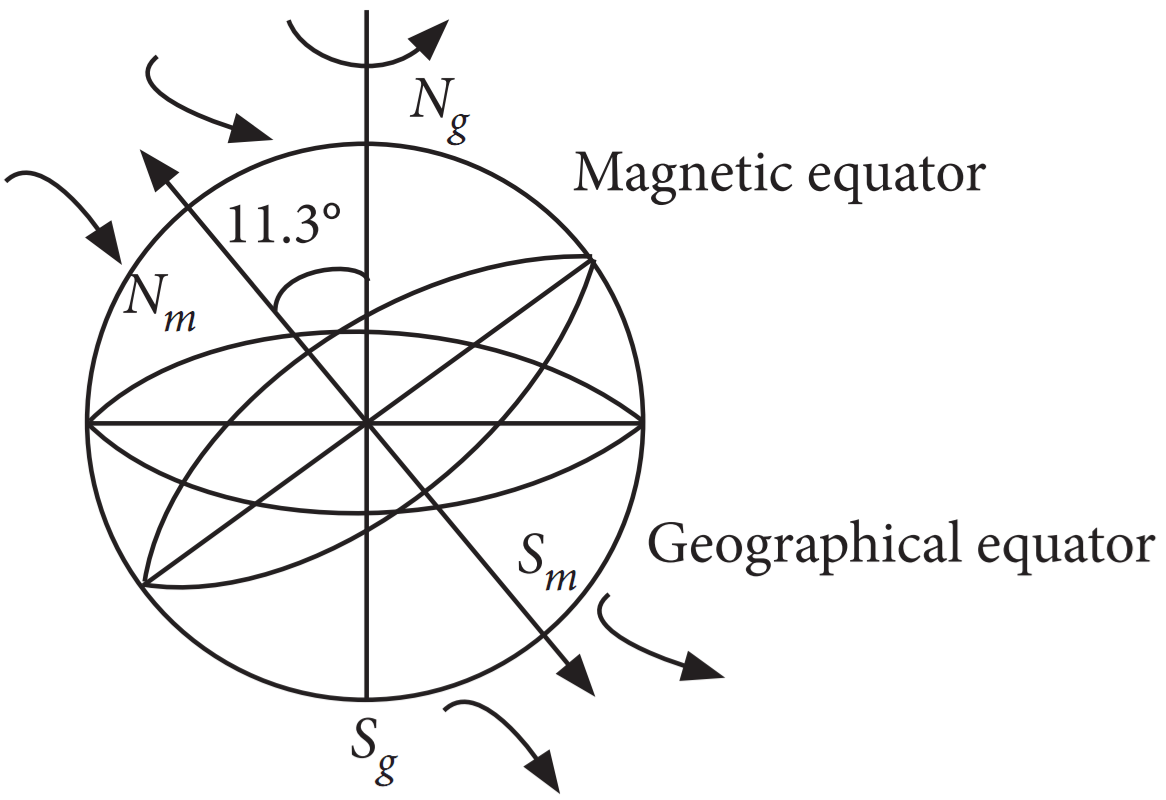
The angle between the true geographic north and the north shown by a compass needle is called as magnetic declination or simply declination.
Explanation:
Since angle of dip at a place is defined as the angle $\delta,$ which is the direction of total intensity of earth's magnetic field B makes with a horizontal tine in magnetic meridian,
At poles $\text{B}=\text{B}_\text{V}$ and $\text{B}_\text{V}=\text{B}\sin\delta\therefore\sin\delta=1\Rightarrow\delta=90^\circ$
At equator $\text{B}=\text{B}_\text{H}$ and $\text{B}_\text{H}=\text{B}\cos\delta$
$\therefore\cos\delta=1\Rightarrow\delta=-0^\circ.$
Explanation:
A compass needle which is allowed to move in a horizontal plane is taken to a geomagnetic pole. It will stay in any position as the horizontal component of earth's magnetic field becomes zero at the geomagnetic pole.
Explanation:
At equator, $\delta=0^\circ$
At poles, $\delta=90^\circ$
$\therefore\delta$ increases as we move from equator towards poles.
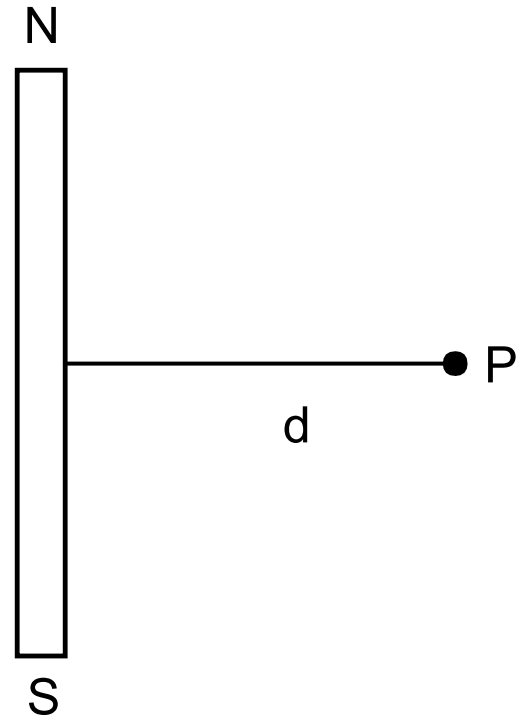
$\text{d}=10\text{cm}=0.1\text{m}$
We know
$\frac{\text{M}}{\text{B}}=\frac{4\pi}{\mu_0}\frac{(\text{d-}^2\ell^2)^2}{2\text{d}}\tan\theta$
$=\frac{4\pi}{\mu_0}\times\frac{\text{d}^4}{2\text{d}}\tan\theta$
[As the magnet is short]$=\frac{4\pi}{4\pi\times10^{-7}}\times\frac{(0.1)^3}{2}\times\tan37^\circ$
$=0.5\times0.75\times1\times10^{-3}\times10^7$
$=3.75\times10^3\text{A-m}^2\text{T}^{-1}$
$\text{B} =\frac{\mu_02\text{M}}{4\pi\text{ d}^3}\Rightarrow2\times10^{-4}=\frac{10^{-7}\times2\text{M}}{(10^ {-1})^3}$
$\Rightarrow\frac{2\times10^{-4}\times10^{-3}}{10^{-7}\times2}=\text{M}\Rightarrow\text{M}=1\text{Am}^2$
$\frac{\mu_0\text{ M }}{4\pi\text{ d}^3}\Rightarrow2\times10^{-4}=\frac{10^{-7}\times\text{M}}{(10^{-1})^3}\Rightarrow\text{m}=2\text{Am}^2$
Explanation:
Magnetic penneability- Henry m-1.
Explanation:
Given, l = 3cm, A= 2cm 2, M = 3A m2 intensity of magneusanon $=\frac{\text{M}}{\text{lA}}=\frac{3}{3\times10^{-2}\times2\times10^{-4}}$
Explanation:
Here, n = 500 turns/ m
$\text{I}=\text{lA},\ \mu^{\text{r}}=500$
Magnetic intensity, $\text{H}=\text{nl}=500\text{m}^{-1}\times1\text{A}=500\text{Am}^{-1}$
As $\mu^{\text{r}}=1+\chi$ or $\chi=(\mu_\text{r}-1)$
Magnetisation, $\text{M}=\chi\text{H}$
$=(\mu_\text{r}-1)\text{H}=(500-1)\times500\text{Am}^{-1}$
$=\text{2.495}\times106{5}\text{Am}^{-1}\approx2.5\times10^{5}\text{Am}^{-1}$
Explanation:
Relative permeability of iron, $\mu_{\text{r}}=6000$
Magnetic susceptibility $\chi_{\text{m}}=\mu_{\text{r}}-1=5999.$
(In) (i) $\vec{\text{E}}$ is ideally treated as a constant between plates and zero outside. In (ii) Magnetic field is constant inside the solenoid and zero outside. These idealised assumptions, however, contradict fundamental laws as below
Explanation:
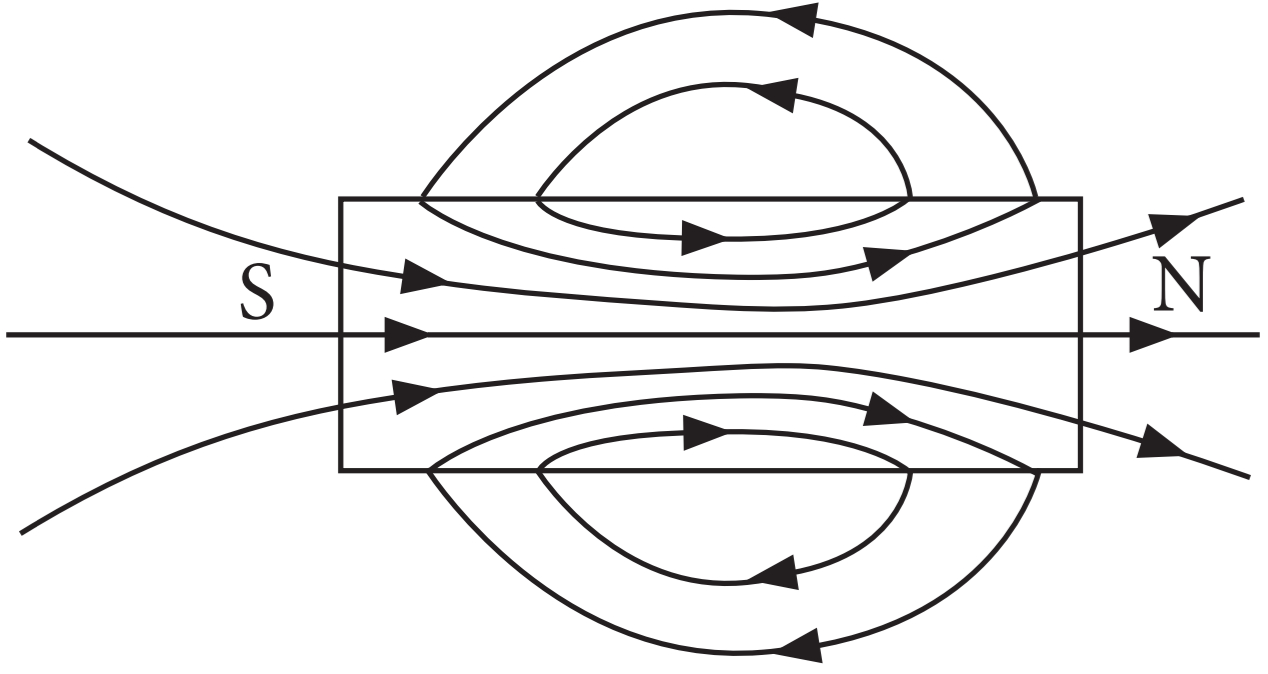
According to Gauss's law in magnetism $\oint\vec{\text{B}}.\text{d}\vec{\text{s}}=0,$ which implies that number of magnetic field tines entering the Gaussian surface is equal to the number of magnetic field lines leaving it. Therefore, case (ii) is not possible.
Explanation:
The net magnetic flux through a closed surface will be zero, $\oint\vec{\text{B}}.\text{d}\vec{\text{s}}=0,$ because there are no magnetic monopoles.
Explanation:
Gauss's law indicates that there are no sources or sinks of the magnetic field inside a closed surface. ln other words, there are no free magnetic charges.
Explanation:
The surface integral of a magnetic field over a surface gives magnetic flux through that surface.
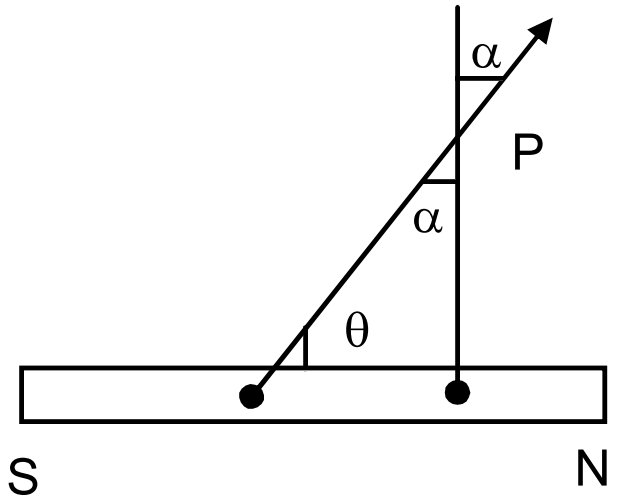
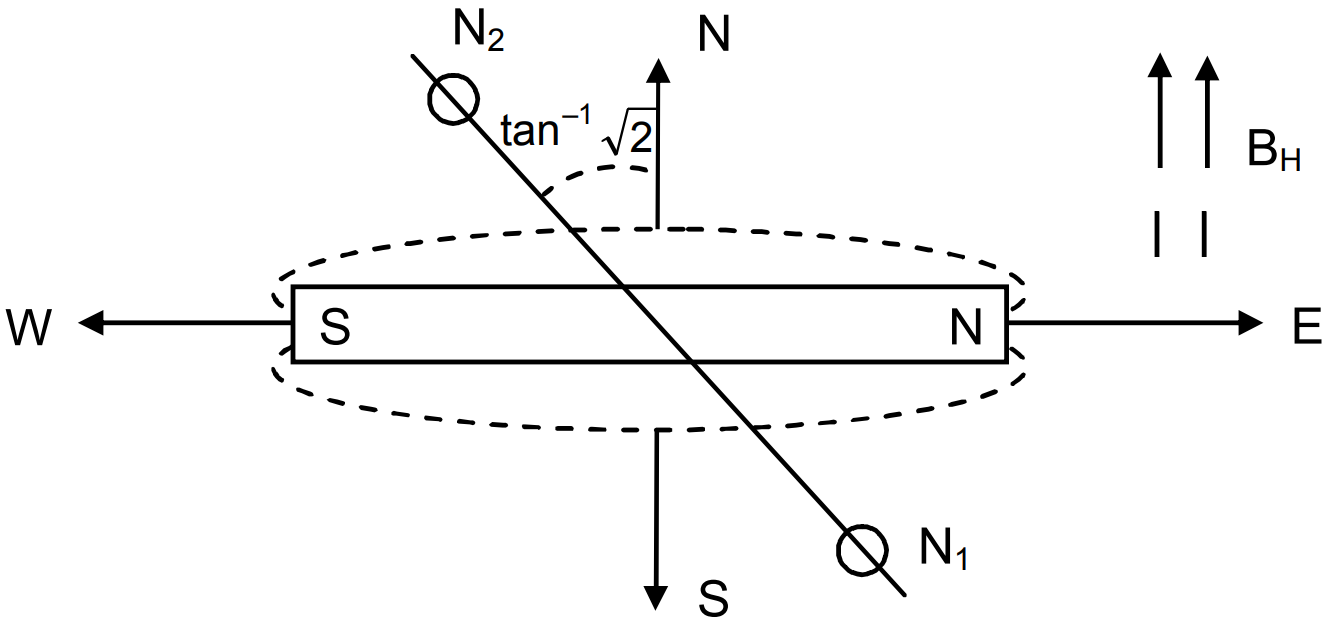
$\theta=\tan^{-1}\sqrt{2}\Rightarrow\tan\theta=\sqrt{2}\Rightarrow2=\tan^2\theta$
$\Rightarrow\tan\theta=2\cot\theta\Rightarrow\frac{\tan\theta}{2}=\cot\theta$
We know
$\frac{\tan\theta}{2}=\tan\propto$Comparing we get,
$\tan\propto=\cot\theta$$\tan\propto=(90-\theta)$
$\propto=90-\theta$
$\theta +\propto=90$
Hence magnetic field due to the dipole is
$\perp\text{r}$ to the magnetic axis.
Explanation:
At equator vertical component of magnetic fields is zero.
Explanation:
Given, $\text{V}=\text{H}$
$\therefore\tan\delta=\frac{\text{V}}{\text{H}}=1$ or $\delta=45^\circ$
Explanation:
Given: Biot-Savart law can be expressed alternatively as Ampere circuital law.
Explanation:
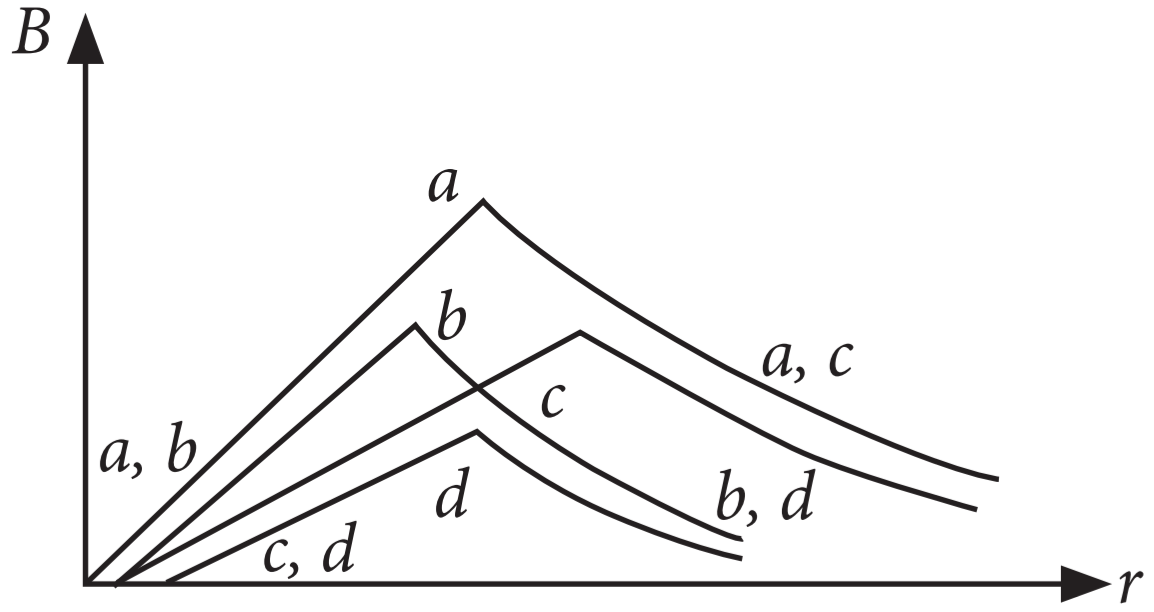
It can be seen that slop of curve for wire a is greater th an wire c.
Explanation:
Inside the wire
$\text{B(r)}=\frac{\mu_0}{2\pi}\frac{\text{I}}{\text{R}^2}\text{r}\Rightarrow\frac{\text{dB}}{\text{dr}}=\frac{\mu_0}{\text{dr}}=\frac{\text{I}}{\text{R}^2}\text{r}$
$\text{i.e. slope}\propto\frac{\text{I}}{\pi\text{R}^2}\propto\text{Current density}$
Explanation:
Wire c has the greatest radius.
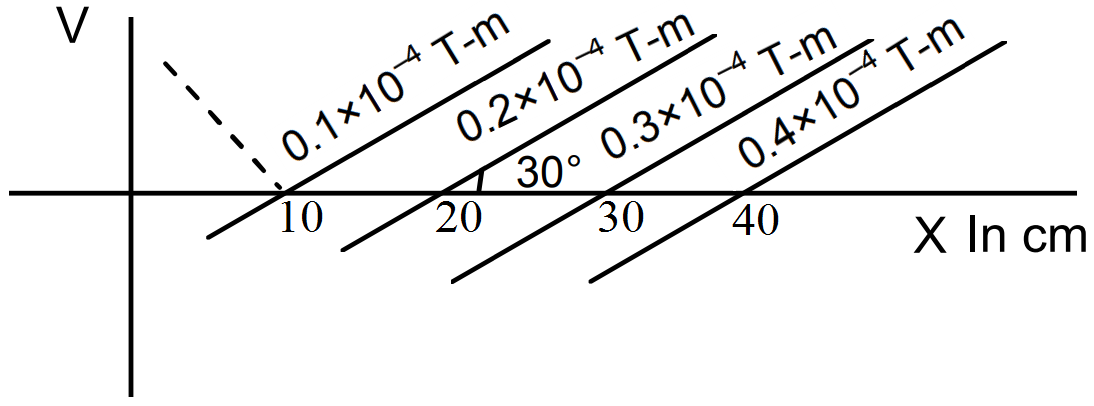
$\text{dx}=10\sin30^\circ\text{cm}=5\text{cm}$
$\frac{\text{dV}}{\text{dx}}=\text{B}=\frac{0.1\times10^{-4}\text{T-m}}{5\times10^{-2}\text{m}}$
Since B is perpendicular to equipotential surface.
Here it is at angle 120° with (+ve) x-axis and B = 2 × 10⁻⁴ T
$=-0.2\times10^{-3}\times0.5=-0.1\times10^{-3}\text{T-m}$
Since the sigh is-ve therefore potential decreases.$\text{B}_\text{H}=\text{B}\cos60^\circ$
$\Rightarrow\text{B}=52\times10^{-6}=52\mu\text{T}$
$\text{B}_\text{v}=\text{B}\sin\delta=52\times10^{-6}\frac{\sqrt{3}}{2}$
$=44.98\mu\text{T} \approx45\mu\text{T}$