Question 14 Marks
Explain the refraction by an equilateral prism and derive the formula $\delta=i+e- A$ in case of triangular prism of glass.
Answer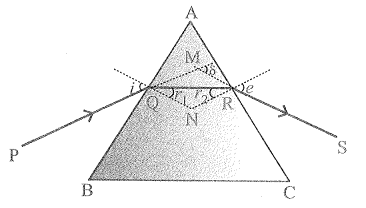
→Figure shows the cross section of a prism.
→The path of a light passing through this prism is PQRS .
→The angle of incidence is $i$ and the angle of refraction is $r$ at the first side AB .
→The angle incidence is $r_2$ and the angle of emergence (angle of refraction) is $e$.
→Angle between the direction of emergent ray RS and incident ray PQ is called angle of deviation $(\delta)$.
→In $\square AQNR m \angle AQN = m \angle ARN =90^{\circ}$
→The sum of remaining two angles is $180^{\circ}$.
$\therefore \angle A +\angle QNR =180^{\circ}......(1)$
→For $\triangle QNR$,
$r_1+r_2+\angle QNR =180^{\circ}......(2)$
→Comparing equation (1) and (2),
$\begin{array}{l}\therefore \angle A +\angle QNR =r_1+r_2+\angle QNR \\\therefore A =r_1+r_2\end{array}......(3)$
→For $\triangle QMR , \delta$ is the exterior angle.
$\begin{array}{l}\therefore \delta=\angle MQR +\angle MRQ......(4) \\\text { but } i=r_1+\angle MQR \\\therefore \angle MQR =i-r_1\end{array}$
and same way $\angle MRQ =e-r_2$.
→Substituting these two values in equation (4),
$\begin{array}{l}\therefore \quad \delta=i-r_1+e-r_2 \\\therefore \delta=i+e-\left(r_1+r_2\right)\end{array}$
→From equation (3),
$\therefore \delta=i+e- A$
View full question & answer→→Figure shows the cross section of a prism.
→The path of a light passing through this prism is PQRS .
→The angle of incidence is $i$ and the angle of refraction is $r$ at the first side AB .
→The angle incidence is $r_2$ and the angle of emergence (angle of refraction) is $e$.
→Angle between the direction of emergent ray RS and incident ray PQ is called angle of deviation $(\delta)$.
→In $\square AQNR m \angle AQN = m \angle ARN =90^{\circ}$
→The sum of remaining two angles is $180^{\circ}$.
$\therefore \angle A +\angle QNR =180^{\circ}......(1)$
→For $\triangle QNR$,
$r_1+r_2+\angle QNR =180^{\circ}......(2)$
→Comparing equation (1) and (2),
$\begin{array}{l}\therefore \angle A +\angle QNR =r_1+r_2+\angle QNR \\\therefore A =r_1+r_2\end{array}......(3)$
→For $\triangle QMR , \delta$ is the exterior angle.
$\begin{array}{l}\therefore \delta=\angle MQR +\angle MRQ......(4) \\\text { but } i=r_1+\angle MQR \\\therefore \angle MQR =i-r_1\end{array}$
and same way $\angle MRQ =e-r_2$.
→Substituting these two values in equation (4),
$\begin{array}{l}\therefore \quad \delta=i-r_1+e-r_2 \\\therefore \delta=i+e-\left(r_1+r_2\right)\end{array}$
→From equation (3),
$\therefore \delta=i+e- A$