Question
Explain how the image is formed by thin convex lens and derive
$-\frac{1}{u}+\frac{1}{v}=\left(n_{21}-1\right)\left[\frac{1}{R_1}-\frac{1}{ R _2}\right]$###
Derive lens maker's formula for thin convex lens.
Answer

Image
Image
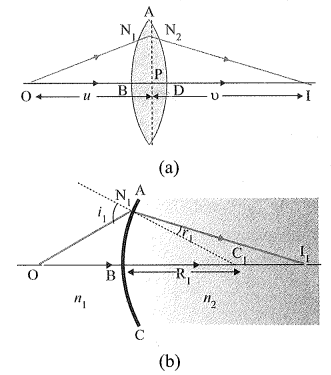
→Figure (a) shows the geometry of image formation by a convex lens.
→A point object $O$ is placed at a distance $u$ from the optical centre. On the other side of the lens there is image I. Here image distance is $v$. The radii of curvature of both surfaces of the lens are $R_1$ and $R_2$ respectively and the focal length of the lens is $f$.
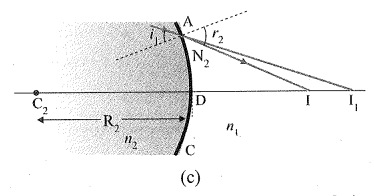
→The image formation can be seen in terms of two steps :
(i) The first refracting surface forms the image $I_1$ of the object $O$. (figure b)
(ii) The image $I _1$ acts as a virtual object for the second surface. (figure c) that forms image at I .
→For refraction at interface ABC ,
$\frac{n_1}{ OB }+\frac{n_2}{ BI _1}=\frac{n_2-n_1}{ BC _1}......(1)$
→A similar procedure applied to the interface ADC gives,
$-\frac{n_2}{ DI _1}+\frac{n_1}{ DI }=\frac{n_2-n_1}{ DC _2}$
→For a thin lens,
$\begin{aligned}
& BI _1= DI _1 \\\therefore & -\frac{n_2}{ BI _1}+\frac{n_1}{ DI }=\frac{n_2-n_1}{ DC _2}......(2)\end{aligned}$
→Adding equations (1) and (2),
$\frac{n_1}{ OB }+\frac{n_1}{ DI }=\frac{n_2-n_1}{ BC _1}+\frac{n_2-n_1}{ DC _2}......(3)$
→Suppose the object is at infinity
i.e. $OB \rightarrow \infty$ and $DI \rightarrow f$ (focal length)
→from equation (3),
$\begin{array}{c}0+\frac{n_1}{f}=\frac{n_2-n_1}{ BC _1}+\frac{n_2-n_1}{ DC _2} \\\therefore \quad \frac{n_1}{f}=\left(n_2-n_1\right)\left(\frac{1}{ BC _1}+\frac{1}{ DC _2}\right)\end{array}$
→Now substituting $BC _1= R _1$ and $DC _2=- R _2$ in above equation.
(Positive and negative signs are determined according to the sign convention). $\begin{array}{l}\therefore \quad \frac{n_1}{f}=\left(n_2-n_1\right)\left(\frac{1}{ R _1}-\frac{1}{ R _2}\right) \\\therefore \quad \frac{1}{f}=\left(\frac{n_2-n_1}{n_1}\right)\left(\frac{1}{ R _1}-\frac{1}{ R _2}\right) \\\therefore \quad \frac{1}{f}=\left(\frac{n_2}{n_1}-1\right)\left(\frac{1}{ R _1}-\frac{1}{ R _2}\right) \\ \therefore \quad \frac{1}{f}=\left(n_{21}-1\right)\left(\frac{1}{ R _1}-\frac{1}{ R _2}\right)\end{array}$
→This equation is known as lensmaker's formula.
→Note that the formula is true for a concave lens also. For concave lens $R_1$ is negative, $R_2$ positive and therefore $f$ is negative.

Need a full question paper?

Generate a complete, print-ready paper with questions like this in minutes — across 16+ boards, with answer keys.

Start Generating Free

Similar questions

Calculate the height of the potential barrier for a head-on collision of two deuterons.
(Hint: The height of the potetnial barrier is given by the Coulomb repulsion between the two deuterons when they just touch each other. Assume that they can be taken as hard spheres of radius 2.0 fm.)
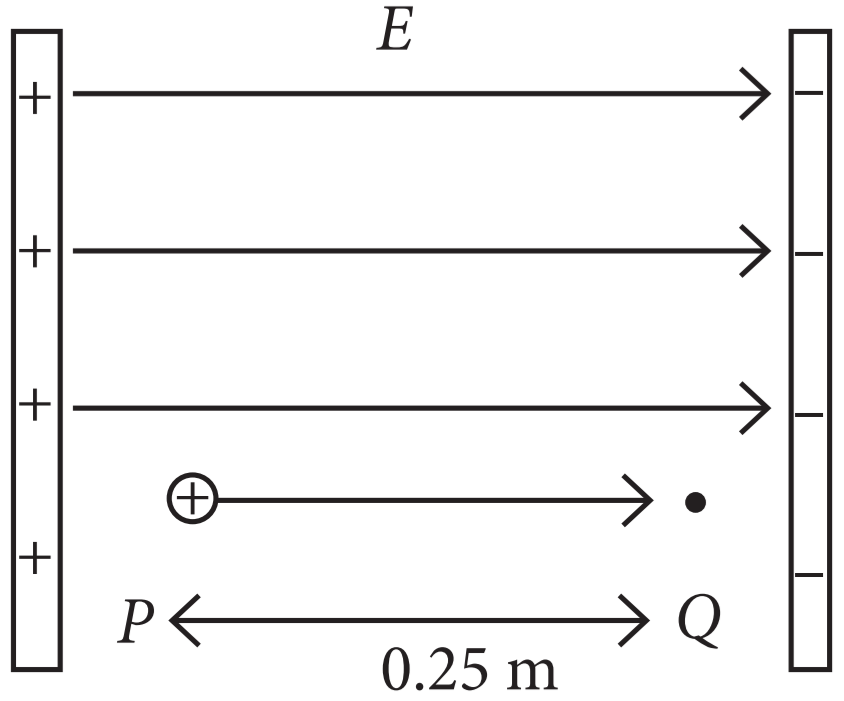
Potential difference $(\triangle\text{V})$ between two points A and B separated by a distance x, in a uniform electric field E is given by $\triangle\text{V}=-\text{Ex},$ where xis measured parallel to the field lines. If a charge q0 moves from P to Q, the change in potential energy $(\triangle\text{U})$ is given as $\triangle\text{U}=-\text{q}_0\triangle\text{V}.$ A proton is released from rest in uniform electric field of magnitude 4.0 × 108Vm-1 directed along the positive X-axis. The proton undergoes a displacement of 0.25m in the direction of E.

Mass of a proton = 1.66 × 10-27kg and charge of proton = 1.6 × 10-19C.

  1. The change in electric potential of the proton between the points A and B is:
  1. -1 × 108V
  2. 1 × 108V
  3. 6.4 × 10⁻¹⁹V
  4. -6.4 × 10⁻¹⁹V
  1. The change in electric potential energy of the proton for displacement from A to B is:
  1. 1.6 × 1011J
  2. 0.5 × 10²³J
  3. -1.6 × 10-11J
  4. 3.2 × 1022J
  1. The mutual electrostatic potential energy between two protons which are at a distance of 9 × 10-15m, in 92U235 nucleus is:
  1. 1.56 × 10-14J
  2. 5.5 × 10-14J
  3. 2.56 × 10-14J
  4. 4.56 × 10-14J
  1. If a system consistsoftwocharges 4mC and -3mC with no external field placed at (-5cm, 0, 0) and (5cm, 0, 0) respectively. The amount of work required to separate the two charges infinitely away from each other is:
  1. -1.1J
  2. 2J
  3. 2.5J
  4. 3J
  1. As the proton moves from P to Q, then:
  1. The potential energy of proton decreases.
  2. The potential energy of proton increases.
  3. The proton loses kinetic energy.
  4. Total energy of the proton increases.
State Bohr's quantization condition for defining stationary orbits. How does de-Broglie hypothesis explain stationary orbits ?
The magnetic field due to the earth has a horizontal component of $26\mu\text{T}$ at a place where the dip is 60°. Find the vertical component and the magnitude of the field.
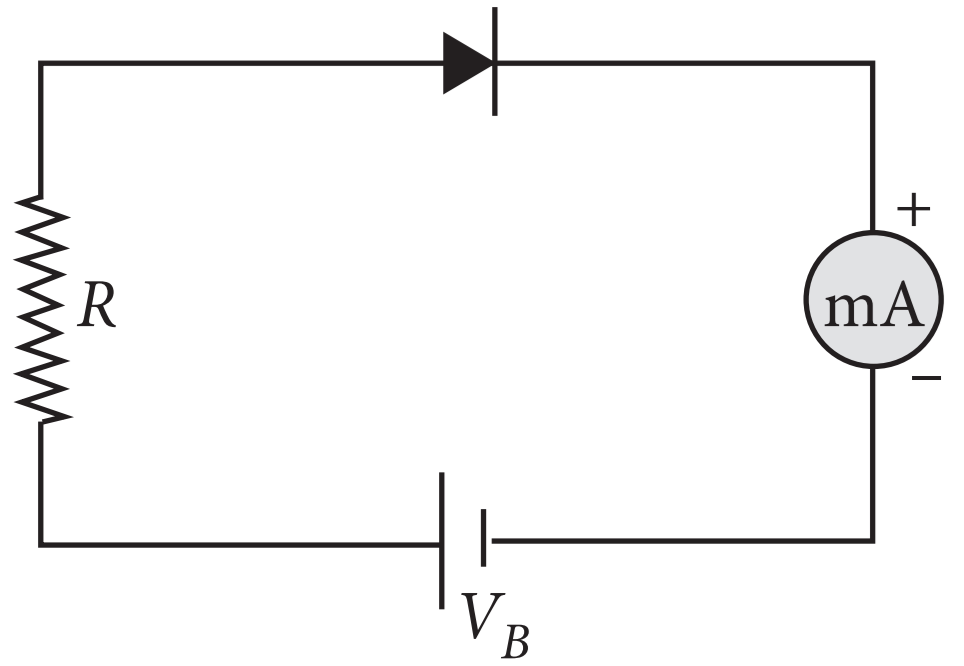
A silicon p-n junction diode is connected to a resistor Rand a battery of voltage VB through milliammeter (mA) as shown in figure. The knee voltage for this junction diode is VN = 0.7V. The p-n junction diode requires a minimum current of 1mA to attain a value higher than the knee point on the I-V characteristics of this junction diode. Assuming that the voltage Vacross the junction is independent of the current above the knee point. A p-n junction is the basic building block of many semiconductordevices like diodes. Important process occurring during the formation of a p-n junction are diffusion and drift. ln an n-type semiconductor concentration of electrons is more as compared to holes. ln a p-type semiconductor concentration of holes is more as compared to electrons.

  1. If V= 5V, the maximum value of R so that the voltage V is above the knee point voltage is:
  1. $40\text{k}\Omega$
  2. $4.3\text{k}\Omega$
  3. $5.0\text{k}\Omega$
  4. $5.7\text{k}\Omega$
  1. If VB = 5V, the value of R in order to establish a current to 6mA in the circuit is:
  1. $833\Omega$
  2. $717\Omega$
  3. $950\Omega$
  4. $733\Omega$
  1. If VB = 6V, the power dissipated in the resistor R, when a current of 6mA flows in the circuit is:
  1. 30.2mW
  2. 30.8mW
  3. 31.2mW
  4. 31.8mW
  1. When the diode is reverse biased with a voltage of 6V and Vbi = 0.63V. Calculate the total potential.
  1. 9.27V
  2. 6.63V
  3. 5.27V
  4. 0.63V
  1. Which of the below mentioned statement is false regarding a p-n junction diode?
  1. Diodes are uncontrolled devices.
  2. Diodes are rectifying devices.
  3. Diodes are unidirectional devices.
  4. Diodes have three terminals.
A car starts from rest on a half kilometer long bridge. The coefficient of friction between the tyre and the road is 1.0. Show that one cannot drive through the bridge in less than 10s.
The magnetic field at a point, 10cm away from a magnetic dipole, is found to be 2.0 × 10⁻⁴ T. find the magnetic moment of the dipole if the point is.
  1. In end-on position of the dipole.
  2. In broadside-onposition of the dipole.
A child has near point at 10cm. What is the maximum angular magnification the child can have with a convex lens of focal length 10cm?
A magnetic dipole of magnetic moment 1.44A-m2 is placed horizontally with the north pole pointing towards north. Find the position of the neutral point if the horizontal component of the earth's magnetic field is $18 \mu\text{T}.$