Question 513 Marks
- Three photo diodes D1 , D2 and D3 are made of semiconductors having band gaps of 2.5eV, 2eV and 3eV respectively. Which of them will not be able to detect light of wavelength 600nm?
- Why photodiodes are required to operate in reverse bias? Explain.
Answer
View full question & answer→- Energy of the incident light
$\text{E}=\frac{\text{hC}}{\lambda}$
$=\frac{(6.6\times10^{-34})\times(3\times10^8)}{(600\times10^{-9})\times(1.6\times10^{-19})}$
$\text{E}=2.06\text{eV}$
The incident radiations can be detected by a photodiode if the energy of incident radiation photon is greater than the band gap. This is true only for D2 (2eV). Hence, only D2 will detect the light of 600nm wavelength.
- The photodiode is reverse biased for operating in the photoconductive mode. As the photodiode is in reverse bias, the width of the depletion layer increases. This reduces the junction capacitance and thereby the response time. In effect, the reverse bias causes faster response times for the photodiode. The photocurrent is linearly proportional to the illuminance.

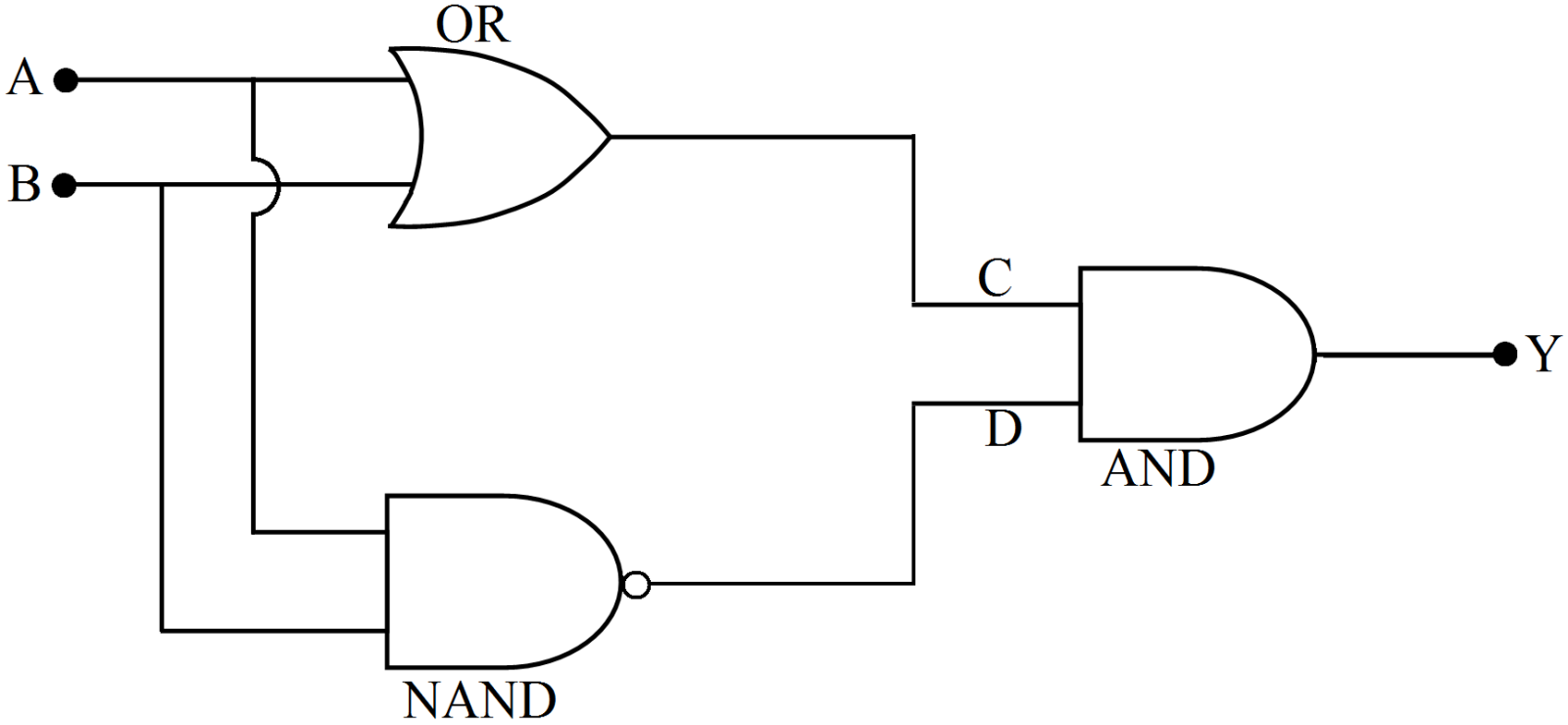
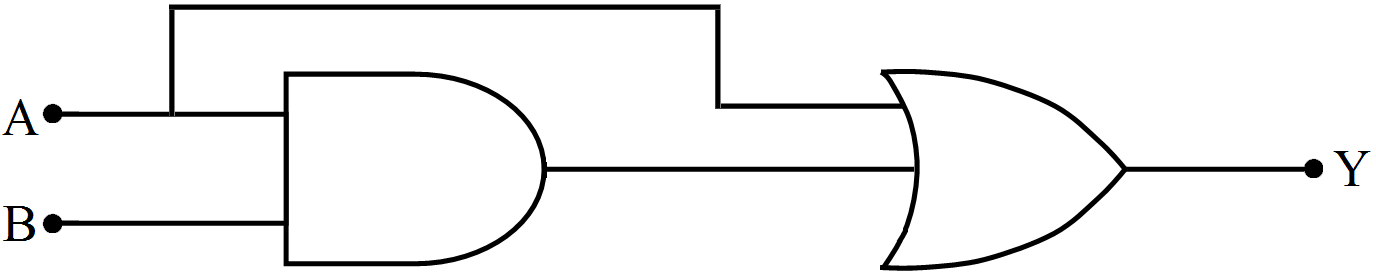
 The logic circuit represents NOR gate.