Question 11 Mark
In a class of $40$ students, $\frac{1}{5}$ of the total number of students like to eat rice only, $\frac{2}{5}$ of the total number of students like to eat chapati only and the remaining students like to eat both. What fraction of the total number of students like to eat both$?$
AnswerTotal number of students $= 40$
Student who eat rice only $=\frac{2}{5}$ of total students $=\frac{1}{5}\times40=8$
Student who eat chapati only $=\frac{2}{5}$ of total student $=\frac{2}{5}\times40=16$
$\therefore$ students who eat both chapati and rice $=$ Total number of student $- ($student who eat rice only $+$ Student who eat chapati only$)$
$= 40 - (8 ÷ 16) = 40 - 24 = 16$
$\therefore$ Fraction of student who eat both chapati and rice $=\frac{\text{Number of students eat both chapati and rice}}{\text{Total number of students}}$
$=\frac{16}{40}=\frac{2}{5}$
View full question & answer→Question 21 Mark
If $5$ is added to both the numerator and the denominator of the fraction $\frac{5}{9}$will the value of the fraction be changed$?$ If so, will the value increase or decrease$?$
AnswerGiven fraction $=\frac{5}{9}$ Now, adding $5$ to numerator and denominator $=\frac{5+5}{9+5}=\frac{10}{14}=\frac{5}{7}$
Obviously, $\frac{5}{7}>\frac{5}{9}$
So, thr value will increase.
View full question & answer→Question 31 Mark
To divide a decimal number by $100,$ we move the decimal point in the number to the left by two places.
Answere.g. $\frac{273.2}{100}=2.732$ (moving decimal point to the left by two places).
View full question & answer→Question 41 Mark
Product of two fractions $=\frac{\text{Product of their denominators}}{\text{Product of their numerators }}$
AnswerTwo fractions are multiplied by multiplying their numerators and denominators separately and writing the product as,
Product of two fractions $=\frac{\text{Product of their numerators}}{\text{Product of their denominators }}$
View full question & answer→Question 51 Mark
To multiply a decimal number by $1000,$ we move the decimal point in the number to the right by three places.
Answere.g. $2.732 \times 1000 = 2732 ($moving the decimal to right by three places$).$
View full question & answer→Question 61 Mark
Rani ate $\frac{2}{7}$ part of a cake while her brother Ravi ate $\frac{4}{5}$ of the remaining. Part of the cake left is _____.
AnswerGiven, Rani ate $\frac{2}{7}$ part of the cake,
then Remaining part $=1-\frac{2}{7}=\frac{7-2}{7}=\frac{5}{7}$
Her brother ate $\frac{4}{5}\ \text{of}\ \frac{5}{7}=\frac{4}{5}\times\frac{5}{7}=\frac{4}{7}$
So, remaining part of the cake $=\frac{5}{7}-\frac{4}{7}=\frac{5-4}{7}=\frac{1}{7}$
Hence, part of the cake left is $\frac{1}{7}$
View full question & answer→Question 71 Mark
$\frac{2}{5}$ of $25$ is _____.
AnswerGiven, $\frac{2}{5}\ \text{of}\ 25=\frac{2}{5}\times25=2\times5=10$
Hence, $\frac{2}{5}\ \text{of}\ 25\ \text{is}\ 10$
View full question & answer→Question 81 Mark
$\frac{1}{2}$ of $4\frac{2}{7}$ is _____.
AnswerGiven, $\frac{1}{2}\ \text{of}\ \frac{2}{7}=\frac{1}{2}\times\frac{(4\times7)+2}{7}$
$=\frac{2}{7}\times\frac{30}{7}=\frac{30}{14}=\frac{15}{7}$
Hence, $\frac{1}{2}\ \text{of}\ 4\frac{2}{7}\ \text{is}\ \frac{15}{7}$
View full question & answer→Question 91 Mark
The directions for a pain reliever recommend that an adult of $60\ kg$ and over take $4$ tablets every $4$ hours as needed, and an adult who weighs between $40$ and $50\ kg$ take only $2\frac{1}{2}$ tablets every $4$ hours as needed. Each tablet weighs $\frac{4}{25}\text{gram}.$ If a $72\ kg$ adult takes $4$ tablets, how many grams of pain reliever is he or she receivings$?$
AnswerGiven, $72\ kg$ adult takes $4$ tablets and each tablet weights $\frac{4}{25}\text{gram}$
$\therefore$ Total weight of pain reliever, he/ she is receiving $=4\times\frac{4}{25}\text{gram}$
View full question & answer→Question 101 Mark
$2$ _____ $\frac{5}{3}$ = $\frac{10}{3}$
AnswerSince, on multiplying $2$ by $\frac{5}{3}$ we get $\frac{10}{3}$
Hence, $2\times\frac{5}{3}=\frac{10}{3}$
View full question & answer→Question 111 Mark
What happens to the value of a fraction if the denominator of the fraction is decreased while numerator is kept unchanged?
AnswerWhen the numerator is kept unchanged and the denominator of the fraction is decreased the value of fraction would increase. e.g. Fraction $=\frac{2}{3}$
New fraction $=\frac{2}{2}$
Obviously $\frac{2}{2}>\frac{2}{3}[\because 1 > 0.66]$
View full question & answer→Question 121 Mark
$4.7 ÷ 10 = $_____.
AnswerGiven, $47+10=\frac{47}{10}\times\frac{1}{10}$
$\big[\because\text{reciprocal of }10=\frac{1}{10}\big]$
$=\frac{47}{100}=0.47$ Hence, $47+10=0.47$
View full question & answer→Question 131 Mark
While dividing a fraction by another fraction, we _____ the first fraction by the _____ of the other fraction.
AnswerWhile dividing a fraction by another fraction, we multiply the first fraction by the reciprocal of the other fraction.Solution:
While dividing a fraction by another fraction, we multiply the first fraction by the reciprocal of the other fraction. e.g. $4+\frac{1}{2}=4\times2=8$ $\big[\because\text{reciprocal of }\frac{1}{2}=2\big]$
View full question & answer→Question 141 Mark
The reciprocal of $\frac{4}{7}$ is $\frac{4}{7}$
AnswerFalse. Solution: Reciprocal of $\frac{4}{7}\ \text{is}\ \frac{7}{4}$
View full question & answer→Question 151 Mark
$52.7 ÷ $_____ $= 0.527$
AnswerLet $x$ be the missing number, then $52.7 + x = 0.527$
$\Rightarrow \frac{527}{10}\times\frac{1}{\text{x}}=\frac{527}{1000}$
$\big[\because\text{reciprocal of x}=\frac{1}{\text{x}}\big]$
$\Rightarrow\frac{527}{10}\times\frac{1000}{527}=\text{x}$
$\Rightarrow\text{x}=100$
Hence, $52.7 + 100 = 0.527$
View full question & answer→Question 161 Mark
The reciprocal of $\frac{3}{7}$ is _____.
AnswerThe reciprocal of $\frac{3}{7}$ is $\frac{7}{3}$ Solution: Note: The reciprocal of a non-zero fraction is obtained by interchanging its numerator and denominator.
View full question & answer→Question 171 Mark
Cost of a burger is $\text{Rs. }20\frac{3}{4}$ and of Macpuff is $\text{Rs. }15\frac{1}{2}$ Find the cost of $4$ burgers and $14$ macpuffs.
AnswerCost of $1$ burger $=\text{Rs. }20\frac{3}{4}$
$=\text{Rs. }\frac{(20\times4)+3}{4}=\text{Rs. }\frac{83}{4}$
$\therefore$ cost of $4$ burgers $=\text{Rs. }4\times\frac{83}{4}=\text{Rs. }83$
cost of $1$ macpuffs $=\text{Rs. }15\frac{1}{2}=\text{Rs. }\frac{31}{2}$
cost of $14$ macpuffs $=\text{Rs. }14\times\frac{31}{2}=\text{Rs. }217$
$\therefore$ Total cost of $4$ burgers and $14$ macpuffs $= Rs. (83 + 217) = Rs. 300$
View full question & answer→Question 181 Mark
$8.4 ÷ $_____$ = 2.1$
AnswerLet $x$ be the missing number,
then $84 + x = 2.1$
$\Rightarrow8.4\times\frac{1}{\text{x}}=2.1$
$\big[\because\text{reciprocal of}\ \text{x}=\frac{1}{\text{x}}\big]$
$\Rightarrow8.4=2.1\text{x}$ [by cross-multiplication]
$\Rightarrow\text{x}=\frac{8.4}{2.1}$
$\Rightarrow \text{x}=\frac{84}{21}\times\frac{10}{10}=4$
$\Rightarrow\text{x}=4$
Hence, $8.4 + 4 = 2.1$
View full question & answer→Question 191 Mark
$3.2 \times 10 = $_____.
AnswerGiven, $3.2\times10=\frac{32}{10}\times10=32$
Hence, $3.2 \times10 = 32$
View full question & answer→Question 201 Mark
$4.7 ÷ 1000 =$ _____.
AnswerGiven, $47+100=\frac{47}{1000}\times\frac{1}{100}$
$\big[\because\text{reciprocal of}\ 100=\frac{1}{1000}\big]$
$=\frac{47}{10000}=0.0047$
Hence, $4.7+1000=0.0047$
View full question & answer→Question 211 Mark
A reciprocal of a fraction is obtained by inverting it upside down.
AnswerTrue. Solution: Let $\frac{\text{a}}{\text{b}}$ be the fraction. Then, for obtaining its reciprocal, numerator and denominator are interchanged. $\therefore$ Reciprocal of $\frac{\text{a}}{\text{b}}=\frac{\text{b}}{\text{a}}$
View full question & answer→Question 221 Mark
Which letter comes $\frac{2}{5}$of the way among $A$ and $J?$
Answer$D$ From $A$ to $J,$ there are $10$ letters. So, letter at $\frac{2}{5}$ place $=\big(\frac{2}{5}\times10\big)$ th letter $= 4th$ letter $= D.$
View full question & answer→Question 231 Mark
The lowest form of the product $2\frac{3}{7}\times\frac{7}{9}$ is _____.
AnswerGiven, $2\frac{3}{7}\times\frac{7}{9}=\frac{(2\times7)+3}{7}\times\frac{7}{9}$
$=\frac{17}{7}\times\frac{7}{9}=\frac{17}{9}=1\frac{8}{9}$
Hence, the lowest from of the product
$2\frac{3}{7}\times\frac{7}{9}\ \text{is}\ \frac{17}{9}\text{or}\ 1\frac{8}{9}$
View full question & answer→Question 241 Mark
In Questions to replace ‘?’ with appropriate fraction.
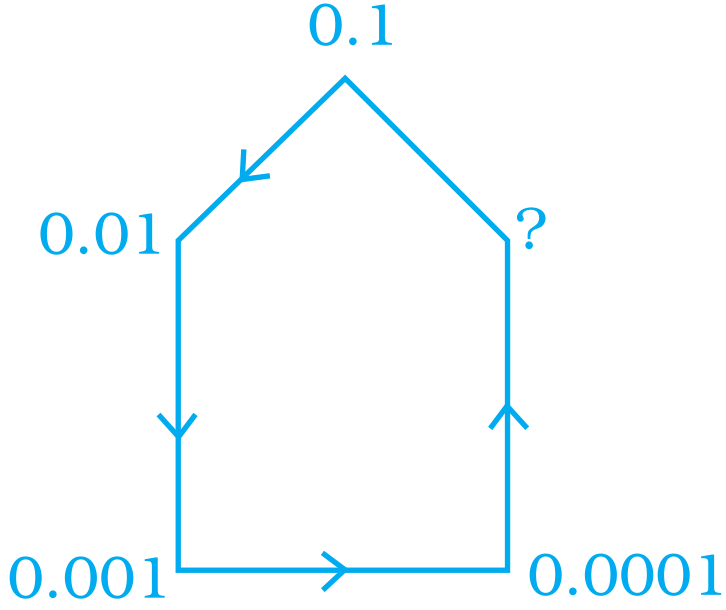
AnswerGiven sequence is $0.1, 0.01, 0.001, 0.0001, ?.$ We observe that, each number is multiplied by $10$ to get next number. $\therefore?=\frac{0.0001}{10}=0.00001$
View full question & answer→Question 251 Mark
Write the number in the box $\Box$ such that $\frac{3}{7}\times\Box=\frac{15}{98}$
AnswerLet the missing number be x. Then, $\frac{3}{7}\times\text{x}=\frac{15}{98}$ $\Rightarrow\text{x}=\frac{15}{98}\div\frac{3}{7}=\frac{15}{98}\times\frac{7}{3}$ $\big[\because\text{reciprocal of}\ \frac{3}{7}=\frac{7}{3}\big]$ $\text{x}=\frac{5}{14}$ Hence, $\frac{3}{7}\times\frac{5}{14}=\frac{15}{98}$
View full question & answer→Question 261 Mark
In her science class, Jyoti learned that the atomic weight of Helium is $4.0030$ of Hydrogen is $1.0080$ and of Oxygen is $16.0000.$ Find the difference between the atomic weights of: Oxygen and Helium.
AnswerGiven, atomic weight of Helium $= 4.0030$
Hydrogen $= 1.0080$ and
Oxygen $= 16.0000$
Difference between atomic weights of Oxygen and Helium $\frac{16.0000}{\frac{-04.0030}{11.9970}}$
View full question & answer→Question 271 Mark
Reemu read$\frac{1}{5}$ th pages of a book. If she reads further $40$ pages, she would have read $\frac{7}{10}$ th pages of the book. How many pages are left to be read$?$
AnswerLet total pages of the book be $x.$
According to the question, $\frac{1}{5}\text{x}+40=-\frac{7}{10}\text{x}$
$\Rightarrow\frac{1}{5}\text{x}+40=-\frac{1}{5}\text{x}=\frac{7\text{x}-2\text{x}}{10}$
$\Rightarrow40=\frac{5\text{x}}{10}$
$\Rightarrow\text{x}=\frac{400}{5}=80$
$\therefore$ Total pages of a book $= 80$
Hence, pages left to be read $=$ Total pages of abook $-\big(\frac{7}{10}\text{x}\big)$
$=80-\frac{7}{10}\times80$
$=80-56=24\ \text{pages}$
View full question & answer→Question 281 Mark
In her science class, Jyoti learned that the atomic weight of Helium is $4.0030$ of Hydrogen is $1.0080$ and of Oxygen is $16.0000.$ Find the difference between the atomic weights of: Helium and Hydrogen.
AnswerGiven, atomic weight of Helium $= 4.0030$
Hydrogen $= 1.0080$ and Oxygen $= 16.0000$ Difference between atomic weights of Oxygen and Helium and Hydrogen $\frac{4.0030}{\frac{-1.0080}{2.9950}}$
View full question & answer→Question 291 Mark
In Questions to replace $‘?’$ with appropriate fraction.
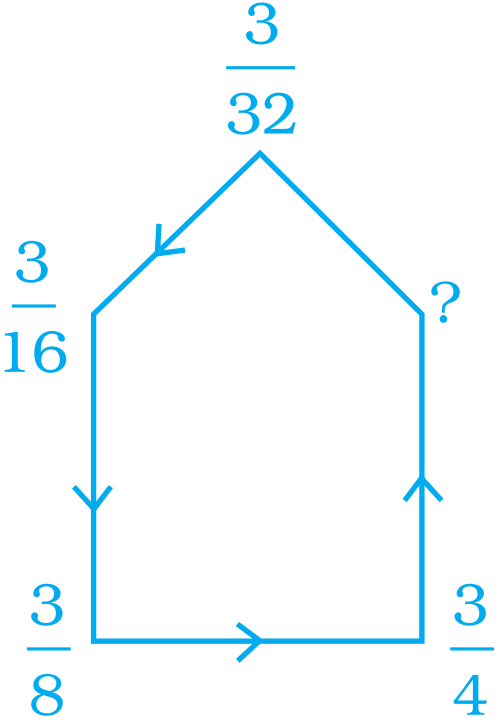
AnswerGiven sequence is $\frac{3}{32},\frac{3}{16},\frac{3}{8},\frac{3}{4},?.$
We observe that each fraction is divided by $2$ to get next fraction.
So, $?=\frac{3}{4}\times2=\frac{3}{2}$
View full question & answer→Question 301 Mark
$4\times6\frac{1}{3}$ is equal to _____.
Answer$4\times6\frac{1}{3}$ is equal to $=25\frac{1}{3}$Solution:
Given, $4\times6\frac{1}{3}=4\times\frac{(6\times3)+1}{3}$ $4\times\frac{19}{3}=\frac{76}{3}=25\frac{1}{3}$ Hence, $4\times 6\frac{1}{3}=25\frac{1}{3}$
View full question & answer→Question 311 Mark
If $\frac{2}{3}$of a number is $10,$ then what is $1.75$ times of that number$?$
AnswerLet the number be $x.$
According to the question, $\frac{2}{3}\ \text{of}\ \text{x}=10$
$\Rightarrow\frac{2}{3}\times\text{x}=10$
On multiplying both sides by $\frac{3}{2}$
we get $\frac{2}{3}\times\text{x}\times\frac{3}{2}=10\times\frac{3}{2}$
$\Rightarrow\text{x}=5\times3$
$\Rightarrow\text{x}=15$
$1.75$ times of $15 = 1.75 \ \text{of}\ 15 = 1.75 \times 15 $
$=\frac{175}{100}\times15=\frac{2625}{100}=26.25$
View full question & answer→Question 321 Mark
$\frac{1}{5}\div\frac{5}{6}=\frac{1}{5}$ _____ $\frac{6}{5}$
Answer$\frac{1}{5}\div\frac{5}{6}=\frac{1}{5}\underline{\times}\frac{6}{5}$ Solution: Given, $\frac{1}{5}+\frac{6}{5}$ $\big[\because\text{reciprocal of}\ \frac{5}{6}=\frac{6}{5}\big]$ $\therefore\frac{1}{5}+\frac{5}{6}=\frac{1}{5}\times\frac{6}{5}$
View full question & answer→Question 331 Mark
$\frac{1}{9}$ of $\frac{6}{5}$ is _____.
Answer$\frac{1}{9}$ of $\frac{6}{5}$ is $\frac{2}{15}$ Solution: Given, $\frac{1}{9}\ \text{of}\ \frac{6}{5}=\frac{1}{9}\times\frac{6}{5}=\frac{2}{15}$ Hence, $\frac{1}{9}\ \text{of}\ \frac{6}{5}\ \text{is}\ \frac{2}{15}$
View full question & answer→Question 341 Mark
Heena’s father paid an electric bill of $Rs. 385.70$ out of a $500$ rupee note. How much change should he have received$?$
AnswerGiven, total rupees $= Rs. 500$ and money paid $= Rs. 385.70$
$\therefore$Change he received $= Rs. (500 - 385.70) = Rs. 114.30$
View full question & answer→Question 351 Mark
What is the Error in question$?$ A student compared $-\frac{1}{4}$ and $-0.3.$ He changed $-\frac{1}{4}$ to the decimal $-0.25$ and wrote, $“$Since $0.3$ is greater than $0.25, -0.3$ is greater than $-0.25”.$ What was the student’s error$?$
AnswerIf the numbers are negative, then the numbers whose ab solute value is greater, will be smaller. Hence, $-0.25$ is greater than $-0.3$ So, the student made the error that $(-0.3) > - (0.25)$
View full question & answer→Question 361 Mark
$0.5 $_____$ 0.7 = 0.35$
Answer$\because0.5=\frac{5}{10}$ and $0.7=\frac{7}{10}$
$\therefore0.5\times0.7=\frac{5}{10}\times\frac{35}{100}=0.35$
Hence, $0.5 \times 0.7 = 0.35$
View full question & answer→Question 371 Mark
In her science class, Jyoti learned that the atomic weight of Helium is $4.0030$ of Hydrogen is $1.0080$ and of Oxygen is $16.0000.$ Find the difference between the atomic weights of:
Oxygen and Hydrogen.
AnswerGiven, atomic weight of Helium $= 4.0030$
Hydrogen $= 1.0080$
and Oxygen $= 16.0000$
Difference between atomic weights of Oxygen and Hydrogen
$\frac{16.0000}{\frac{-01.0080}{14.9920}}$
View full question & answer→Question 381 Mark
$\frac{4}{5}$ of $45$ is _____.
AnswerGiven, $\frac{4}{5}\ \text{of}\ =\frac{4}{5}\times45=4\times9=36$
Hence, $\frac{4}{5}\ \text{of}\ 45\ \text{is}\ 36.$
View full question & answer→Question 391 Mark
Sports: Reaction time measures how quickly a runner reacts to the starter pistol. In the $100m$ dash at the $2004$ Olympic Games, Lauryn Williams had a reaction time of $0.214$ second. Her total race time, including reaction time, was $11.03$ seconds. How long did it take her to run the actual distance?
AnswerTime taken to run the actual distance $=$ Total race time $-$ Reaction time. $= (11.03 - 0.214)s = 10.816s.$
View full question & answer→Question 401 Mark
$1$ is the only number which is its own reciprocal.
AnswerFor obtaining the reciprocal of a number, we simply interchange the numerator and denominator. Hence, reciprocal of $1$ will be $\frac{1}{1}=1$
View full question & answer→Question 411 Mark
$25.4 \times 1000 = $_____.
AnswerGiven, $25.4\times1000=\frac{254}{10}\times1000=25400$ Hence, $25.4\times1000 = 25400$
View full question & answer→Question 421 Mark
$93.5 \times 100 = $_____.
AnswerGiven, $=\frac{935}{10}\times100=9350$ Hence, $93.5 \times10 = 9350$
View full question & answer→Question 431 Mark
$\frac{4}{5}\div4$ is equal to _____.
Answer $\frac{4}{5}\div4$ is equal to $\frac{1}{5}$
Solution:
Given, $\frac{4}{5}+4=\frac{4}{5}\times\frac{1}{4}=\frac{1}{5}$ $\big[\because\text{reciprocal of}4=\frac{1}{4}\big]$
Hence, $\frac{4}{5}+4$ is equql to $\frac{1}{5}$
View full question & answer→Question 441 Mark
It takes $17$ full specific type of trees to make one tonne of paper. If there are $221$ such trees in a forest, then. To save $\frac{7}{13}$ part of the forest how much of paper we have to save.
Answer$\frac{7}{13} $
part of forest $=\frac{7}{13}\times221$
trees $= 119$ trees
$\therefore$ Number of tonnes of paper which can be made by $119$ trees $=\frac{119}{17}=7$
View full question & answer→Question 451 Mark
The reciprocal of a proper fraction is a proper fraction.
AnswerThe reciprocal of a proper fraction is always an improper fraction.
e.g. $\frac{5}{6} \rightarrow $ Proper fraction Its reciprocal is $\frac{5}{6}$, i.e. improper fraction.
View full question & answer→Question 461 Mark
$\frac{2}{3}$ of 8 is same as $\frac{2}{3}\div8$
Answer False.
Solution:
$\frac{2}{3}\text{of}\ 8=\frac{2}{3}\times8=\frac{16}{3}$
$\frac{2}{3}+8=\frac{2}{3}\times\frac{1}{8}=\frac{2}{24}$
$\therefore\frac{2}{3}\text{of}\ 8\neq\frac{2}{3}+8$
Hence, $\frac{2}{3}$ of 8 is not same as $\frac{2}{3}+8$
View full question & answer→Question 471 Mark
In Questions to replace $‘?’$ with appropriate fraction.
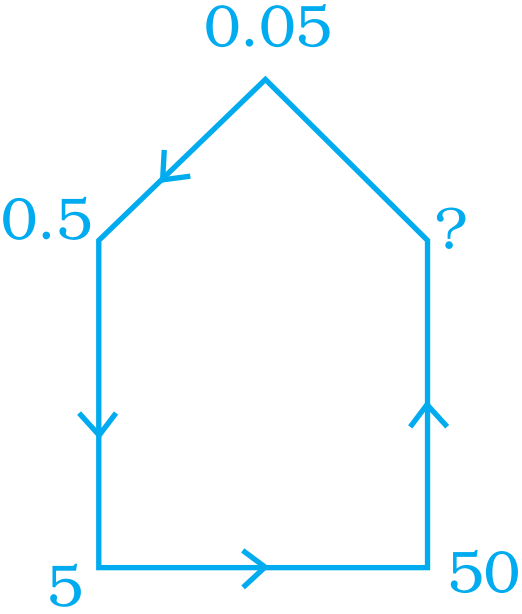
AnswerGiven sequence is $0.05, 0.5, 5, 50, ?$ We observe that, each number is multiplied by $10$ to get next number. $?= 50 × 10 = 500$
View full question & answer→Question 481 Mark
What is the cost of $27.5m$ of cloth at $Rs. 53.50$ per metre$?$
AnswerBy unitary method, Cost of $1m$ of cloth
$= Rs. 53.50$ Cost of $27.5m$ of cloth $Rs. (53.50 27.5)$
$=\big(\frac{5350}{100}\times\frac{275}{10}\big)=\text{Rs. }\big(\frac{1471250}{1000}\big)$
$=\text{Rs. }1471.25$
View full question & answer→Question 491 Mark
$2.001 ÷ 0.003 =$ _____.
AnswerGiven, $2.001 + 0.003$
$\because2.001=\frac{2001}{1000}$ and $0.003=\frac{3}{1000}$
$\therefore2.001+0.003=\frac{2001}{1000}+\frac{2001}{1000}$
$\big[\because\text{reciprocal of }\frac{3}{1000}=\frac{1000}{3}\big]$
$=\frac{1000}{3}=667$
Hence, $2.001 + 0.003 = 667$
View full question & answer→Question 501 Mark
In Questions to replace $‘?’$ with appropriate fraction.
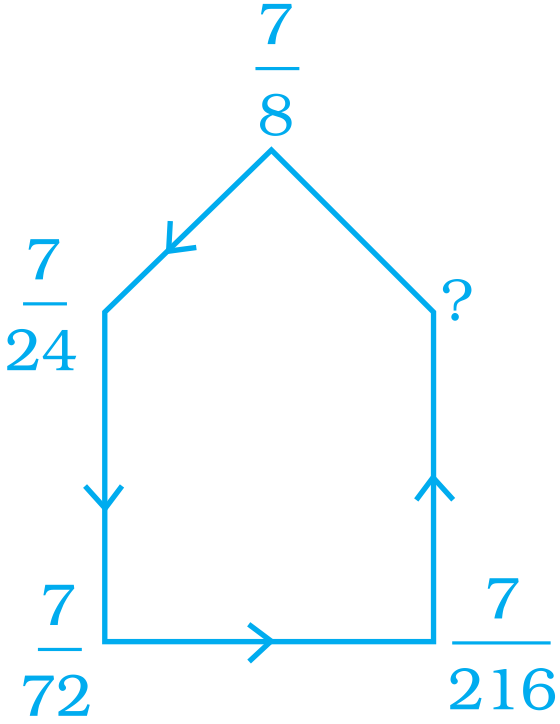
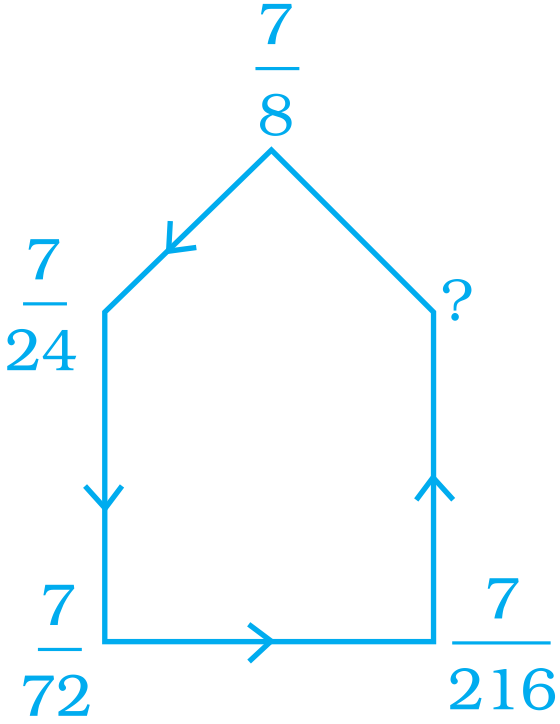
AnswerGiven sequence is $\frac{7}{8},\frac{7}{24},\frac{7}{72},\frac{7}{216},?.$
We observe that each fraction is divided by $3$ to get next fraction.
So, $?=\frac{7}{216}+3=\frac{7}{216}\times\frac{1}{3}=\frac{7}{648}$
View full question & answer→