Question 12 Marks
To find the distance around a circular disc, multiply the diameter of the disc by $3.14$ What is the distance around the disc when: The radius is $6.45\ cm?$
AnswerGiven, Distance around a circular disc $=$ Diameter of disc $\times \ 3.14$
Radius of disc $= 6.45\ cm$
Diameter of disc $= 2\ \times $ Radius of disc $= 2 \times 6.45 = 12.9\ cm$
Distance around a circular disc $= 12.9 \times 3.14 = 40.506\ cm = 58.718\ cm.$
View full question & answer→Question 22 Marks
How many $\frac{1}{16}\text{kg}$ boxes of chocolates can be made with $1\frac{1}{2}\text{kg}$ chocolates?
AnswerTotal chocolates $=1\frac{1}{2}\text{kg}=\frac{(1\times2)+1}{2}=\frac{3}{2}\text{kg}$ $\therefore$ Number of boxes of chocolates of $\frac{1}{16}=\frac{\text{Total chocolates}}{\text{Weight of 1 box}}$ $=\big(\frac{3}{2}+\frac{1}{16}\big)$ $\big[\because\text{reciprocal of}\frac{1}{16}=16\big]$ $=\frac{3}{2}\times16$ $=3\times8=24$
View full question & answer→Question 32 Marks
What is the Error in question? A student multiplied two mixed fractions in the following manner $2\frac{4}{7}\times3\frac{1}{4}=6\frac{1}{7}$ What error the student has done?
AnswerFor multiplying two mixed fractions, first convert them into improper fraction. So, $2\frac{4}{7}\times3\frac{1}{4}=\frac{2\times7+4}{7}\times\frac{3\times4+1}{4}$ $=\frac{18}{7}\times\frac{13}{4}=\frac{234}{28}$ $=\frac{117}{14}=8\frac{5}{14}$
View full question & answer→Question 42 Marks
Divide: $\frac{3}{10}$ by $\big(\frac{1}{4}\ \text{of}\ \frac{3}{5}\big)$
AnswerGiven, $\frac{3}{10}+\big(\frac{1}{4}\ \text{of}\ \frac{3}{5}\big)=\frac{3}{10}+\big(\frac{1}{4}\times\frac{3}{5}\big)$ $=\frac{3}{10}+\big(\frac{3}{10}\big)$ $=\frac{3}{10}\times\frac{20}{3}$ $\big[\because\text{reciprocal of}\ \frac{3}{20}=\frac{20}{3}\big]$ $=2$
View full question & answer→Question 52 Marks
What is the product of $\frac{5}{129}$ and its reciprocal?
Answer$\because$ Reciprocal of $\frac{5}{129}=\frac{129}{5}$ $\therefore$ Product of $\frac{5}{129}$ and its reciprocal $=\frac{5}{129}\times\frac{129}{5}=1$ Note: Product of any number and its reciprocal is always 1
View full question & answer→Question 62 Marks
$\frac{1}{8}$ of a number equals $\frac{2}{5}\div\frac{1}{20}$What is the number$?$
AnswerLet the number be $x.$
Then, $\frac{1}{8}$ of a number $=\frac{2}{5}\div\frac{1}{20}$
Givcen,
$\Rightarrow \frac{1}{8}\times\text{x}=\frac{2}{5}\times20$ $\big[\because\text{reciprocal of}\ \frac{1}{20}=20\big]$
$\Rightarrow\frac{\text{x}}{8}=8$
$\Rightarrow\text{x}=8\times8$
$\Rightarrow\text{x}=64$
Hence, the number is $64$
View full question & answer→Question 72 Marks
Anuradha can do a piece of work in $6$ hours. What part of the work can she do in $1$ hour in $5$ hours in $6$ hours$?$
AnswerIt is given that, Anuradha can do a piece of work $6h$ In other words.
In $6h$ Anuradha can do $=$ Compelete the work In $1h$
Anuradha can do $=\frac{1}{6}$ part of work In $5h$
Anuradha can do $=\frac{1}{6}\times5=\frac{5}{6}$ part of work.
View full question & answer→Question 82 Marks
Measurement made in science lab must be as accurate as possible. Ravi measured the length of an iron rod and said it was $19.34\ cm$ long Kamal said $19.25\ cm$ and Tabish said $19.27\ cm$ The correct length was $19.33\ cm$ How much of error was made by each of the boys$?$
AnswerThe actual length of an iron rod $= 19.33\ cm$
Measured Ravi $= 19.34\ cm$
Error $=$ Measured value $-$ Actual value $= (19.34 - 19.33) \ cm = 0.01\ cm$
Kamal measured $= 19.25\ cm$
Error $= (19.25- 19.33) \ cm = -0.08\ cm$
Tabish measured $= 19.27\ cm$
Error $= (19 27 - 19.33) \ cm = -0.06\ cm.$
View full question & answer→Question 92 Marks
A rule for finding the approximate length of diagonal of a square is to multiply the length of a side of the square by $1.414.$ Find the length of the diagonal when: The length of a side of the square is exactly $7.875\ cm.$
AnswerSide of square $= 7.875\ cm$
$\therefore$ Length of diaonal $=$ Length of side of the square $\times \ 1.414 $
$= 7.875 \times 1.414 = 11.13525 $
$= 11.14\ cm ($approx$)$
View full question & answer→Question 102 Marks
To find the distance around a circular disc, multiply the diameter of the disc by $3.14$ What is the distance around the disc when: The diameter is $18.7\ cm?$
AnswerGiven, Distance around a circular disc $=$ Diameter of disc $\times \ 3.14$
Diameter of disc $= 18.7\ cm$
Distance around a circular disc $= 18.7 \times 3.14 = 58.718\ cm.$
View full question & answer→Question 112 Marks
Sunita and Rehana want to make dresses for their dolls. Sunita has $\frac{3}{4}\ m$ of cloth, and she gave $\frac{1}{3}$ of it to Rehana. How much did Rehana have?
AnswerGiven, Sunita has $\frac{3}{4}\text{m}$ of cloth.
$\therefore$ She gave clath to Rehana $=\frac{1}{3}\ \text{of}\ \frac{3}{4}=\frac{1}{3}\times\frac{3}{4}$
$=\frac{1}{4}\text{m}$
Hence, Rehana has $\frac{1}{4}\text{m}$ of cloth.
View full question & answer→Question 122 Marks
What number divided by $520$ gives the same quotient as 85 divided by $0.625?$
AnswerLet the number be $x.$
According to the question,
$\frac{\text{x}}{520}=\frac{85}{0.625}$
$\Rightarrow\text{x}=\frac{5\times520\times1000}{625}$
$=\frac{44200000}{625}$ [by corss-multiplication]
$\Rightarrow\text{x}=70720$
Hence, the number is $70720.$
View full question & answer→Question 132 Marks
Evaluate: $(0.3) \times (0.3) - (0.2) \times (0.2)$
AnswerGiven, $(0.3) \times (0.3) - (0.2) \times (0.2)$
$\because0.3=\frac{3}{10}\text{ and }0.2=\frac{2}{10}$
$\therefore\big(\frac{3}{10}\times\frac{3}{10}\big)-\big(\frac{2}{10}\times\frac{2}{10}\big)$
$=\frac{9}{100}-\frac{4}{100}=\frac{9-4}{100} [$taking $LCM]$
$=\frac{5}{100}=0.05$
View full question & answer→Question 142 Marks
The largest square that can be drawn in a circle has a side whose length is $0.707$ times the diameter of the circle. By this rule, find the length of the side of such a square when the diameter of the circle is: $8.63\ cm$
AnswerGiven, Side of square $= 0.707\ \times $ Diameter of circle We have,
Diameter of circle $= 8.63\ cm$
$\therefore$ Side of square $= 0.707 \times 8.63\ cm = 6.10\ cm.$
View full question & answer→Question 152 Marks
A square and an equilateral triangle have a side in common. If side of triangle is $\frac{4}{3}\text{cm}$ long find the perimeter of figure formed (Fig).
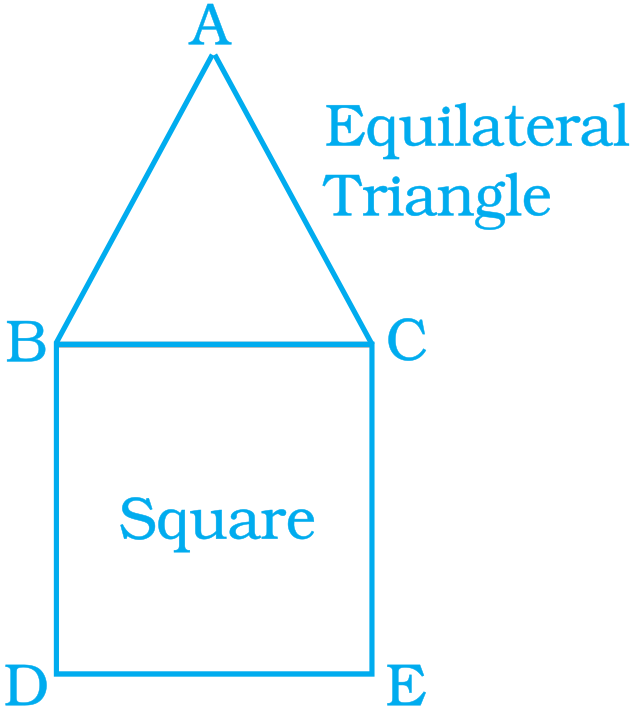
AnswerAs square and equilateral triangle both have a common side, i.e. $BC$
So, all the sides of square and trangle will be equal and of measure $\frac{4}{3}\text{cm}$
$\therefore$ Perimeter of the figure $= AB + BD + DE + EC + AC$
$5 \times AB [$since, all the lengths are equal$]$
$=5\times\frac{4}{3}$
$=\frac{20}{3}\text{cm}.$
View full question & answer→Question 162 Marks
The directions for a pain reliever recommend that an adult of $60\ kg$ and over take $4$ tablets every $4$ hours as needed, and an adult who weighs between $40$ and $50\ kg$ take only $2\frac{1}{2}$ tablets every $4$ hours as needed. Each tablet weighs $\frac{4}{25}\text{ gram}.$ How many grams of pain reliever is the recommended dose for an adult weighing $46 \ kg?$
AnswerGiven, Adult weighing $46\ kg$
takes $2\frac{1}{2}$ tablets and each tablet weighs $\frac{4}{25}\text{ gram}$
$\therefore$ Total weight of pain reliever,
he/ she is receiving $=\bigg(\frac{4}{25}\times2\frac{1}{2}\bigg)\text{gram}$
$=\bigg[\frac{4}{25}\times\frac{(2\times2)+1}{2}\bigg]\text{gram}$
$\bigg(\frac{4}{25}\times\frac{5}{2}\bigg)\text{gram}$
$=\frac{2}{5}\text{ gram.}$
View full question & answer→Question 172 Marks
The largest square that can be drawn in a circle has a side whose length is $0.707$ times the diameter of the circle. By this rule, find the length of the side of such a square when the diameter of the circle is: $14.35\ cm$
AnswerGiven, Side of square $= 0.707\ \times $ Diameter of circle We have,
Diameter of circle $= 14.35\ cm$
$\therefore$ Side of square $= 0.707 \times 14.35 = 10.15\ cm.$
View full question & answer→Question 182 Marks
Kajol has $Rs. 75$ This is $\frac{3}{8}$ of the amount she earned. How much did she earn$?$
AnswerGiven, kajol has rupees $Rs. 75$
According to the question, $75=\frac{3}{8}$ of amount earned
$\Rightarrow 75=\frac{3}{8}\ ×$ amount earned
$\therefore$ Amount earned $=\frac{75}{3}\times8=\text{Rs. }200$
View full question & answer→Question 192 Marks
Diameter of Earth is $12756000\ m.$ In $1996,$ a new planet was discovered whose diameter is $\frac{5}{86}$ of the diameter of Earth. Find the diameter of this planet in km.
AnswerGiven, diameter of Earth $= 12756000\ m$
$\frac{12756000}{1000}=12756\text{km}$
According to the question,
Diameter of new planet $=\frac{5}{86}$ of diameter of Earth $=\frac{5}{86}\times12756=\frac{63780}{86}$
$=741.62\text{km}$
View full question & answer→Question 202 Marks
A flower garden is $22.50\ m$ long. Sheela wants to make a border along one side using bricks that are $0.25\ m$ long. How many bricks will be needed$?$
AnswerLength of flower garden $= 22.50\ m$
Length one of brick $= 0.25\ m$
Number of bricks used in one side $=\frac{\text{Length of flower garden}}{\text{Length of a brick}}$
$=\frac{22.50}{0.25}$ $=\frac{2250}{25}=90$
Hence, $90$ bricks will be needed.
View full question & answer→Question 212 Marks
A rule for finding the approximate length of diagonal of a square is to multiply the length of a side of the square by $1.414.$ Find the length of the diagonal when: The length of a side of the square is $8.3\ cm.$
AnswerSide of square $= 8.3\ cm$
$\therefore$ Length of diaonal $=$ Length of side of the square $\times \ 1.414$
$= 8.3 \times 1.414 = 11.7362$
$= 11.74\ cm ($approx$)$
View full question & answer→Question 222 Marks
When $0.02964$ is divided by $0.004$ what will be the quotient$?$
AnswerGiven, $0.02964 + 0.004$
$=\frac{2964}{100000}+\frac{4}{1000}$
$=\frac{2964}{100000}\times\frac{1000}{4}$
$\big[\because\text{reciprocal of}\frac{4}{1000}=\frac{1000}{4}\big]$
$=\frac{741}{100}=7.41$
View full question & answer→Question 232 Marks
There are four containers that are arranged in the ascending order of their heights. If the height of the smallest container given in the figure is expressed as $\frac{7}{25}\text{x}=10.5\text{cm} $ Find the height of the largest container. 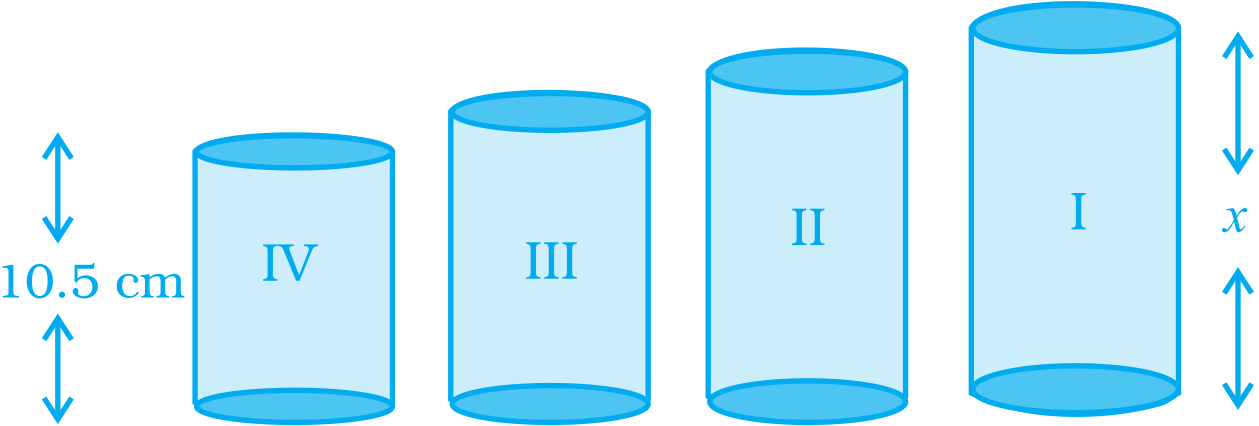
AnswerFrom the above figure,
it is given that height of the smallest cylinder is $10.5\ cm$
It is also given that height of smallest cylinder in terms of $x$ is $\frac{7}{25}\text{x}$
where $x$ is height of largest cylinder.
Then, $\frac{7}{25}\text{x}=10.5$
$\Rightarrow \text{x}=\frac{10.5}{1}\times\frac{25}{7}=\frac{10.5\times25}{7}$
$=\frac{262.5}{7}=37.5\text{cm}$
Hence, height of the container is $37.5\ cm.$
View full question & answer→Question 242 Marks
Raj travels $360\ km$ on three fifths of his petrol tank. How far would he travel at the same rate with a full tank of petrol$?$
AnswerGiven, Raj travels $360\ km$ on three-fifth of his petrol tank.
$\therefore$ Total distance trevelled $=$ Reciprocal of $\frac{3}{5}\times360\text{km}=\frac{5}{3}\times360$
$=5\times120=600\text{km}$
Hence, total distance travelled by Raj from the available petrol tank is $600\ km.$
View full question & answer→