Questions · Page 5 of 5

M.C.Q. [1 Marks Each]

MCQ 2011 Mark
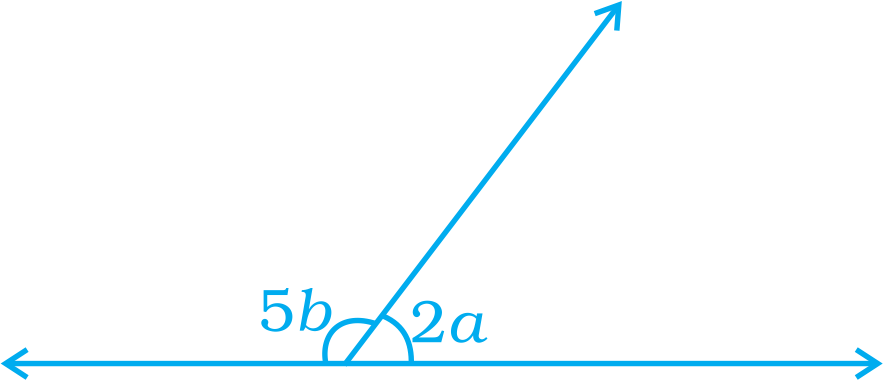
In Fig. $a = 40^\circ .$ The value of $b$ is:
  • $20^\circ$
  • B
    $24^\circ$
  • C
    $36^\circ$
  • D
    $120^\circ$
Answer
Correct option: A.
$20^\circ$

 From the given figure it is clear that,
$2a + 5b = 180^\circ [$Liner pair$]$
$\Rightarrow 2 \times 40^\circ + 5b$ $180^\circ [\because a = 40^\circ ]$
$\Rightarrow 80^\circ + 5b = 180^\circ $
$\Rightarrow 5b = 180^\circ - 80^\circ $
$\Rightarrow 5b = 100^\circ $
$\Rightarrow\text{b}=\frac{100^\circ}{5}$
$\Rightarrow b = 20^\circ $
View full question & answer
MCQ 2021 Mark
Mark the correct alternative of the following. An angle is double of its supplement. The measure of the angle is$?$
  • $60^\circ $
  • B
    $120^\circ$
  • C
    $40^\circ$
  • D
    $80^\circ$
Answer
Correct option: A.
$60^\circ $

 Let one angle be $x$ then the other be $2x.$
Then according to the problem we have, $2x + x = 180^\circ [$ Since two angles are said to be supplementary if their sum is $180^\circ $ or, $3x = 180^\circ $ or, $x = 60^\circ .$
So the measure of the angle is $60^\circ .$

View full question & answer
MCQ 2031 Mark
Two complemntary angles are in the ratio $2 : 3.$ The measure of the larger angle is:
  • A
    $60^\circ$
  • $54^\circ$
  • C
    $66^\circ$
  • D
    $48^\circ$
Answer
Correct option: B.
$54^\circ$

 Let the angles be $2x$ and $3x$
Now, $2x + 3x = 90^\circ $
$\Rightarrow 5x = 90^\circ $
$\Rightarrow x = 18^\circ $
$\therefore$ Larger angle $= 3x = 3 \times 18^\circ = 54^\circ $
Hence, the correct answer is option $(b).$

View full question & answer
MCQ 2041 Mark
Find the angle, which is $60^\circ $ more than its complement.
  • A
    $55$
  • $75$
  • C
    $85$
  • D
    $60$
Answer
Correct option: B.
$75$
Let the required angle be $x,$
then its complement $= (90 - x)$
Given that $x = (90 - x) + 60$
$\Rightarrow 2x = 150$
$\Rightarrow \text{x}=\frac{150}{2}$
$\Rightarrow\text{x}=75^\circ$
View full question & answer
MCQ 2051 Mark
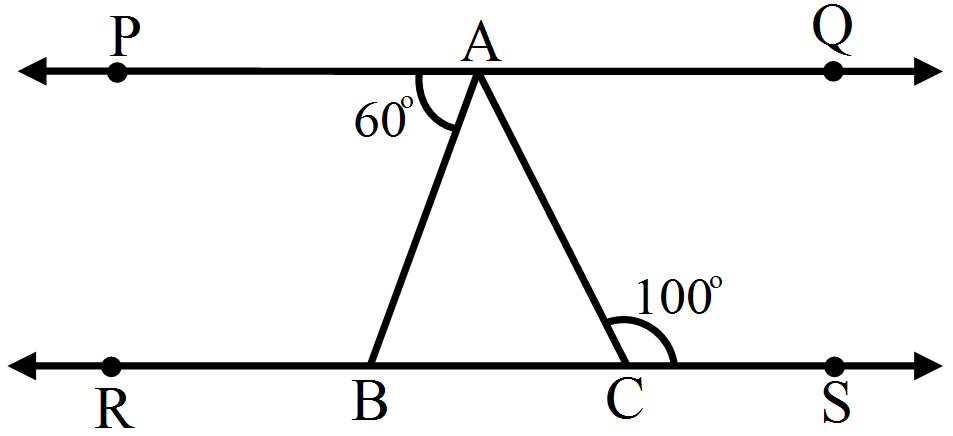
In Fig. $PO || RS$ and $\angle \text{PAB}=60^\circ$ and $\angle \text{ACS}=100^\circ.$ Then, $\angle \text{BAC}=$
  • $40$
  • B
    $60$
  • C
    $80$
  • D
    $50$
Answer
Correct option: A.
$40$

Since, $PQ || RS$
$\therefore \angle \text{PAC}= \angle \text{ACS}=100^\circ$ [Corresponding angles]
Now, $\angle \text{PAC}=100^\circ$
$\Rightarrow \angle \text{PAB}+\angle \text{BAC}=100^\circ$
$\Rightarrow 60^\circ+\angle \text{BAC}=100^\circ$
$\Rightarrow \angle \text{BAC}=40^\circ$
Hence, the correct answer is option $(a).$

View full question & answer
MCQ 2061 Mark
The measure of an angle which is four times its supplementary angle is:
  • A
    $36^\circ$
  • $144^\circ$
  • C
    $180^\circ$
  • D
    $150^\circ$
Answer
Correct option: B.
$144^\circ$

Let the required angle be $\theta $
$\therefore$ supplementary angle $= 180 - \theta $
$\therefore \theta = 4 \times (180 - \theta )$
$\Rightarrow 5\theta = 720$
$\therefore \theta = 144$

View full question & answer
MCQ 2071 Mark
Two angles are adjacent and form an angle of $100^\circ .$ The larger is $20^\circ $ less than five times the smaller. The larger angle is:
  • A
    $90^\circ$
  • B
    $70^\circ$
  • $80^\circ$
  • D
    $75^\circ$
Answer
Correct option: C.
$80^\circ$
Let the smaller angle be $x.$
Then, Larger angle $= 5x - 20^\circ .$
Given, $x + 5x - 20^\circ = 100^\circ $
$\Rightarrow 6x = 120^\circ $
$\Rightarrow x = 20^\circ $
$\therefore $ Larger angle $= 5 \times 20^\circ - 20^\circ = 80^\circ .$
View full question & answer
MCQ 2081 Mark
A bicycle wheel makes four and half turns, then the number of right angles through which it turns is ________.
  • A
    $16$
  • $18$
  • C
    $20$
  • D
    $8$
Answer
Correct option: B.
$18$

$1$ turn $= 4$ right angles
$\therefore 4 $turns $= 4 \times 4 = 16$ right angles and$  \frac{1}{2}​$ turn $= 2$ right angles.
So, the number of right angles in four and half turns $= 16 + 2 = 18$

View full question & answer
MCQ 2091 Mark
Find the measure of the angle which is half of its supplementary angle$?$
  • $ 60^\circ$
  • B
    $ 120^\circ$
  • C
    $ 90^\circ$
  • D
    $ 45^\circ$
Answer
Correct option: A.
$ 60^\circ$
$x^{\circ}=\frac{1}{2}\left(180^{\circ}-x^{\circ}\right) \Rightarrow x^{\circ}=60^{\circ}$
View full question & answer
MCQ 2101 Mark
Find the measure of the angle which is double of its complementary angle$?$
  • $ 60^\circ$
  • B
    $ 30^\circ$
  • C
    $45^\circ$
  • D
    $ 120^\circ$
Answer
Correct option: A.
$ 60^\circ$
$ x^\circ = 2(90^\circ – x^\circ )$
$\Rightarrow x^\circ = 60^\circ .$
View full question & answer
MCQ 2111 Mark
Which of the following statements is false?
  • A
     When a transversal cuts two lines, such that pairs of corresponding angles are equal, then the lines have to be parallel.
  • B
     When a transversal cuts two lines such that pairs of alternate interior angles are equal, then the lines have to be parallel.
  • C
     When a transversal cuts two lines such that pairs of interior angles on the same side of the transversal are supplementary, then the lines have to be parallel.
  •  When a transversal cuts two lines such that pairs of interior angles on the same side of the transversal are complementary, then the lines have to be parallel
Answer
Correct option: D.
 When a transversal cuts two lines such that pairs of interior angles on the same side of the transversal are complementary, then the lines have to be parallel
View full question & answer
MCQ 2121 Mark
Which of the following statements is false?
  • A
     When a transversal cuts two parallel lines, each pair of corresponding angles are equal.
  • B
     When a transversal cuts two parallel lines, each pair of alternate interior angles are equal.
  • C
     When a transversal cuts two parallel lines, each pair of interior angles on the same side of the transversal are supplementary.
  •  A transversal cuts two parallel lines in three points
Answer
Correct option: D.
 A transversal cuts two parallel lines in three points
View full question & answer
MCQ 2131 Mark
Which of the following statements is false?
  • A
     Two vertically opposite angles can be acute
  •  Two vertically opposite angles can be obtuse
  • C
     Two vertically opposite angles can be right angles
  • D
     Two vertically opposite angles may be unequal
Answer
Correct option: B.
 Two vertically opposite angles can be obtuse
View full question & answer
MCQ 2141 Mark
Which of the following statements is true?
  • A
     Two acute angles can form a linear pair.
  • B
     Two obtuse angles can form a linear pair
  • C
     Two right angles can form a linear pair
  •  One obtuse angle and one acute angle cannot form a linear pair
Answer
Correct option: D.
 One obtuse angle and one acute angle cannot form a linear pair
View full question & answer
MCQ 2151 Mark
The angles in a linear pair are
  • A
     complementary
  •  supplementary
  • C
     not adjacent angles
  • D
     vertically opposite angles
Answer
Correct option: B.
 supplementary
View full question & answer
MCQ 2161 Mark
Which of the following statements is true?
  •  Two adjacent angles can be complementary.
  • B
     Two adjacent angles cannot be supplementary
  • C
     An acute angle cannot be adjacent to an obtuse angles.
  • D
     Two right angles cannot be adjacent angles
Answer
Correct option: A.
 Two adjacent angles can be complementary.
View full question & answer
MCQ 2171 Mark
The measure of the supplement of the angle $179^\circ $ is
  • $ 1^\circ$
  • B
    $ 2^\circ$
  • C
    $ 3^\circ$
  • D
    $ 4^\circ$
Answer
Correct option: A.
$ 1^\circ$
View full question & answer
MCQ 2181 Mark
What is the measure of the supplement of the angle $0^\circ ?$
  • A
    $ 45^\circ$
  • B
    $ 90^\circ$
  • C
     $120^\circ$
  •  $180^\circ$
Answer
Correct option: D.
 $180^\circ$
View full question & answer
MCQ 2191 Mark
 Which of the following pairs of angles is not a pair of supplementary angles?
  • A
    $ 90^\circ , 90^\circ$
  •  $32^\circ , 58^\circ$
  • C
    $ 0^\circ , 180^\circ$
  • D
    $ 76^\circ , 104^\circ$
Answer
Correct option: B.
 $32^\circ , 58^\circ$
View full question & answer
MCQ 2201 Mark
The measure of the angle which is equal to its supplement is
  • A
    $ 30^\circ$
  • B
    $ 45^\circ$
  • $ 90^\circ$
  • D
    $ 60^\circ$
Answer
Correct option: C.
$ 90^\circ$
$x^\circ + x^\circ = 180^\circ \Rightarrow x^\circ = 90^\circ .$
View full question & answer
MCQ 2211 Mark
The measure of the supplement of the angle $90^\circ $ is
  • A
    $ 45^\circ$
  • B
    $ 60^\circ$
  • C
    $ 30^\circ$
  • $ 90^\circ$
Answer
Correct option: D.
$ 90^\circ$
$180^\circ – 90^\circ = 90^\circ .$
View full question & answer
MCQ 2221 Mark
Which of the following statements is true?
  • A
     Two acute angles can be supplementary.
  •  Two right angles can be supplementary.
  • C
     Two obtuse angles can be supplementary.
  • D
     One obtuse angle and one acute angle cannot be supplementary
Answer
Correct option: B.
 Two right angles can be supplementary.
View full question & answer
MCQ 2231 Mark
The measure of the supplement of the angle $120^\circ $ is
  • A
    $ 30^\circ$
  • B
    $45^\circ$
  •  $60^\circ$
  • D
    $ 90^\circ$
Answer
Correct option: C.
 $60^\circ$
$180^\circ – 120^\circ = 60^\circ .$
View full question & answer
MCQ 2241 Mark
The sum of the measures of two supplementary angles is
  • A
    $ 90^\circ$
  • $ 180^\circ$
  • C
    $ 360^\circ$
  • D
     none of these
Answer
Correct option: B.
$ 180^\circ$
Definition of supplementary angles.
View full question & answer
MCQ 2251 Mark
When the sum of the measures of two angles is $180^\circ $, the angles are called
  • A
     adjacent angles
  • B
     complementary angles
  • C
     vertically opposite angles
  •  supplementary angles
Answer
Correct option: D.
 supplementary angles
Definition of supplementary angles.
View full question & answer
MCQ 2261 Mark
What is the measure of the complement of the angle $90^\circ ?$
  • A
    $90^\circ$
  • $ 0^\circ$
  • C
    $ 180^\circ$
  • D
    $ 46^\circ$
Answer
Correct option: B.
$ 0^\circ$
$90^\circ – 90^\circ = 0^\circ .$
View full question & answer
MCQ 2271 Mark
Which of the following pairs of angles is not a pair of complementary angles?
  • A
    $ 60^\circ , 30^\circ$
  • B
     $66^\circ , 34^\circ$
  • C
     $0^\circ , 90^\circ$
  •  $160^\circ , 30^\circ$
Answer
Correct option: D.
 $160^\circ , 30^\circ$
$150^\circ + 30^\circ = 180^\circ \neq 90^\circ .$
View full question & answer
MCQ 2281 Mark
The measure of the angle which is equal to its complement is
  • A
     $30^\circ$
  • B
    $60^\circ$
  • $ 46^\circ$
  • D
    $ 90^\circ$
Answer
Correct option: C.
$ 46^\circ$
$x^\circ + x^\circ = 90^\circ \Rightarrow x^\circ = 45^\circ .$
View full question & answer
MCQ 2291 Mark
What is the measure of the complement of the angle $80^\circ ?$
  •  $10^\circ$
  • B
     $100^\circ$
  • C
    $ 36^\circ$
  • D
    $ 20^\circ$
Answer
Correct option: A.
 $10^\circ$
$90^\circ – 80^\circ = 10^\circ .$
View full question & answer
MCQ 2301 Mark
The measure of the complement of the angle $46^\circ $ is
  • A
    $ 90^\circ$
  •  $45^\circ$
  • C
    $ 16^\circ$
  • D
     $136^\circ$
Answer
Correct option: B.
 $45^\circ$
$90^\circ - 45^\circ = 45^\circ .$
View full question & answer
MCQ 2311 Mark
Which of the following statements is true?
  •  Two acute angles can be complementary to each other
  • B
     Two obtuse angles can be complementary to each other
  • C
     Two right angles can be complementary to each other
  • D
     One obtuse angle and one acute angle can be complementary to each other
Answer
Correct option: A.
 Two acute angles can be complementary to each other
View full question & answer
MCQ 2321 Mark
The measure of the complement of the angle $30^\circ $ is
  • A
    $30^\circ$
  • B
    $ 16^\circ$
  • $ 60^\circ$
  • D
    $ 160^\circ$
Answer
Correct option: C.
$ 60^\circ$
$90^\circ – 30^\circ = 60^\circ .$
View full question & answer
MCQ 2331 Mark
The sum of the measures of two complementary angles is
  • A
    $ 180^\circ$
  • B
    $ 60^\circ$
  • C
    $ 45^\circ$
  • $ 90^\circ$
Answer
Correct option: D.
$ 90^\circ$
Definition of complementary angles
View full question & answer
MCQ 2341 Mark
When the sum of the measures of two angles is $90^\circ $, the angles are called
  • A
    supplementary angles
  •  complementary angles
  • C
     adjacent angles
  • D
     vertically opposite angles
Answer
Correct option: B.
 complementary angles
Definition of complementary angles
View full question & answer
M.C.Q. [1 Marks Each] - Page 5 - MATHS STD 7 Questions - Vidyadip