Questions

5 Marks Questions

🎯

Test yourself on this topic

12 questions · timed · auto-graded

Question 15 Marks
Explain the process involved in obtaining wool.
Answer
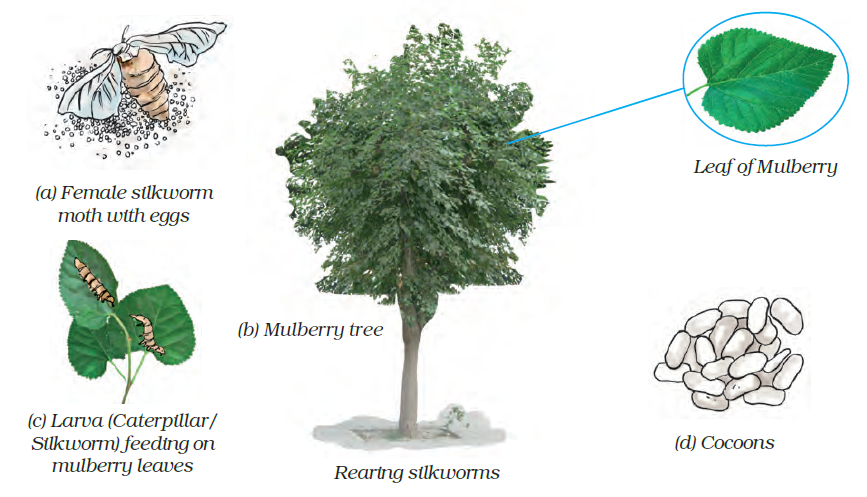
For obtaining silk, moths are reared and their cocoons are collected to get silk threads. The cocoons are boiled to separate out silk fibres from cocoon. Threads obtain from the cocoon spun into silk threads, which are woven into silk cloth by weavers. The process of taking out threads from the cocoon for use as silk is called reeling the silk. Sericulture is the rearing, breeding and management of silkworms for the production of raw silk. For obtaining silk, silk worm moths are reared and their cocoons are collected to get silk threads. Silk yarns come from the cocoon of the silkworm. The caterpillar hatches from a very small egg and is an eating machine. Their diet of continually eating mulberry leaves results in a semi-liquid protein called fibroin. When the silkworms start its spinning process in the cocoon, the worm's head is coated with a gummy protein called sericin. The silkworm rotates its body thousands of times extruding one continuous strand of silk the length of 12 football fields. The silk adheres to itself, forming the cocoon. Female silk moth lays hundreds of eggs at a time' these eggs are stored carefully on strips of cloth or paper and are sold to silkworm farmers. The eggs are kept in hygienic condition and under suitable temperature and humidity, then the eggs are warmed to suitable temperature and the larva is hatched from the eggs. This is done when mulberry trees bear a fresh crop of leaves. The larvae called caterpillar eat day and night and gets bigger and bigger in size, and are kept on clean bamboo trays along with freshly chopped mulberry leaves. After 25 to 30 days caterpillars stop eating and move to a tiny chamber of bamboo in the tray to spin cocoons. The caterpillar or silkworm spins the cocoon inside which silk moth is developed.
View full question & answer
Question 25 Marks
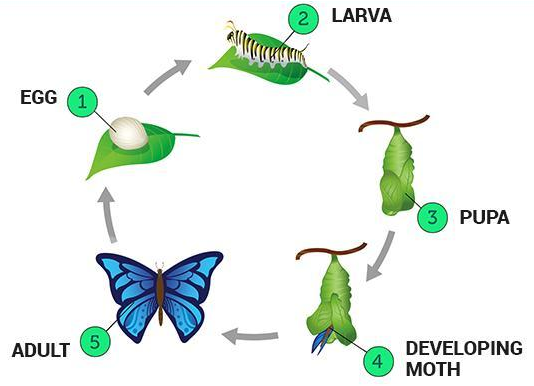
Describe the life history of silk moth with the help of figures of various stages.
Answer

Life History of Silk Moth Formation of Silkworm,
The female silk moth lays eggs on mulberry leaves. The eggs are hatched into very small larvae within a week. The larvae of silk moth are called caterpillar or silkworm. The silkworms feed on the leaves of mulberry tree and grow bigger in size.

Development of Cocoon-
When the silkworm (or caterpillar) is ready to enter the next stage of its development called pupa, it first weaves a net to hold itself. Then, it swings its head from side to side. During these movement of head, the silkworm secrets fibre made of protein which hardens on exposure to air and becomes silk fibre (or silk thread). Soon the silkworm (or caterpillar) covers itself by silk fibres and turns into pupa. This covering is known as cocoon. The silkworm continues to develop in the form of pupa inside the cocoon to form the silk moth.
Production of Silk-
In order to produce silk, the silkworm developing inside the cocoon (as pupa) is not allowed to mature into an adult silk moth. So, as soon as the cocoon is formed, it is used to obtain silk fibres and the developing silkworm (as pupa) gets killed. Some of the silkworms (as pupae) are however, allowed to live and mature into silk moths so that they can lay eggs to produce more silkworms.
There is a variety of silk moths which look very different from one another and the silk yarn they yield is different in texture (coarse, smooth, shiny, etc). Thus, tassar silk, kosa silk, mooga silk, etc are obtained from cocoons spun by different types of moths. The most common silk moth is the mulberry silk moth. The silk obtained from the cocoons of mulberry silk moth is called mulberry silk. Mulberry silk is soft, lustrous (shiny) and elastic and can be dyed in beautiful colours.
Take a thread of pure silk and another thread of an artificial (synthetic) silk. Burn them separately and observe the smell produced. The thread which burns giving a smell of burning hair will be pure silk thread. The thread which burns giving a smell of burning paper will be artificial silk thread.
View full question & answer
Question 35 Marks
How silkworms are reared? Explain in brief.
Answer

Pure and Artificial Silk - Pure silk is obtained from the cocoons of silkworm and it is made up of protein. Artificial silk is obtained from wood pulp and it is made of modified plant material ‘cellulose’. Just like silk, wool is also made up of proteins. So, a piece of woollen fabric also burns giving the smell of burning hair. The thread which burns giving a smell of burning paper will be cotton fibres. Cotton and paper both are carbohydrates. Paper is made of cellulose obtained from wood pulp. So, on burning cotton and paper both give similar smell.

From Cocoon to Silk - For obtaining silk, silk moths are reared and their cocoons are collected to get silk thread.
Rearing Silkworms - A female silk moth lays hundred of eggs at a time. The eggs are stored carefully on strips of paper or cloth and sold to silkworm farmers. The farmers keep eggs under hygienic condition. They warm them to a suitable temperature for the larvae to hatch from egg.
The larvae are kept in clean bamboo trays along with young and freshly chopped mulberry leaves. After 25-30 days, the silkworms stop eating and start spinning the cocoons. Small racks or twigs may be provided in the trays to which cocoons get attached.
Processing Silk - The cocoons are collected and boiled in water to kill the insect inside them. The resulting fibre is known as raw silk. The silk fibres separate out.
Reeling the Silk - The process of taking out fibres from the cocoon for use as silk is known as reeling the silk. Reeling is done in special machines. Silk fibres are spun into silk threads which are woven into silk cloth by weavers.
View full question & answer
Question 45 Marks
How we get wool fibres from sheep?
Answer
The processing of fibres into wool involves the following steps:Step I: Shearing: At first hair are removed using shearing machine.
Step II: scouring: Hair is washed in tanks to remove grease, dust and dirt. This process is called scouring.
Step III: After scouring, sorting of hair is done on the basic of different texture.
Step IV: The small fluffy fibres, called burrs, are picked out from the hair.
Step V: The fibres then dyed in various colours, according to choice.
Step VI: The coloured fibres are straightened, combed and rolled into yarn.
View full question & answer
Question 55 Marks
Name some breeds of sheep reared in our country. Explain the quality of wool they provide and the state where they are found.
Answer
Name of breed of sheep
Quality of wool
Name of the state where found
Lohi
Good quality wool
Rajasthan, Punjab
Rampur bushair
Brown fleece
Uttar Pradesh, Himachal Pradesh
Nali
Carpet wool
Rajasthan, Haryana, Punjab
Bakharwal
For woollen shawls
Jammu and Kashmir
Marwari
Coarse wool
Gujarat
Patanwadi
For hosiery
Gujarat
View full question & answer
Question 65 Marks
Explain the process of obtaining silk from the silk moth.
Answer
The processing of fibres into wool involves the following steps:
Step I: Shearing: At first hair are removed using shearing machine.
Step II: scouring: Hair is washed in tanks to remove grease, dust and dirt. This process is called scouring.
Step III: After scouring, sorting of hair is done on the basic of different textures.
Step IV: The small fluffy fibres, called burrs, are picked out from the hair.
Step V: The fibres then dyed in various colours, according to choice.
Step VI: The coloured fibres are straightened, combed and rolled into yarn.
View full question & answer
Question 75 Marks
Write various steps for processing fibres into wool.
Answer
The various steps for processing fibres into wool are as follows:
  1. Shearing The first step is to remove fleece of the sheep along with thin layer of skin. This process is called shearing.
  2. Scouring In this step, the sheared hair is washed thoroughly to remove grease, dust and dirt.
  3. Sorting In this step, different textures of hair are separated or sorted.
  4. Separating burrs Burrs are small fluffy fibres which are picked out from the hair.
  5. Dyeing The fibres are dyed in various colours, as the original colours of fleece are usually black, white or brown.
  6. Rolling In this process, the fibres are straightened, combed and rolled into yarn. And the fibres now as wool are ready to be woven.
View full question & answer
Question 85 Marks
Match the items of Column I with the items given in Column II.
Column I
 
 
Colunm II
a.
Yak wool
i
Sheared hair.
b.
Angora goats
ii
Silkworm.
c.
Mulberry leaves
iii
Tibet and ladakh.
d.
Scouring
iv
Jammu and kashmir.
Answer
Column I
 
 
Colunm II
a.
Yak wool
iii
Tibet and Ladakh.
b.
Angora goats
iv
Jammu and Kashmir.
c.
Mulberry leaves
ii
Silkworm.
d.
Scouring
i
Sheared hair.
Yak are found in Tibet and Ladakh, while angora goats are reared in Jammu and Kashmir. Mulberry leaves are used to feed silkworm. Scouring is the process to clean sheared hair.
View full question & answer
Question 95 Marks
Write a short note on how first silk industry began in China.
Answer
According to an old Chinese legend, the empress Si-lung-Chi was asked by the emperor Huang-ti to find the cause of the damaged leaves of mulberry trees growing in their garden. The empress found white worms eating up mulberry leaves. She also noticed that they were spinning shiny cocoons around them. Accidentally, a cocoon dropped into her cup of tea and a tangle of delicate threads separated from the cocoon. This is how silk was discovered by chance. In this way, the first silk industry began in China.
View full question & answer
Question 105 Marks
A wholesale woollen fibre dealer gets the woollen fibre of different textures sorted for various purposes. Match the items in Column I with the woollen fibre in Column II.
 
Column I
 
Column II
a.
Pashmina shawl
i
Camel wool.
b.
Woollen carpet
ii
Angora wool.
c.
Baby
iii
Kashmir goat.
d.
Wollen sweater
iv
sheep wool.
Answer
 
Column I
 
Column II
a.
Pashmina shawl
iii
Kashmiri goat.
b.
Woollen carpet
i
Camel wool.
c.
Baby
ii
Angora wool.
d.
Wollen sweater
iv
sheep wool.
View full question & answer
Question 115 Marks
Write and explain the sequence of steps in processing of wool.
Answer
Following are the steps involved in processing of wool:
  1. Shearing, scouring, Sorting, fiber spinning, fiber dying, rolling into Silk yarn.Rearing is raising livestock like goat, cows, sheep etc. for commercial purpose by taking them out in herds for grazing , feeding them on a mixture of pulses, corn, jowar, oil cakes (material left after taking out oil from seeds) and minerals for better growth and yield of produce like meat, milk, wool. Beside this in extreme climatic condition like winter these are also provided shelter and fed on leaves, grain and dry fodder.
  2. Shearing is the process in which fleece of the sheep along with a thin layer of skin is removed from its body. Machines similar to those used by barbers are used to shave off hair. Generally, the hair is removed during the hot weather which enables the sheep to survive without their protective coat of hair. The hair provides woollen fibres. Woollen fibres are then processed to obtain woollen yarn. Shearing does not hurt the sheep as the uppermost layer of the skin is dead.
  3. Sericulture is the rearing, breeding and management of silkworms for the production of raw silk. For obtaining silk, silk worm moths are reared and their cocoons are collected to get silk threads. Silk yarns come from the cocoon of the silkworm. The caterpillar hatches from a very small egg and is an eating machine. Their diet of continually eating mulberry leaves results in a semi-liquid protein called fibroin. When the silkworms start its spinning process in the cocoon, the worm's head is coated with a gummy protein called sericin. The silkworm rotates its body thousands of times extruding one continuous strand of silk the length of 12 football fields. The silk adheres to itself, forming the cocoon.
View full question & answer
Question 125 Marks
Match the words of Column $I$ with those given in Column $II:$
 
Column I
 
Column II
$1.$
Scouring
$(a)$
Yields silk fibres
$2.$
Mulberry leaves
$(b)$
Wool yielding animal
$3.$
Yak
$(c)$
Food of silk worm
$4.$
Cocoon
$(d)$
Reeling
 
 
$(e)$
Cleaning sheared skin
Answer
 
Column I
 
Column II
$1.$
Scouring
$(e)$
Cleaning sheared skin
$2.$
Mulberry leaves
$(c)$
Food of silk worm
$3.$
Yak
$(b)$
Wool yielding animal
$4.$
Cocoon
$(a)$
Yields silk fibres
View full question & answer