Questions

5 Marks Questions

🎯

Test yourself on this topic

14 questions · timed · auto-graded

Question 15 Marks
Match the items given in Column I with those in Column II:
Column I Column II
Chlorophyll Bacteria
Nitrogen Heterotrophs
Amarbel Pitcher plant
Animals Leaf
Insects Parasite
Answer
Column I Column II
Chlorophyll Leaf
Nitrogen Bacteria
Amarbel Parasite
Animals Heterotrophs
Insects Pitcher plant
View full question & answer
Question 35 Marks
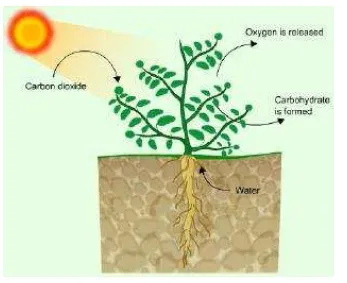
Give a brief description of the process of synthesis of food in green plants.
Answer
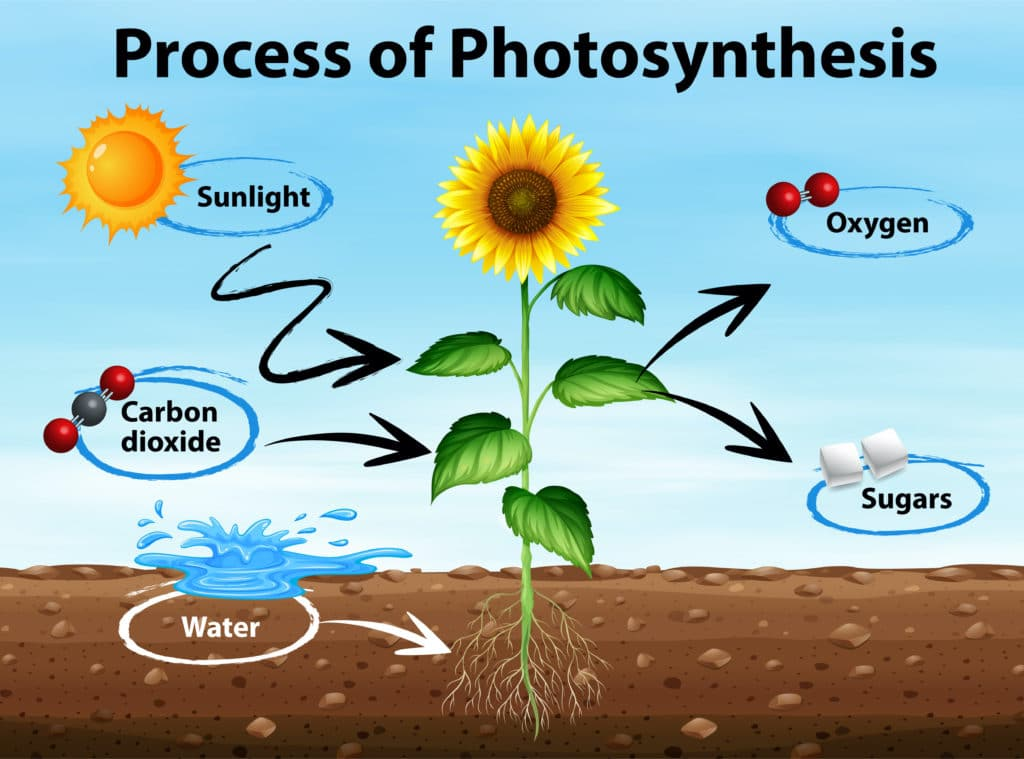
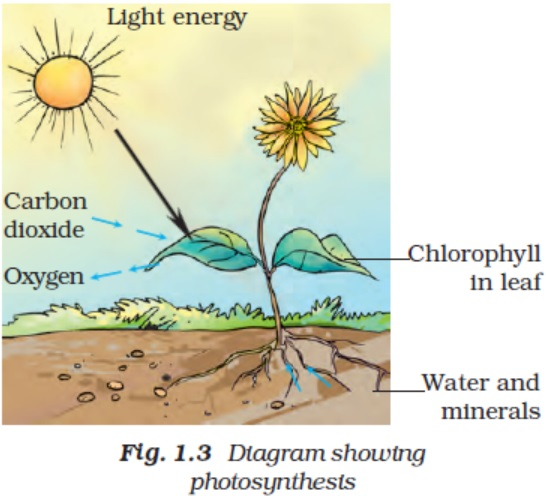
Photosynthesis is defined as the process in which the chlorophyll-containing plant cells synthesise food in the form of carbohydrates, using carbon dioxide and water in the presence of solar energy.
Image
Photosynthesis
Sources of raw materials required for photosynthesis:
$a)$ Water is taken in from the roots of the plant and is transported to the leaves.
$b)$ Carbon dioxide from the air enters the leaves through the tiny pores called stomata and diffuses to the cells containing chlorophyll.
$c)$ Solar energy is used to break water into hydrogen and oxygen. This hydrogen is combined with carbon dioxide to form food for the plants, which is ultimately used by the animals as well.
Thus, photosynthesis can be represented by the following equation.
$\underset{\text { Carbon Dioxide }}{6 CO _2}+\underset{\text { Water }}{6 H _2 O } \underset{\text { Chlorophyll }}{\stackrel{\text { Sunlight }}{\longrightarrow}} \underset{\text { Carbohydrate }}{ C _6 H _{12} O _6}+\underset{\text { Oxygen }}{6 O _2}$
View full question & answer
Question 45 Marks
Distinguish between a parasite and a saprotroph.
Answer
Parasite Saprotroph
The organism that grows on the body of another organism and derives nutrients from it is known as a parasite The organism that obtains nutrients from the dead or decaying organic matter is called saprotroph
The Organism on Which it feeds is called host They do not feed on a living organism
Examples of parasites are Cuscuta and orchids. Examples of saprotrophs are fungi and some bacteria.

View full question & answer
Question 55 Marks
Describe the method for replinishing the soils with minerals and other essential constituents used by plants growing in those soil by farmers.
Answer
Replenishment of Nutrients in Soil:
Crops require a lot of nitrogen to make proteins. After the harvest, the soil becomes deficient in nitrogen. Plants cannot use the nitrogen gas available in atmosphere directly. Action of certain bacteria can convert this nitrogen into form readily used by plants. Rhizobium bacteria live in the root nodules of leguminous plants. These bacteria take nitrogen gas from the atmosphere and convert it into water soluble nitrogen compounds making it available to the leguminous plants for their growth.
In return, leguminous plants provide food and shelter to the bacteria as Rhizobium cannot prepare its food. They, thus have a symbiotic relationship. This association is very important for the farmers, as they do not need to add nitrogen fertilisers to the soil in which leguminous plants are grown.
View full question & answer
Question 65 Marks
Distinguish between a parasite and a saprotrophs.
Answer
S.No.
Parasites
Saprotrophs
$1.$
A parasite takes readymade food from the organism on which it feeds.
They secrete the digestive juices on the matter they live and convert it into a solution and then absorb it.
$2.$
They feed on a living organism.
They feed on dead and decaying organism.
$3.$
The organism on which it feeds is called host.
They do not feed on a living organism.
$4.$
It deprives the host of valuable nutrients
There is no host at all.
View full question & answer
Question 75 Marks
Describe the process by which plants prepare their food using different raw materials.
Answer

The process by which green plants can prepare their own food is called photosynthesis. Green plants possess chlorophyll in their leaf and utilises carbon dioxide (from air) water, minerals (from soil, through root) as raw material and sunlight as source of energy and convert light energy into chemical energy. The food thus synthesised is in the form of starch (carbohydrate). The overall reaction for photosynthesis can be given as follows:
View full question & answer
Question 85 Marks
How would you test the presence of starch in leaves?
Answer
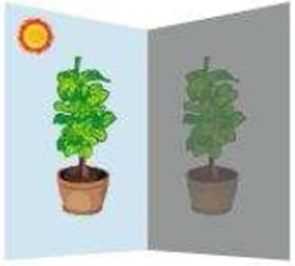
Experiment to test the presence of starch in leaves: Take two healthy green potted plants of the same type. Keep one potted plant in a dark room for one or two days in order to remove all the starch from the leaves. Keep the other plant in sunlight. Now, take one leaf from each potted plant and put a few drops of iodine solution on them. Then note down the observation.

Plants kept in light and dark conditions: No blue black colour will be observed on the leaves of the plant kept in the dark room. This indicates the absence of starch. Blue black colour will be observed on the leaves of the plant kept in sunlight. This indicates the presence of starch.
View full question & answer
Question 95 Marks
What is photosynthesis?
Answer
It is the process by which green plants prepare their own food is called photosynthesis. The chlorophyll containing leaves in the presence of sunlight converts carbon dioxide and water into glucose (carbohydrate sugar) and produces oxygen. Later this glucose is converted into starch and gets stored in plants. $\text{Water + Carbon Dioxide}\xrightarrow[\text{Sunlight}]{\text{Chlorophyll}}\text{Starch + Oxygen}$
View full question & answer
Question 105 Marks
Wild animals like tiger, wolf, lion and leopard do not eat plants. Does this mean that they can survive without plants? Can you provide a suitable explanation?
Answer
Animals like tiger, wolf, lion and leopard are carnivorous and do not eat plants. They hunt and eat herbivorous animals like deer, gaur, bison, zebra, giraffe, etc., which are dependent on plants for food. If there are no plants, herbivorous animals will not be able to survive as they will have no food and would die of starvation. This will ultimately affect animals like tiger, wolf, lion and leopard that depend on herbivorous animals for food. They will have nothing to eat and thus would not survive from this, it can be concluded that all heterotrophs directly or indirectly depend on plants for food and cannot survive without plants.
View full question & answer
Question 115 Marks
Different modes of nutrition has been observed in plants. What are they? Give example of each.
Answer
Plants show two major modes of nutrition, i.e.
  1. Autotrophs are those which can synthesise their own food.
  2. Heterotrophs are those which are dependent on other plants and animals for their food.
They are of following types:
  1. Parasites, e.g. Cuscuta.
  2. Saprotrophs, e.g. fungi.
View full question & answer
Question 125 Marks
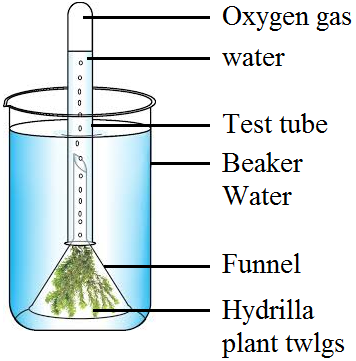
With the help of an activity prove that light is necessary for photosynthesis.
Answer
  • Take some twigs of an aquatic plant like Hydrilla in beaker filled with water.
  • Invert a funnel over the twigs. Invert a test tube filled with water on the stem of the funnel.
  • Keep this set-up in sunlight for sometime.
  • Air bubbles (oxygen gas) will be seen coming out from the twigs. If this set-up is kept in the dark, no air bubbles will be seen.
This proves that light is necessary for photosynthesis
View full question & answer
Question 135 Marks
Match the organisms given in Column $I$ with their mode of nutrition given in Column $II.$
  Column I   Column II
$(a)$ Mango tree $(i)$ Insectivorous plant
$(b)$ Mushroom $(ii)$ Heterotroph
$(c)$ Pitcher plant $(iii)$ Autotroph
$(d)$ Cuscuta $(iv)$ Saprophyte
$(e)$ Elephant $(v)$ Parasitic
Answer
 
Column I
 
Column II
$(a)$
Mango tree
$(iii)$
Autotroph
$(b)$
Mushroom
$(iv)$
Saprophyte
$(c)$
Pitcher plant
$(i)$
Insectivorous plant
$(d)$
Cuscuta
$(v)$
Parasitic
$(e)$
Elephant
$(ii)$
Heterotroph
Explanation:
  1. Mango tree prepares its own food, has green leaves-Autotroph.
  2. Mushroom grows on dead and decaying organic matter and obtain their nutrition from them. So, they are saprophytes.
  3. Pitcher plant has modified leaves that trap insect to obtain nitrogen compounds. Thus, it is an insectivorous plant.
  4. Cuscuta does not have chlorophyll. It takes food from the tree on which it climbs, depriving the host tree of nutrients. Therefore, it is parasitic. Elephant cannot make its own food. So, its a heterotroph.
View full question & answer
Question 145 Marks
Match the items given in Column I with those in Column II:
Column I Column II
Chlorophyll Rhizobium
Nitrogen Heterotrophs
Cuscuta Pitcher plant
Animals Leaf
Insects Parasite
Answer
Column I Column II
Chlorophyll Leaf
Nitrogen Rhizobium
Cuscuta Parasite
Animals Heterotrophs
Insects Pitcher plant
View full question & answer
5 Marks Questions - Science STD 7 Questions - Vidyadip