Questions

3 Marks Question

🎯

Test yourself on this topic

32 questions · timed · auto-graded

Question 13 Marks
Why is blood needed by all the parts of a body$?$
Answer
Blood is needed by all parts of the body as it is an important part of the transport system of our body. It performs the following important functions:
$1)$ It transports $\mathrm{O}_2$ from the lungs to all the body cells.
$2)$ It carries $\mathrm{CO}_2$, a waste product back to the lungs so that it can be exhaled easily.
$3)$ It transmits heat, thus regulating the body temperature.
$4)$ It also fights off diseases and infections.
View full question & answer
Question 23 Marks
What are the components of blood$?$
Answer
The main components of blood are
$1)$ Red blood cells $(RBCs):$ Red blood cells are the most abundant cells in the blood. These cells contain a red pigment called haemoglobin. It is the haemoglobin which carries oxygen and transports it to all parts of the body
$2)$ White blood cells $(WBCs):\ WBCs$ are colourless cells without haemoglobin. They fight against infections and protect the body from foreign particles such as germs and bacteria
$3)$ Platelets: Platelets are the smallest cells in the blood. The main function of platelet is to prevent bleeding.
View full question & answer
Question 33 Marks
Does transpiration serve any useful function in the plants? Explain.
Answer
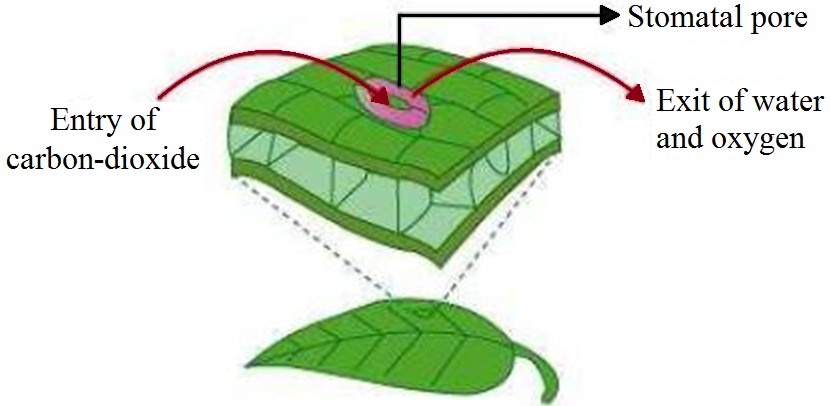
Transpiration is the evaporation of water from the plants. The water evaporates through the stomata present on the surface of the leaves.

Transpiration is mainly responsible for the loss of water that was absorbed by the plants. However, it is important for plants as it helps in the movement of water to the top of tall trees. As a result, it helps in the distribution of water throughout the plant body. It also helps in cooling the plant.

View full question & answer
Question 43 Marks
Why is transport of materials necessary in a plant or in an animal? Explain.
Answer
Transport of materials is necessary in both plants and animals as every cell needs a regular supply of nutrients and oxygen for releasing energy through respiration. The food that we eat is broken down into smaller components to be absorbed by the cells. The oxygen that we inhale is also transported to all the cells of the body. Our body also requires a constant removal of waste materials such as carbon dioxide. For the transport of all these materials (food, oxygen, and wastes), our body has a specialised transport system. Similarly, in plants, the transport of water and food is accomplished with the help of a complex transport system.
View full question & answer
Question 53 Marks
While learning to ride a bicycle Boojho lost his balance and fell. He got bruises on his knees and it started bleeding. However, the bleeding stopped after some time.
  1. Why did the bleeding stop?
  2. What would be the colour of the wounded area and why?
  3. Which type of blood cells are responsible for clotting of blood?
Answer
  1. A wound stops bleeding after sometime due to the process of clot formation. It plugs the cut and bleeding stops.
  2. Wounded area becomes dark red in colour due to the clotting of blood.
  3. The blood clot is formed due to the presence of the cells called platelets in the blood.
View full question & answer
Question 63 Marks
Differentiate between $RBC$ and $WBC.$
Answer
S.No.
RBC
WBC
$1.$
They are red in colour.
They are colourless.
$2.$
They help in transport of gases.
They help in fighting against germs and infection.
$3.$
They have haemoglobin.
They lack haemoglobin.
View full question & answer
Question 73 Marks
Human have two major organs that perform transport of materials. Organ $‘A’$ is bean-shaped and dark red in colour lie just above the waist. It helps in’removal of $‘Q’,$ a waste material from blood. The organ $‘S’$ is the opening at the end of the urinary bladder through which the waste material is eliminated. Organ $‘B’$ lies in the chest cavity slightly tilted towards the left side. It pumps continuously and pours liquid $‘C’$ into arteries and through very fine tube-like structure $‘D’$ distributes the liquid to various parts of the body. What are the name of these organs.
Answer
Organ $‘A’$ is kidney which is bean-shaped and helps in the removal of urea $(Q)$ which is a waste material from the blood. $‘S’$ is urethra which is the small opening at the end of urinary bladder. Organ $‘B’$ is heart which acts as pump. It pumps liquid blood continuously and pours into arteries, and through capillaries $(D)$ which are fine tube-like structure, the blood is distributed to various parts of the body.
View full question & answer
Question 83 Marks
What is the special feature present in a human heart which does not allow mixing of blood when oxygen-rich and carbon dioxide-rich blood reach the heart?
Answer
In human, the heart has four chambers. The two upper chambers are called the atria and the two lower chambers are called the ventricles.
On the left side are the left atrium and left ventricle and on the right side of the heart are right atrium and right ventricle.
The left side of the heart is completely separated from its right side by means for a partition of thick muscles called the septum. This septum prevents the mixing of oxygenated blood on the left side with the deoxygenated blood on its right side.
View full question & answer
Question 93 Marks
What are stomata? Give two functions of stomata.
Answer

Stomata are tiny pores present on the surface of a leaf. Functions of stomata:
  1. Stomata help in the exchange of gases.
  2. Evaporation of water from the leaf surface occurs through stomata.
View full question & answer
Question 103 Marks
What is the significance of transport of materials in plants and animals?
Answer
Transport of materials is very important in plant or in animals as all organisms need food, nutrition, water and oxygen for survival. The food is the source of energy and every cell of an organism gets energy by the breakdown of glucose. The cells use this energy to carry out vital activities of life. Therefore food must be made available to every cell of an organism. They need to transport all these to various parts of their body. Further, animals need to transport wastes to parts from where they can be removed.
View full question & answer
Question 113 Marks
While riding a bike, Mason fell from it due to loss of balance. He got up and realised that he was bleeding from several wounds badly. He panicked and started to run but Mansi who was looking at him, stopped him and told him to clean his wound with a clean cloth and that blood will stop coming in a while. Mason noticed that he has stopped bleeding after sometime and a hard covering was appearing on his wounds.
  1. Why did the bleeding stop after a while?
  2. What is blood and what type of cells are responsible for clotting?
  3. What of values do you think Mansi have?
Answer
  1. Bleeding stops after sometime because some specialised cells start forming a hard covering called clot at the site of wound.
  2. Bleeding is a fluid connective tissue present in all parts of the body. Platelets are responsible for formation of clot.
  3. Mansi is helpful, knowledgeable and interested in science subject.
View full question & answer
Question 123 Marks
State one function of the following:
  1. Arteries.
  2. Vein.
  3. Capillaries.
Answer
  1. Arteries: Carry blood from heart to different parts of body.
  2. Veins: Carry blood from different parts of body to the heart.
  3. Capillaries: Exchange of material between blood and surrounding cells.
View full question & answer
Question 133 Marks
Make a table to show the donor blood group and recipient blood group.
Answer
It can be shown as follows:
Blood group
Can donate blood to
Can receive blood from
$A$
$A$ and $AB$
$A$ and $O$
$B$
$B$ and $AB$
$B$ and $O$
$AB$
$AB$
All the group, i.e. $A, B, AB$ and $O$
$O$
All the group, i.e. $A, B, AB$ and $0$
$O$
View full question & answer
Question 143 Marks
Arrange the following statements in the correct order in which they occur during the formation and removal of urine in human beings.
  1. Ureters carry urine to the urinary bladder.
  2. Wastes dissolved in water is filtered out as urine in the kidneys.
  3. Urine stored in urinary bladder is passed out through the urinary opening at the end of the urethra.
  4. Blood containing useful and harmful substances reaches the kidneys for filtration.
  5. Useful substances are absorbed back into the blood.
Answer
The correct order of the formation and removal of urine in human beings is:
  1. Blood containing useful and harmful substances reaches the kidneys for filtration.
  1. Useful substances are absorbed back into the blood.
  1. Wastes dissolved in water is filtered out as urine in the kidneys.
  1. Ureters carry urine to the urinary bladder.
  1. Urine stored in urinary bladder is passed out through the urinary opening at the end of the urethra.
View full question & answer
Question 153 Marks
What will happen if there are no platelets in the blood?
Answer
If there are no platelets in the blood, then the blood would not be able to clot. A clot is formed because of platelets. They release blood clotting chemicals at the site of injury. These chemicals form a clot and prevent further bleeding.
View full question & answer
Question 163 Marks

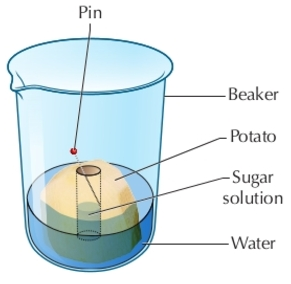
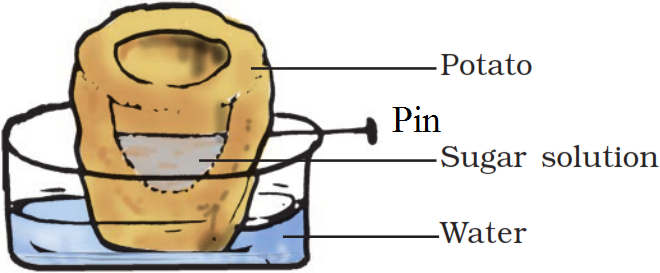
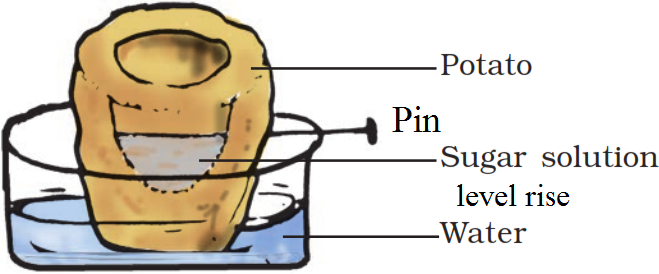
Look at figure and draw another figure of the same set up as would be observed after a few hours.
Answer
After the few hours, the figure will be shown as follows, This figure shows that there will be an increase in the level of sugar solution in the potato piece. This increase in the level of sugar solution rises due to water that passes through the wall of potato and goes inside it.
View full question & answer
Question 173 Marks
List some animals surrounding your locality group them into following groups.
  1. Animals that excrete ammonia in gaseous forms.
  2. Animals that excrete uric acid in the form of pellets.
  3. Animals that excrete urea in the form urine.
Answer
Some animals that surround us are fish, frog, birds, tadpole larva, snake, cow, man, rat, monkey, lizard, toad and snail.These can be grouped as follows:
  1. Animals that excrete ammonia in gaseous form (i.e. ammonotelics)- Fish, tadpole larva.
  2. Animals that excrete uric acid in the form of pellets (i.e. uricotelics)- Bird, snake, rat, lizard, snail.
  3. Animals that excrete urea in the form of urine (i.e. ureotelics)- Frog, cow, man, monkey, toad.
View full question & answer
Question 183 Marks

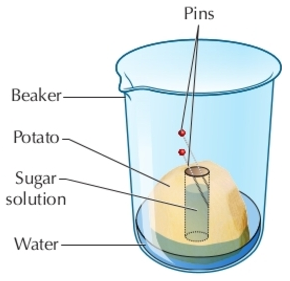
Look at Figure Draw another figure of the same set-up as would be observed after a few hours.
Answer

After a few hours, the same set-up would be as shown as below:

This figure shows that there will be an increase in the level of sugar solution in the potato piece. The level of sugar solution can rise only if some water from the petridish passes through the wall of potato and goes inside it.
Since, the water level has risen, it shows that water can move from cell to cell in the potato wall and reaches inside the cavity.
View full question & answer
Question 193 Marks
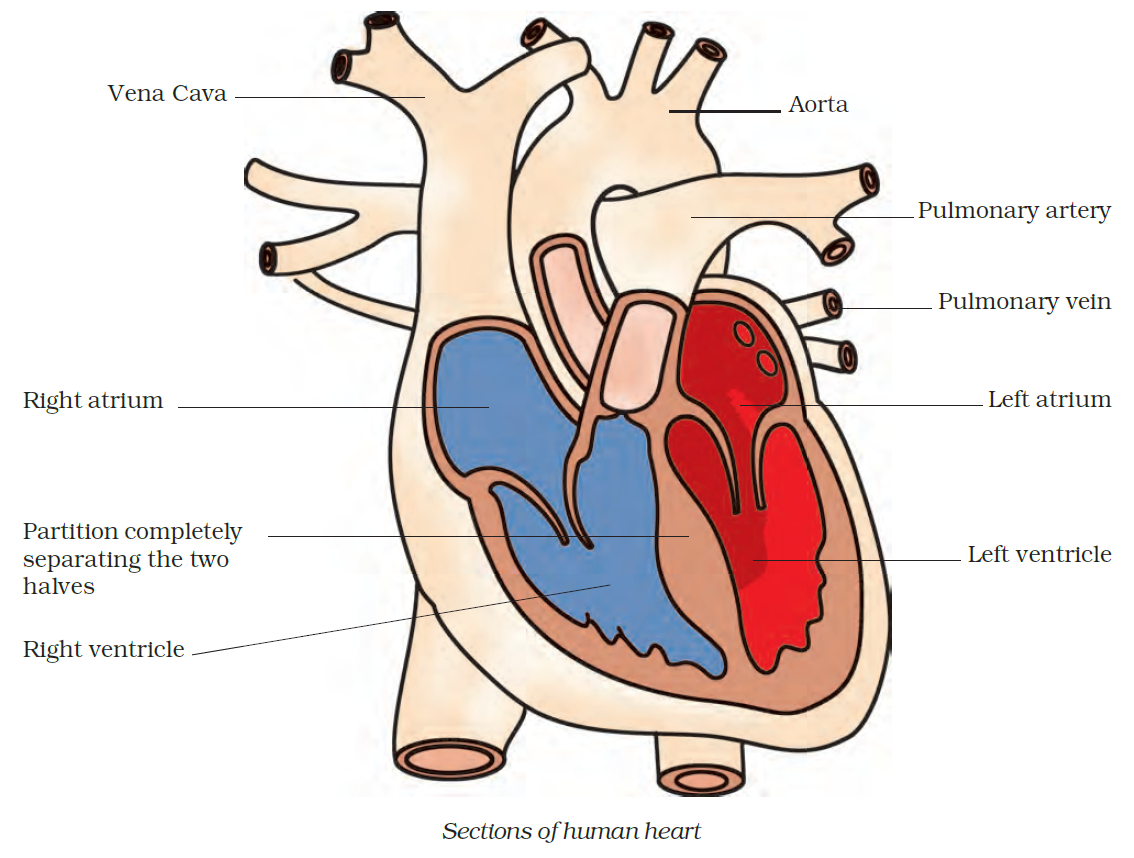
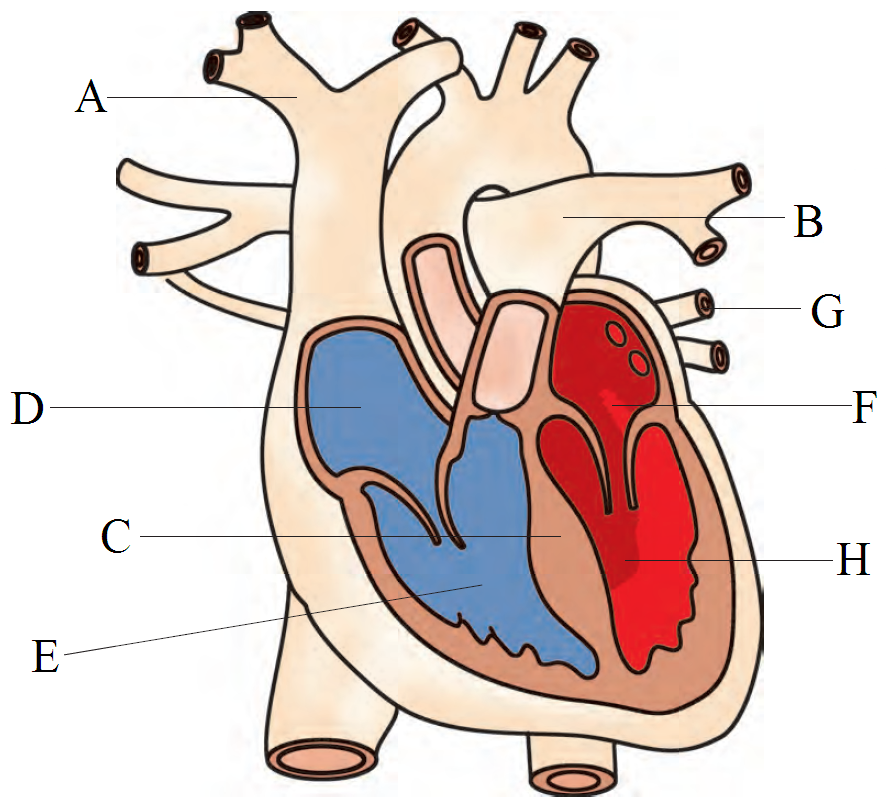
Observe the given diagram of human heart and label all the parts from $A$ to $H.$
Answer


The heart is an organ which beats continuously as a pump for the transport of blood carrying other substances with it, through a network of tubes or blood vessels. The heart pumps blood throughout our life without stopping or relaxing.
View full question & answer
Question 203 Marks
Distinguish between the following. Xylem and Phloem.
Answer
S. No.
Xylem
Phloem
$(i)$
It transports water from roots to different parts of plant.
It transports food from the leaves to different parts of plant.
$(ii)$
The movement of water is unidirectional.
The movement of food is bidirectional.
$(iii)$
It is a living tissue.
It is non-living at maturity.
View full question & answer
Question 213 Marks
Enlist the functions of blood.
Answer
  • It transports substances like digested food from the small intestine to the other parts.
  • It carries oxygen and carbon dioxide to their respective organs and tissues.
  • It transports wastes for removal from the body.
View full question & answer
Question 223 Marks
Distinguish between the following. Arteries and Veins.
Answer
S. No.
Arteries
Veins
(i)
They carry oxygenated blood from heart to different organs.
They carry deoxygenated blood from the organs to the heart.
(ii)
They are usually deep-seated.
They are superficial in position.
(iii)
They do not contain valves.
They contain valves at regular intervals.
View full question & answer
Question 233 Marks
Distinguish between the following. Blood and Plasma.
Answer
S. No.
Blood
Plasma
$(i)$
It is the connective tissue in human body.
It is the watery fluid of blood.
$(ii)$
It is red in colour.
It is pale yellow in colour.
$(iii)$
It contains two types of cells-white blood cells and red blood cells.
It does not contain any cells but is rich in nutrients.
View full question & answer
Question 243 Marks
Why is it necessary to excrete waste products?
Answer
All cells of our body produce waste products. These waste products are toxic to the body and therefore need to be excreted out. This process of removing waste products produced in the cells of living organisms is called excretion.
View full question & answer
Question 253 Marks
Why is it called an artery if it does not carry oxygen-rich blood?
Answer
The main function of artery is to carry blood away from the heart. Also, arteries have thick walls and do not contain valves. Blood flow in arteries, takes place at high pressure. All these characteristics are found in pulmonary artery. It carries away deoxygenated blood from heart to lungs for oxygenation, therefore it is called an artery.
View full question & answer
Question 263 Marks
Paheli uprooted a rose plant from the soil. Most of the root tips, with root hairs got left behind in the soil. She planted it in a pot with new soil and watered it regularly. Will the plant grow or die? Give reason for your answer
Answer
Possible answers are:
  1. Without the root hairs, the roots will not be able to absorb water and nutrients and the plant will die.
  2. The stem of the rose plant may grow new roots and the plant will live.
  3. The rose plant may not be able to survive in a different type of soil.
View full question & answer
Question 273 Marks
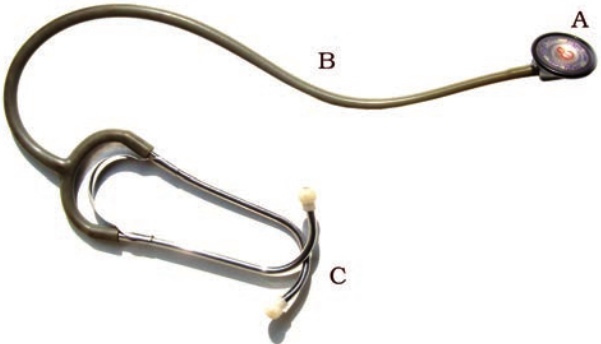
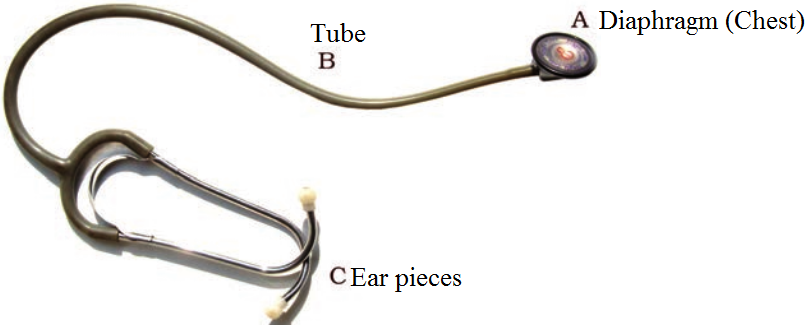
Observe the figure and answer the given questions:
  1. Name the instrument.
  2. Label the parts $A, B$ and $C.$
Answer

  1. The name of the given instrument is stethoscope. It is a device used to amplify the sound of the heart. It consists of a chest piece that carries a sensitive diaphragm, two ear pieces and a tube joining the parts.
  2. Labelled diagram of stethoscope.
View full question & answer
Question 283 Marks
Give an experiment to show the upward movement of water in plants.
Answer
  • Take a potted plant.
  • Cover it by polythene so that its roots along with soil get completely covered. This will prevent evaporation of water from the soil.
  • Put a bell jar over the potted plant.
  • Apply vaseline on the rim of the jar, this will prevent air from entering the jar from outside.
  • Keep this set-up in the sunlight for some time.
  • You will find drops of water on the inner side of the bell jar. These drops are due to the process of transpiration.
View full question & answer
Question 293 Marks
Explain form and function of urinary system in man$?$
Answer
Urinary system consists of Kidney, The ureters, the urinary bladder and the urethra. The Functions of the Urinary System The kidneys regulate blood volume and composition, help to regulate blood pressure and $pH,$ participate in red blood cell production and synthesis of vitamin $D,$ and excrete waste products and foreign substances. The Nephron tubule is the functional unit of the kidney. The ureters transport urine from the kidneys to the urinary bladder. The urinary bladder stores urine and expels urine into the urethra, the urethra discharges urine from the body.
View full question & answer
Question 303 Marks
Briefly describes the human circulatory system?
Answer
The circulatory system is made up of the Blood vessels, heart and Blood that help and control the flow of the blood around the body. Heart pumps blood around your body by alternate systole and diastole. Blood is the connective tissue that carries food, air, waste product and hormones. it contain fluid medium called plasma and three types of cell RBC,WBC and Platelets. There are three distinct types of blood vessels, namely, arteries, veins and capillaries circulate blood around body.
View full question & answer
Question 323 Marks
What are the different blood groups in human$?$
Answer
The blood group of an individual human being always remains unchanged throughout their life. Karl Landsteiner described that human blood can be divided into four groups, i.e. $A, B, AB$ and $O.$ These are named on the basis of substance present in the blood $(RBC).$ Every man has one of these four groups of blood which is inherited from parents to offspring and is never changed. If a person gets injured and heavy blood loss occurs, there is a need to give blood of other person to the patient. The person who gives the blood is called donor while the person who receives the blood is called
recipient.
View full question & answer
3 Marks Question - Science STD 7 Questions - Vidyadip