Questions

3 Marks Question

Take a timed test

13 questions · self-marked practice — reveal the answer and mark yourself.

Question 13 Marks
Write the following rational numbers in the descending order.
$\frac{8}{7},\frac{-9}{8},\frac{-3}{2},0,\frac{2}{5}$
Answer
Given number are $\frac{8}{7},\frac{-9}{8},\frac{-3}{2},0,\frac{2}{5}$
First, we convert the given numbers as like denominators.
$LCM$ of $7, 8, 2, 5 = 2 \times 7 \times 4 \times 5 = 280$
Now, $\frac{8}{7}=\frac{8}{7}\times\frac{40}{40}=\frac{320}{280}$
$\frac{-9}{8}=\frac{-9}{8}\times\frac{35}{35}=\frac{-315}{280}$
$\frac{-3}{2}=\frac{-3}{2}\times\frac{140}{140}=\frac{-420}{280}$
$\frac{2}{5}=\frac{2}{5}\times\frac{56}{56}=\frac{112}{280}$
In descending order,
$\because\frac{320}{280}>\frac{112}{280}>0>\frac{-315}{280}>\frac{-420}{280}$
$\Rightarrow\frac{8}{7}>\frac{2}{5}>0>\frac{-9}{8}>\frac{-3}{2}$
View full question & answer
Question 23 Marks
$\frac{2}{5}$ of total number of students of a school come by car while $\frac{1}{4}$ of students come by bus to school. All the other students walk to school of which $\frac{1}{3}$ walk on their own and the rest are escorted by their parents. If $224$ students come to school walking on their own, how many students study in that school?
Answer
Let the number of students study in school be $x$.
Number of students come by car $=\frac{2}{5}\times\text{x}$
$=\frac{2}{5}\text{x}$ Number of students come by bus $=\frac{1}{4}\times\text{x}$
$=\frac{1}{4}\text{x}$ Remaining students walk to school $=\text{x}-\Big(\frac{2}{5}\text{x}+\frac{1}{4}\text{x}\Big)$
$=\text{x}-\Big(\frac{8\text{x}+5\text{x}}{20}\Big)$
$=\text{x}-\frac{13\text{x}}{20}$
$=\frac{20\text{x}-13\text{x}}{20}$
$=\frac{7\text{x}}{20}$
Now, number of students come to school on their own.
According to the question, $\frac{7\text{x}}{60}=224$
$\Rightarrow\text{x}=\frac{224\times60}{7}$
$=30\times60$
$=1920$ Hence, $1920$ students study in that school.
View full question & answer
Question 33 Marks
Verify the property $x \times (y + z) = x \times y + x \times z$ of rational numbers by taking. $\text{x}=\frac{-2}{3},\ \text{y}=\frac{-4}{6},\ \text{z}=\frac{-7}{9}$
Answer
Given, $\text{x}=\frac{-2}{3},\ \text{y}=\frac{-4}{6},\ \text{z}=\frac{-7}{9}$
Now, $\text{LHS}=\text{x}\times(\text{y}+\text{z})$
$=\frac{-2}{3}\times\Big(\frac{-4}{6}+\frac{-7}{9}\Big)$
$=\frac{-2}{3}\times\Big(\frac{-4}{6}-\frac{7}{9}\Big)$
$=\frac{-2}{3}\times\Big(\frac{-12-14}{18}\Big)$
$=\frac{-2}{3}\times\frac{-26}{18}$
$=\frac{26}{27}$ and $\text{RHS}=\text{x}\times\text{y}+\text{x}\times\text{z}$
$=\frac{-2}{3}\times\Big(\frac{-4}{6}\Big)+\Big(\frac{-2}{3}\Big)\times\Big(\frac{-7}{9}\Big)$
$=\frac{4}{9}+\frac{14}{27}$
$=\frac{12+14}{27}$
$=\frac{26}{27}$
$\text{LHS}=\text{RHS}$
Hence, $\text{x}\times(\text{y}+\text{z})=\text{x}\times\text{y}+\text{x}\times\text{z}$
View full question & answer
Question 43 Marks
Verify the property $x \times (y + z) = x \times y + x \times z$ of rational numbers by taking. $\text{x}=\frac{-1}{5},\ \text{y}=\frac{2}{15},\ \text{z}=\frac{-3}{10}$
Answer
Given, $\text{x}=\frac{-1}{5},\ \text{y}=\frac{2}{15},\ \text{z}=\frac{-3}{10}$
Now, $\text{LHS}=\text{x}\times(\text{y}+\text{z})$
$=\frac{-1}{5}\times\Big(\frac{2}{15}+\frac{-3}{10}\Big)$
$=\frac{-1}{5}\times\Big(\frac{2}{15}-\frac{3}{10}\Big)$
$=\frac{-1}{5}\times\Big(\frac{4-9}{30}\Big)$
$=\frac{-1}{5}\times\frac{-5}{30}$
$=\frac{1}{30}$ and $\text{RHS}=\text{x}\times\text{y}+\text{x}\times\text{z}$
$=\frac{-1}{5}\times\frac{2}{15}+\Big(\frac{-1}{5}\Big)\times\Big(\frac{-3}{10}\Big)$
$=\frac{-2}{75}+\frac{3}{50}$
$=\frac{-4+9}{150}$
$=\frac{5}{150}$
$=\frac{1}{30}$
$\text{LHS}=\text{RHS}$
Hence, $\text{x}\times(\text{y}+\text{z})=\text{x}\times\text{y}+\text{x}\times\text{z}$
View full question & answer
Question 53 Marks
Verify the property $x \times (y + z) = x \times y + x \times z$ of rational numbers by taking. $\text{x}=\frac{-1}{2},\ \text{y}=\frac{2}{3},\ \text{z}=\frac{3}{4}$
Answer
Given, $\text{x}=\frac{-1}{2},\ \text{y}=\frac{2}{3},\ \text{z}=\frac{3}{4}$
Now, $\text{LHS}=\text{x}\times(\text{y}+\text{z})$
$=\frac{-1}{2}\times\Big(\frac{2}{3}+\frac{3}{4}\Big)$
$=\frac{-1}{2}\times\Big(\frac{8+9}{12}\Big)$
$=\frac{-1}{2}\times\frac{17}{12}$
$=\frac{-17}{24}$ and $\text{RHS}=\text{x}\times\text{y}+\text{x}\times\text{z}$
$=\frac{-1}{2}\times\frac{2}{3}+\Big(\frac{-1}{2}\Big)\times\frac{3}{4}$
$=\frac{-1}{3}-\frac{3}{8}$
$=\frac{-8-9}{24}$
$=\frac{-17}{24}$
$\text{LHS}=\text{RHS}$
Hence, $\text{x}\times(\text{y}+\text{z})=\text{x}\times\text{y}+\text{x}\times\text{z}$
View full question & answer
Question 63 Marks
A $117\frac{1}{3}\text{m}$ long rope is cut into equal pieces measuring $7\frac{1}{3}\text{m}$ each. How many such small pieces are these?
Answer
We have, length of rope $=117\frac{1}{3}\text{m}$
$=\frac{117\times3+1}{3}\text{m}$
$=\frac{352}{3}\text{m}$ Length of each pieces $=7\frac{1}{3}\text{m}$
$=\frac{22}{3}\text{m}$
So, the number of pieces of the rope $=\frac{\text{Total length of the rope}}{\text{Length of each pieces }}$
$=\frac{\frac{352}{3}}{\frac{22}{3}}$
$=\frac{352}{3}+\frac{22}{3}$
$\frac{352}{3}\times\frac{3}{32}$
$=16$ Hence, number of small pieces cut from the $117\frac{1}{3}\text{m}$ long rope is $16.$
View full question & answer
Question 73 Marks
Tell which property allows you to compare. $\frac{2}{3}\times\Big[\frac{3}{4}\times\frac{5}{7}\Big]$ and $\Big[\frac{2}{3}\times\frac{5}{7}\Big]\times\frac{3}{4}$
Answer
$\frac{2}{3}\times\Big[\frac{3}{4}\times\frac{5}{7}\Big]=\frac{2}{3}\times\Big(\frac{5}{7}\times\frac{3}4{}\Big)$ [by commutative property over multiplication]
$=\Big(\frac{2}{3}\times\frac{5}{7}\Big)\times\frac{3}{4}$ [by associative over multiplication]
Hence, $\frac{2}{3}\times\Big(\frac{5}{7}\times\frac{3}4{}\Big)$ can be compared with $\Big(\frac{2}{3}\times\frac{5}{7}\Big)\times\frac{3}{4}$ with the help of associative and commutive property.
View full question & answer
Question 83 Marks
Four friends had a competition to see how far could they hop on one foot. The table given shows the distance covered by each.
Name Distance covered $(km)$
Seema $\frac{1}{25}$
Nancy $\frac{1}{32}$
Megha $\frac{1}{40}$
Soni $\frac{1}{20}$
$a.$ How farther did Soni hop than Nancy?
$b.$ What is the total distance covered by Seema and Megha?
$c.$ Who walked farther, Nancy or Megha?
Answer
We have, $\frac{1}{25},\frac{1}{32},\frac{1}{40},\frac{1}{20}$
First, $\text{LCM}$ of $25, 32, 40$ and $20 = 2 \times 2 \times 2 \times 5 \times 5 \times 4 = 800$
$\begin{array}{c|c}2&25,\ 32,\ 40,\ 20 \\\hline2&\ \ \ \ 25,\ 16, \ 20,\ 10\ \ \ \ \\ \hline2&25,\ 8,\ 10, \ \ 5\\\hline5&25,\ \ 4,\ 5,\ \ \ 5\ \\ \hline&5,\ 4,\ 1,\ \ \ \ 1 \end{array}$
We get, $\frac{1}{25}=\frac{1\times32}{25\times32}=\frac{32}{800},$
$\frac{1}{32}=\frac{1\times25}{32\times25}=\frac{25}{800},$
$\frac{1}{40}=\frac{1\times20}{40\times20}=\frac{20}{800}$ and $\frac{1}{20}=\frac{1\times40}{20\times40}=\frac{40}{800}$
$a.$ Soni hop more than Nancy $=\frac{40}{800}-\frac{25}{800}$
$=\frac{40-25}{800}$
$=\frac{15}{800}$
$\frac{3}{160}\text{km}$
$b.$ Total distance covered by Seema and Megha $=\frac{32}{800}+\frac{20}{800}$
$=\frac{32+20}{800}$
$=\frac{52}{800}$
$=\frac{13}{200}\text{km}$
$c.$ Clearly, Nancy walked farther than Megha.
View full question & answer
Question 93 Marks
A mother and her two daughters got a room constructed for Rs. $62,000.$ The elder daughter contributes $\frac{3}{8}$ of her mother’s contribution while the younger daughter contributes $\frac{1}{2}$ of her mother’s share. How much do the three contribute individually?
Answer
Let the mother's share be Rs. $x$
Now, elder daughter's share $=\text{Rs}.\frac{3}{8}\text{x}$
and younger daughter's share $=\text{Rs.}\frac{1}{2}\text{x}$
According to the question, $\text{x}+\frac{3}{8}\text{x}+\frac{\text{x}}{2}=62,000$
$\Rightarrow\frac{8\text{x}+3\text{x}+4\text{x}}{8}=62,000$
$\Rightarrow15\text{x}=62,000\times8$
$\Rightarrow\text{x}=\frac{62,000\times8}{15}$
$\Rightarrow\text{x}=\frac{12400\times8}{3}$
$\Rightarrow\text{x}=\frac{99200}{3}$
$=33,066.6$
So, mother's share $=\text{Rs}.33,066.6$
Elder daughter's share $=\frac{3}{8}\times\frac{99200}{3}$
$=\text{Rs}.12,400$
Younger daughter's share $=\frac{1}{2}\times\frac{99,200}{3}$
$=\text{Rs}.16,533.3$
Hence, mother and her two daughters contributed Rs.$33,066.6,$ Rs. $14,200$ and Rs. $16,533.3$ respectively.
View full question & answer
Question 103 Marks
Give one example each to show that the rational numbers are closed under addition, subtraction and multiplication. Are rational numbers closed under division? Give two examples in support of your answer.
Answer
We know that, rational numbers are closed under addition, subtraction and multiplication.
We can understand this from the following examples.
Rational numbers are closed under addition e.g. $\frac{4}{7}+\frac{1}{2}=\frac{8+7}{14}=\frac{15}{14},$ Which is a rational number.
Subtraction e.g. $\frac{4}{7}-\frac{1}{2}=\frac{8-7}{14}=\frac{1}{14},$ Which is a rational number.
Multiplication e.g. $\frac{4}{7}\times\frac{1}{2}=\frac{4}{14}=\frac{2}{7},$ Which is a rational number.
But rational are not closed under division.
If zero is excluded from the collection of rational numbers, then we can say that rational numbers are closed under division.
Now, we see the examples given below: $\frac{4}{7}+\frac{1}{2}=\frac{4}{7}\times2=\frac{8}{7},$
Whcih is a rational number. But $\frac{4}{7}+0=\frac{4}{7}\times\frac{1}{0},$
Which is not defined and so, it is not a rational number.
Also, $\frac{1}{2}+0=\frac{1}{2}\times\frac{1}{0},$
Which is not defince and so, it is not a rational number.
View full question & answer
Question 113 Marks
One fruit salad recipe requires $\frac{1}{2}$ cup of sugar. Another recipe for the same fruit salad requires $2$ tablespoons of sugar. If $1$ tablespoon is equivalent to $\frac{1}{16}$ cup, how much more sugar does the first recipe require?
Answer
Given, sugar required for one fruit salad $=\frac{1}{2}\text{cup}$
Sugar required for another salad $=2\times\frac{1}{16}=\frac{2}{16}\text{cup}$
$\therefore\ $Required sugar $=\frac{1}{2}-\frac{2}{16}$
$=\frac{8-2}{16}$
$=\frac{6}{16}$
$=\frac{3}{8}\text{cup}$
View full question & answer
Question 123 Marks
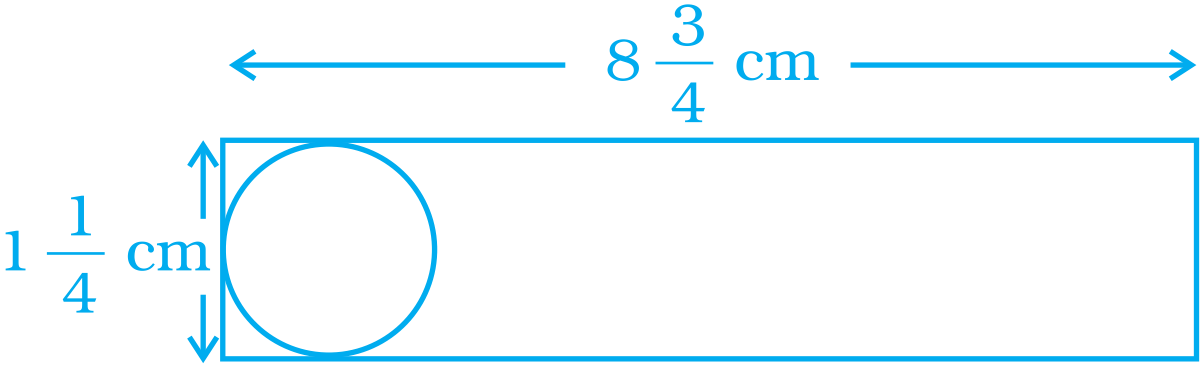
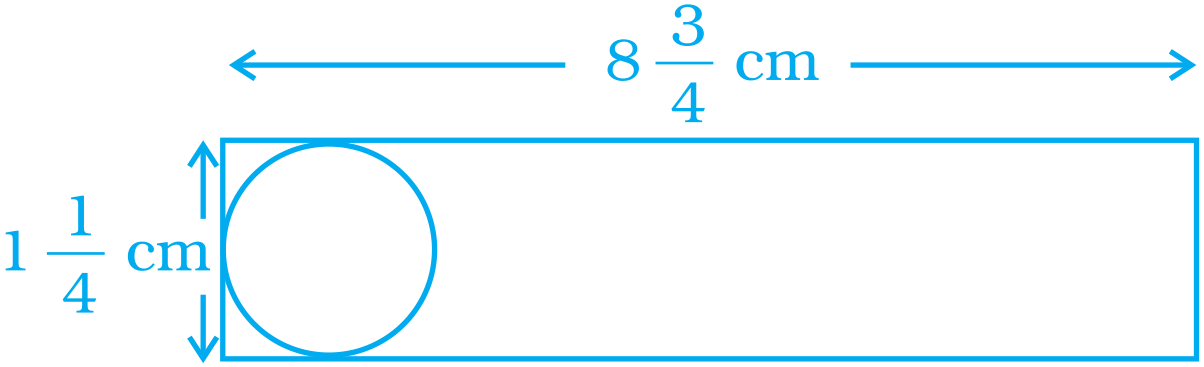
Shalini has to cut out circles of diameter $1\frac{1}{4}\text{cm}$ from an aluminium strip of dimensions $8\frac{3}{4}\text{cm}$ by $1\frac{1}{4}\text{cm}$ How many full circles can Shalini cut? Also calculate the wastage of the aluminium strip.
Answer
Breadth of the circl = Diameter of one circle $1\frac{1}{4}\text{cm}=\frac{5}{4}\text{cm}$ Length of aluminium strip $=8\frac{3}{4}\text{cm}=\frac{35}{4}\text{cm}$
$\therefore\ $Number of full circles cut from the aluminium strip $=\frac{35}{4}+\frac{5}{4}$
$=\frac{35}{4}\times\frac{4}{5}$
$=7$ Hence, the number of circle $7.$

 Now, diameter of circle $=\frac{5}{4}\text{cm}$
​​​​​​​Radius of circle $=\frac{5}{4\times2}=\frac{5}{8}\text{cm}$
Now, area to be cut by one circle $=\pi\text{r}^2=\frac{22}{7}\times\Big(\frac{5}{8}\Big)^2$
$=\frac{22}{7}\times\frac{25}{64}\text{cm}^2$
$\therefore$ Area to be cut by $7$ full circles $=7\times\frac{22}{7}\times\frac{25}{64}$
$=\frac{22\times25}{64}$
Also, area of the aluminium strip = Length \times Breadth $=\frac{35}{4}\times\frac{5}{4}\text{cm}^2$
$\therefore$ Wastage of aluminium strip $=\Big(\frac{35}{4}\times\frac{5}{4}\Big)-\Big(\frac{22\times25}{64}\Big)$
$=\frac{175}{16}-\frac{550}{64}$
$=\frac{700-550}{64}$
$=\frac{150}{64}$
$=\frac{75}{32}$
$=2\frac{11}{32}\text{cm}^2$
Hence, the wastage of aluminium strip is $2\frac{11}{32}\text{cm}^2.$
View full question & answer
Question 133 Marks
Huma, Hubna and Seema received a total of Rs. $2,016$ as monthly allowance from their mother such that Seema gets $\frac{1}{2}$ of what Huma gets and Hubna gets $1\frac{2}{3}$ times Seema’s share. How much money do the three sisters get individually?
Answer
Seema gets allowance $=\frac{1}{2}$
of Huma's share Hubna gets allowance $1\frac{2}{3}$ of
Seema's share $=\frac{5}{3}$ of
Seema's share $=\frac{5}{3}$ of $\frac{1}{2}$ of
Huma's share $\Big[\because$ Seema's share $=\frac{1}{2}$ of Huma's share$\Big]$
$=\frac{5}{3}$ of $\frac{1}{2}$ of
Huma's share $=\frac{5}{6}$ of Huma's share But Huma,
Hubna and Seema received total monthly allowance from their mother $= Rs. 2016$
$\therefore $ Huma's share + Hubna's share + Seema's share $= Rs. 2016 1$ of Huma's share $+\frac{5}{6}$ of
Huma's share $+\frac{1}{2}$ of Huma's share $= Rs. 2016$
So, $\Big(1+\frac{5}{6}+\frac{1}{2}\Big)$ of Huma's share $= Rs. 2016$
$\Rightarrow\Big(\frac{6+5+3}{6}\Big)$ of Huma's share = Rs. 2016$
$\Rightarrow\frac{14}{6}$ of Huma's share = Rs. 2016
$\therefore $Huma's share $=\text{Rs}.2016+\frac{14}{6}$
$=\text{Rs}.2016\times\frac{6}{14}$
$=144\times6$
$=\text{Rs}.864$
So, Seema's share $=\frac{1}{2}$ of 864 $= 5\times144$
$=\text{Rs}.720$
Hence, Huma, Hubna and Seema get $Rs. 864, Rs. 432$ and Rs. $720$, respectively.
View full question & answer